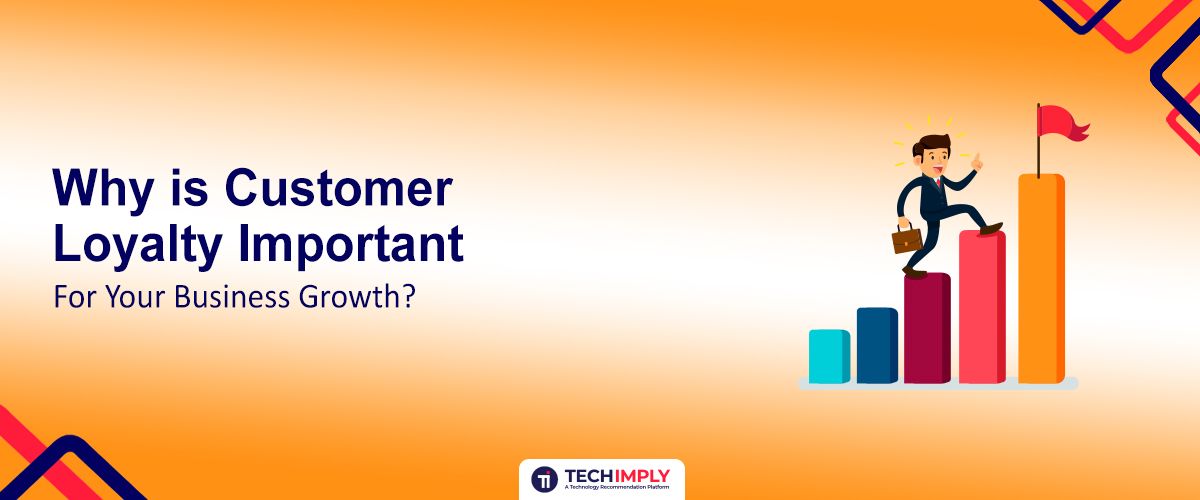
Nowadays, the market has become a cacophony in the midst of hyper-competition in the digital world. A new business is formed every day, and all these are competing for the attention of consumers. Therefore, it is no longer possible to buy a customer and be successful for the long term. A strong and profitable business can build relationships. This brings us to one of the reasons for the importance of customer loyalty.

Looking for Customer Loyalty Software?
Check out Techimply's Best Customer Loyalty Software in India for your business.
This in-depth discovery will not merely delve into the meaning of customer loyalty but also just how the development of better customer loyalty significantly influences your bottom line, giving you a clear path towards creating a more viable, profitable business.
What is Customer Loyalty?
The essence of customer loyalty is the readiness of a customer to buy a brand over and over again and to volunteer to buy a specific brand instead of the competition. It is much more than mere contentment with a product or service; it is an emotional attachment and trust that affects the buying behavior.
The customer loyalty definition can be best viewed as a promise and not as a transaction. A loyal customer means that he or she will still purchase your product when there is a rival that is giving lower prices or a similar feature. This is a significant difference, as it is in contrast to habitual buying, which is simply buying according to convenience.
The end product of any business is to convert first-time customers into repeat and loyal champions. This is the starting point for a successful strategy of customer loyalty development.
How to Build Customer Loyalty for Business Growth?
Customer loyalty will not be built by magic, but that is a strategic way of doing it. As such, companies should strategically create experiences that will continuously satisfy and be rewarding to their customers. The following are some of the strategies that have been established.
1. Exceptional Service
Consistency is key. Each contact should be simple, useful, and personalized. Acting speedily and with empathy to solve a problem for a customer is a sure way to gain the confidence of the customer.
2. Personalized Rewards
Adopt customer loyalty software of a super standard. This would enable you to monitor behavior and provide rewards that would be significant to the person, be it early access to products or special discounts.
3. Community and Connection
In this sense, provide customers with more than a reason to identify with your brand besides the product. Building a strong community helps to improve the degree of brand loyalty and turn transactional relationships into relationship relationships.
4. Listen and Act
Utilize data collected in your CRM or customer loyalty in CRM solutions to know the prevalent points of pain. Responding to positive feedback also demonstrates that you appreciate their opinion, and this goes a long way towards customer loyalty.

Do You Know?
Consumer loyalty is not a new concept, and it has been studied for decades; now it has been transformed by digital tools. Nowadays, small businesses may use the modern, improved customer loyalty software to assist them in monitoring sophisticated metrics, generating rewards depending on the preferences of the customer, and developing relationships at a large scale without much effort, which would have been achieved only 20 years ago with retail giants.
Why is Customer Loyalty Important for Business Growth
Customer loyalty is not merely a good-affirming marketing instrument; it literally translates to both economic and strategic gains in the form of unparalleled business growth.
1. Increased Revenue and Profitability
Loyal customers are the lifeblood of robust financial health.
-
Repeat Purchases: Consistent customers are of high frequency in their purchases. Consequently, any number of retention increases can lead to a geometric rise in the sales volume with no rise in the marketing budget.
-
Higher Customer Lifetime Value (CLV): When a customer becomes loyal to your company, he or she remains longer. This inherently extends their customer lifetime value, as a result of which the significance of customer loyalty is directly related to long-term revenue.
-
Reduced Price Sensitivity: When the customer is convinced of your quality and service, chances are that he/she will not switch for a minor rise in prices. This decreased sensitivity to price helps to protect your profit margins, and as a result, your business becomes more stable.
-
Upselling and Cross-selling Opportunities: The loyal customers become much more willing to purchase new products or high-quality services. Moreover, a firm will find it easy to launch new products once they have developed trust and can maximize its income on the current client base.
2. Lower Customer Acquisition Costs (CAC)
Costs of acquiring a new customer are exponentially greater than those of retention. This is the reason why our customers are so important to a business.
-
Cost-Effectiveness: Since the sales funnel of a dedicated customer is literally zero, this means that your Customer Acquisition Costs (CAC) are reduced significantly. You are also spending less on promotion, content marketing, and ads to drive traffic.
-
Efficient Marketing: Having a good base of loyal customers will give good data to your marketing team. Hence, they will be able to reach new potentials with similar attributes, and this can make acquisition programs more efficient and less wasteful. This customer loyalty enhancement capacity in your base is the direct indication of smarter lead generation.
3. Enhanced Brand Reputation and Advocacy
The most valuable marketing asset that you have is loyal customers, who are free.
-
Word-of-Mouth Marketing: Customers who love your brand will talk about it. Positive Word of Mouth Positive word of mouth is the best and most credible form of advertising and is the organic growth that cannot be purchased with money.
-
Positive Reviews and Testimonials: Satisfied customers do not hesitate to make a five-star review and provide strong testimonials. These resources increase your search engine position, reduce the cost of advertising, and, most importantly, create social evidence that will persuade the new, doubtful consumers.
-
Stronger Brand Image: When a firm has high customer loyalty, it will have a reputation for quality and reliability. Such good brand loyalty comes with the talent, investors, and good value partnerships that further propel the growth cycle.
4. Valuable Feedback and Insights
Customers who are loyal to your business are also interested in your success, and their reviews are priceless.
-
Actionable Feedback: Customers who are loyal provide you with frank, descriptive, and constructive feedback that will assist you in improving products and services. Therefore, they are co-creators of your offering and lead to better products with less chance of failure regarding new offers.
-
Market Understanding: By tracking the path and sentiment of your most loyal segment, you get deep insights into market trends and unmet needs. This powerful data-driven approach grows your strategic planning.
5. Competitive Advantage
In a saturated market, loyalty is the ultimate shield and sword.
-
Differentiation: Within the scope of customer loyalty, a keen emphasis will distinguish you among the rest of your competitors, who merely aim at making sales on a transactional basis. On similar products, the superior customer experience will win, creating a strong competitive edge.
-
Stability and Resilience: Loyal customers will still buy in the low economic times or when the product takes a small step in the wrong direction. This consistency and strength will make your business stand stronger in the face of other external forces as opposed to the competition, and this is a clear indication of the importance of customer loyalty. Businesses that invest in a top loyalty solution are often better positioned to maintain this resilience, since structured programs keep customers engaged even when market conditions shift.
Pro-tip
Do not simply follow your definition of customer loyalty based on purchases. Rather, develop a Customer Health Score under your customer loyalty on the CRM dashboard. Add non-revenue measures such as the frequency of logins, support tickets solved within a time, and non-exclusive content.
Real-World Examples of Customer Loyalty
The overall market trends speak volumes of this strategic need: the global Loyalty Management Market size is valued at USD 12.89 billion in 2025 and is expected to reach USD 20.36 billion by 2030, growing at a really high CAGR, at a remarkable 9.6% from 2025 to 2030. This dramatic growth is a prediction of how important it is for businesses to focus on investing in customer loyalty software and related strategies to gain market leadership.
Adobe: Building Loyalty Through Subscription and Value
Adobe, the maker of Photoshop and Premiere Pro, completely revolutionized its business model in the early 2010s. They no longer sell software licenses that cost customers a lot with one-time use, but through a subscription that is cloud-based, called Creative Cloud.
1. Customer Loyalty Strategy: The strategy of Adobe did not lie in the idea of collecting payments monthly; it was about providing value constantly. Besides, the subscription model enables them to deliver small but regular updates to the software, cloud synchronization, and a built-in community. They applied their model to radically enhanced customer loyalty by making sure that they had the latest and greatest version of the software in the hands of the users.
2. Business Impact:
- Recurring Revenue Growth: The transition created predictable, stable, and high growth of recurring revenue, a direct consequence of high retention rates.
- High Retention Rates: Since they delivered their values continually, the users had no incentive to quit. Their retention rates are high, and that is why when you focus on the continuous success of the client, they are retained.
- Community Advocacy: Adobe has built a huge community advocacy base in which the tools are enthusiastically marketed by the designers and editors, and it has been used to reinforce their position as an industry standard.
Key Takeaways
The point is that customers are the center of the main purpose, why there is a business at all. When you realize the importance of customers to a business, you will cease to look at short-term gains but long-term value.
-
Efficiency: Loyalty is the least expensive strategy of growth that will reduce CAC significantly and increase organic referrals.
-
Stability: A stable foundation serves as a financial shield in case of market instability.
-
Mandate: To achieve success, tools such as CRM9 will have to be implemented to create clear guidelines on how the leads will be scored and nurtured, resulting in a smooth transition between prospect and lifetime advocate.
Conclusion
The role of customer loyalty cannot be disputed; it is a financial and business necessity. Companies that treat their customers as a one-off will be hard-pressed to compete with the companies that are able to develop real brand loyalty and confidence. You don't merely survive in the competitive environment; by concentrating your resources on building customer loyalty through the use of special customer loyalty software and by considering each loyal client as your most valuable marketing tool, you control the market.