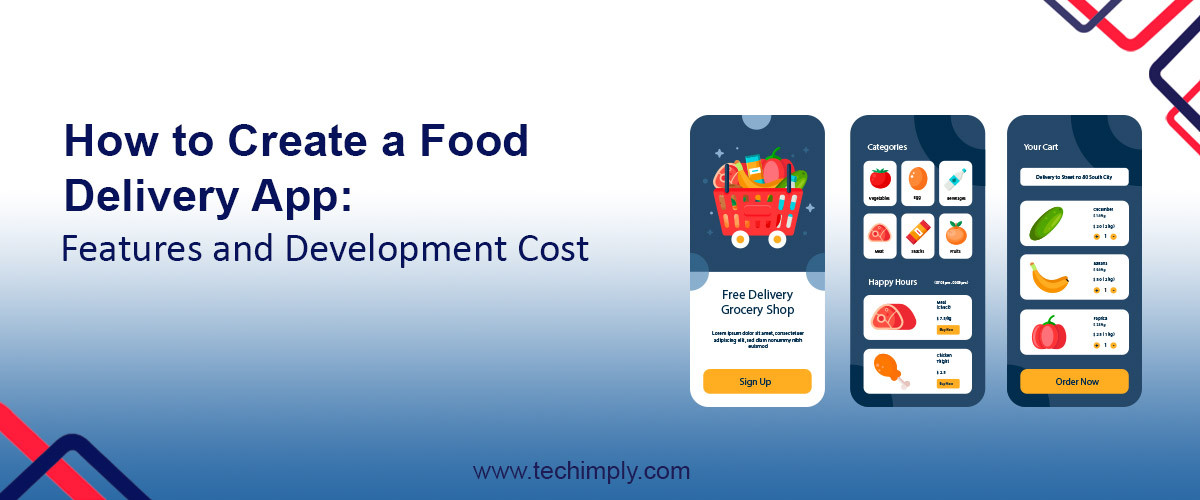
Consumers' preference for the ease of having their food brought to their door has led to rapid expansion in the food delivery industry in recent years. Building and maintaining a successful food delivery service can be a lucrative economic endeavor, but it also comes with its fair share of difficulties. An in-depth discussion of what goes into making a food delivery app is what you'll find here.
To help you out, here's a quick rundown of the steps required for food delivery app development:
- To implement your plan, you need to seek out a reliable IT company.
- Plan and investigate with your technology collaborator.
- Have your team go through the Discovery process to determine what enhancements should be made.
- Help the design team create a user-friendly app layout.
- The team will add the necessary functionality to your product to the project's needs.
- The QA group will test and tweak your software till it's flawless.
- The experts will get your software out to early adopters and offer assistance based on user input.
Essential Functions For A Food-Ordering App And How To Make One
Let's start from the ground up. You need to create a strong brand with a user-friendly app. You can start with a logo design tool or business name generator to get started, but more is needed to make an app for delivering food. A digital ecosystem must be constructed around it, with all solutions integrated.
The most often used methods for keeping the various aspects of the meal delivery business running well are as follows:
Customer app. Users can place an order for food delivery from local restaurants.
Restaurant app. The restaurants will be able to view the orders and fulfill them.
Courier app. Deliveries are alerted to the arrival of orders. They are also informed of the order's completion and delivery location.
System control interface. The platform as a whole can be managed by the product owner and their team via an administrative panel. Restaurants and users can be added or removed, for instance.
You can run your food delivery service with this suite of apps. It's a little hard to follow. Let's delve into these apps and evaluate them in detail.
The Consumer-Focused App
Since this is where everything is put in its proper place, this app is crucial. A user-friendly user interface and user experience are essential to maintaining and growing your consumer base. It would help if you prioritized a simple search function, as users will use your app in search of a specific dish or restaurant from which to place an order. Improve the search features by allowing users to narrow their results based on distance from their current location and keywords (restaurant name, dish name, etc.). Payment simplicity is also crucial to creating a positive user experience.
You can start with a logo design tool or business name generator to get started, but more is needed to make an app for delivering food. A digital ecosystem must be constructed around it, with all solutions integrated. Consider utilizing a business app builder for streamlined development.
Regarding functionality, the following aspects are essential for any food delivery software.
Registration And login
To make your food delivery app successful, make it easy for users to sign up and log in through their preferred social media platform. This method is the quickest because no confirmation emails must be sent to new users. The more user-friendly your login process is, the more people will use it. Use the appropriate tools if you've forgotten your password or need to change it. Facebook SDK, Google SDK, and Apple Sign Up are the greatest third-party tools for implementing the sign-in/sign-up procedure.
Location Tracking
Build a geolocation-based restaurant finder app for consumers of your online food delivery service. Adding several filters might make The search procedure more efficient and user-friendly. Additionally, you may include in-depth restaurant descriptions to help users do their research before placing an order. GrubHub is a great illustration of a search feature realization.
Order Placement And Payment
Give customers real-time access to a map showing the location of their picked orders. Glovo has done an excellent job implementing and making this functionality extremely user-friendly. Google's Location API for Android and Apple's Location Framework for iOS can be used to create location-tracking apps.
Placing An Order And Making A Payment
After settling on a selection, the next step is to place a payment. You can reduce the number of abandoned orders placed through your food delivery app by making the checkout procedure as easy as possible. Take a look at how easy Deliveroo makes placing orders.
Braintree, Stripe, and PayPal are all accepted payment gateways. With these services, you can set up payment processing quickly. The fees for using these gateways are 2.9% plus $0.30 for each transaction. Also, remember that you can always pay with cash.
Push Notifications
Through push notifications, users can be prompted at various points in the delivery process (accepted, in transit, delivered, etc.). Many services, including Uber Eats and Glovo, use this method.
Like GrubHub, you may notify clients via numerous means whenever you have a sale or special offer. The most effective strategies for creating push notifications are:
- SNS by Amazon
- The APSN, or Apple Push Notification Service
- Online Chat with Firebase
Ranking And Reviews
Business growth can only occur with feedback. It will reveal where your service is lacking so you can strengthen it. Add a star rating and remark section so people can assess the food and how it was delivered. A future development could be the addition of a tipping system. Customers can appreciate the courier's promptness and precision by leaving a tip.
Microsoft Azure, Amazon Web Services, or Digital Ocean can provide a secure repository for your team to save all comments.
Restaurant App
Taking orders, receiving notifications, and organizing menus are the main concerns. Either a web app or native software installed on a kitchen tablet, this one could fool you.
The software will allow the restaurant staff to monitor incoming orders and notify the delivery person when the food is ready.
This app's primary features have a somewhat different focus:
Registration And Login
Here, staff members can check the status of pending orders after logging into the system.
Menu Management
Menus at eating establishments should be flexible enough for periodic updates to reflect the most recent offerings. Doing so could positively affect your service and the restaurant's standing.
Order Management
A restaurant's wait staff must be aware of and able to process all customer orders efficiently. This functionality allows them to take orders and modify existing ones.
Reviews And Ratings
Allow proprietors to view feedback and ratings, and remember to enable the ability to respond to remarks. Communicating with the customer is crucial while developing a meal-ordering app.
The Courier App
This software needs to be straightforward, but that shouldn't come at the expense of efficiency. It's important that the messenger can access all functions while on the move.
If you want your app to be delivered quickly, include the following:
Registration And Login
Make the authentication process as quick and painless as possible, much as with a customer app. Use Facebook SDK, Google SDK, or another social networking platform for authentication. Use Apple Maps by logging in.
Navigation
Help the couriers get where they need to go as quickly as possible by marking key locations along the route (pickup point, delivery location, etc.). The Google Maps Platform for Android and the Location Framework for iOS are available to your developer team.
Order Detail And Status
If you want to know how to start a food delivery app, you need to know that you must provide the courier with complete order details, including the exact meal content, the customer's address, and the delivery time. Remember to update the courier on the order's status to indicate whether or not they should take it.
-
Order History
Use a cloud service like Azure, AWS, or Digital Ocean to store all completed orders.
- Admin Panel
Your company's nerve center is located here. These tools help you organize your data and craft a winning business plan.
So, let's look at some of the most important controls an admin panel should contain.
- Administrator Sign In
Make a secure login screen that requires an ID and password for your managers.
- Restaurant Manager
If customer ratings are excessively poor or a restaurant ends its association with your app, your admin can directly remove the business from the platform.
- Analytics
Using this handy tool, you can keep tabs on the best-selling eateries and rank them by factors like revenue, customer satisfaction, and much more. You can use this information to learn the ropes of the business and improve your operations.
- Payment Manager
Modifying delivery fees was built into the software development for ordering food online services. If you want restaurants to switch to using your delivery service exclusively, one option is to reduce or eliminate costs for those that send you a high volume of orders.
- Coupons And Discounts Manager
Discounts are a great way to get repeat business from existing customers and attract new ones. Manage sales that depend on a variety of holidays and events.