The decision of the correct ERP system in 2026 is not an IT decision anymore. It has a direct influence on your business efficiency level, speed of scalability, and responsiveness to market changes. As organizations continue to go digital, the question of whether you should invest in a traditional ERP set-up or go to the cloud remains a subject that continues to emerge in boardrooms and strateges.

Looking for ERP Software?
Check out Techimply's ERP Software for your business.
Knowing how to distinguish between on-premises and cloud ERP models can make you save on mistakes that can be costly and align technology and business objectives. Both alternatives have their advantages, weaknesses, and best applications. This guide takes you through the steps you need to know about, in a simple and practical manner, to enable you make a sound decision regarding your business in the year 2026.
Core Differences: Cloud ERP vs. On-Premise Defined?
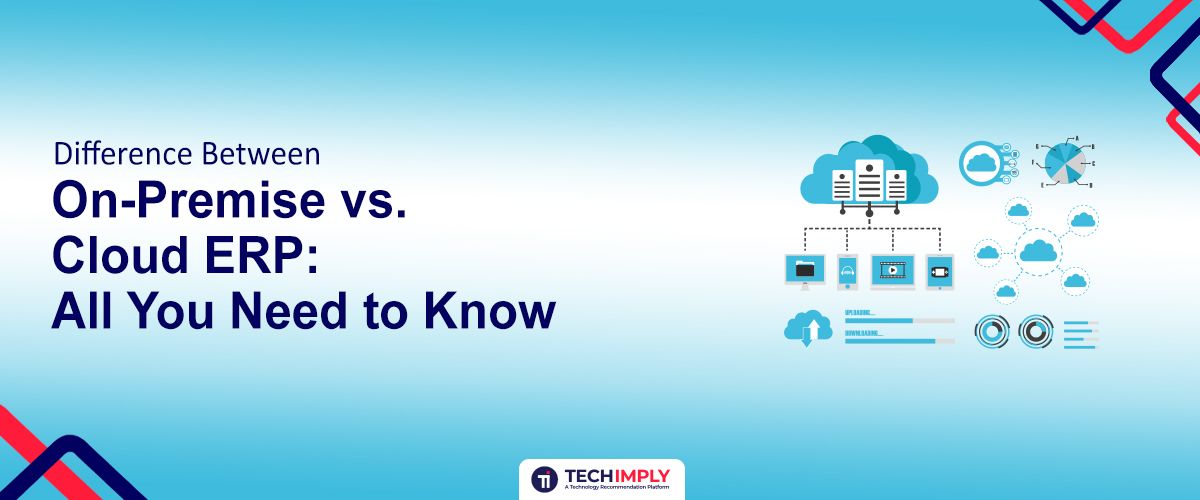
ERP systems fall into two deployment categories. One is inside your physical premises and infrastructure, as compared to the other which is governed by internet via a service provider. Hosting is not the only difference between Cloud ERP vs on-premise. They affect structure of cost, scalability, security obligations, and the speed with which your groups can collaborate.
It is not about which model is better in general, but which is better that fits your organization as to its size, industry, compliance requirements and long term strategy.
What Is On-Premise ERP?
On premise ERP is a software deployment model where the system is installed locally on your company's hardware. You own the servers, you manage the database, and your IT team is responsible for every patch, update, and hardware upgrade. It is the traditional way of doing business, offering a fortress approach to data management.
What Is Cloud ERP?
Cloud ERP is hosted by the server systems of the vendor and is accessed via the internet. You do not maintain infrastructure, but instead pay a recurring fee to subscribe. The provider solves updates, security patches, backups and system availability.
A current clouded ERP enables companies to work anywhere, scale at a low rate and remain current without significant IT participation. This model of deployment is increasingly popular in the industry as remote working, distributed teams become the new reality.
What Are The Advantages Of On-Premise ERP?
Nevertheless, regardless of the enormous cloud migration, on premise systems are also an important option to certain industries.
1. Complete Control And Ownership
With an on premise deployment, you decide how the system is configured, when updates happen, and how data is stored. This type of control is particularly significant to the organizations that have stringent internal policies or regulatory requirements.
2. Enhanced Data Security And Privacy
There are businesses that choose to maintain sensitive information in their own infrastructure. Storing data in an in-premise network can limit the use of third-party setting and ease the requirements of controlled industries.
3. Greater Customization Options
Premises-based ERP systems tend to have more customization on the code level. When your processes are extremely specialized, then this flexibility may pay off.
4. Reliable Performance And Offline Access
The system is locally based, meaning that its performance does not rely on the internet connectivity. This makes it accessible and responsive in low bandwidth areas.
5. Potential Long-Term Cost Savings
Long term costs will even out with time, though initial costs are more expensive, organizations whose operations are stable can find that the long term costs even out as long as the system does not have significant modifications and is operated over a long period of time.
6. Easier Integration With Legacy Systems
There are still a large number of established businesses who use older applications. These legacy systems tend to be more amenable to on premise environments without much reengineering.
7. Reduced Vendor Dependence
You do not have a subscription or update cycles. This will make you less dependent on some external providers and be more autonomous.

Pro Tip:
On-premise server meaning goes beyond physical hardware. It represents full responsibility for performance, security, scalability, and disaster recovery. Make sure your IT team is equipped before committing.
Cloud ERP: The Modern Solution's Key Benefits
Valued at USD 55.40 billion in 2024 and expected to reach USD 168.34 billion by 2032, the Cloud ERP market is growing at a 12.53% CAGR, showing how rapidly businesses are moving to cloud-based systems. This growth highlights Cloud ERP as a modern, future-ready solution that offers scalability, real-time access, lower upfront costs, and greater operational flexibility.
1. Reduced IT Infrastructure Costs And Lower TCO
Tthere is no necessity of investing in servers, data centres, and big IT teams with cloud-based ERP software. This will save a lot of capital costs and total cost of ownership.
2. Improved Scalability And Flexibility
Cloud systems are able to expand with your business. Regardless of the type of additions we are talking of, whether it is adding new users, location, or a module, the corresponding adjustments are fast and do not require any infrastructure upgrade.
3. Enhanced Accessibility And Collaboration
The system avails of secure credentials that allow teams to access the system at any location. Such accessibility facilitates the hybrid work system and real-time teamwork across departments.
4. Automatic Updates And Maintenance
The updates are done automatically and you will always have the latest version with new features and security improvements, without the need to spend time or effort on doing so.
5. Enhanced Data Security And Disaster Recovery
Major cloud providers spend a lot of money in encryption, monitoring and redundancy. Their security measures, in most instances, are more than what can be adopted by the individual businesses individually.
6. Streamlined Business Processes And Increased Operational Efficiency
Cloud ERP platforms are designed around best practices.This encourages process standardization and improves overall efficiency across finance, HR, supply chain, and operations.
7. Real-Time Insights And Data-Driven Decision Making
Analytics and dashboards are developed to provide real-time access to performance. This allows leaders to make decisions and act as fast as possible.
8. Future-Proofing
Cloud solutions are flexible and can be applied to add AI, automation, and enhanced reporting capabilities to ensure that your business would not be obsolete in the constantly shifting market.
Do You Know?
More than half of mid-sized businesses adopting ERP in recent years choose cloud-first models because they reduce implementation risks and accelerate time to value.
Which Is Right For Your Business In 2026?
The Cloud ERP vs on-premise decision usually comes down to these seven critical factors:
1. Costs
- On-Premise
Higher upfront investment for licenses, hardware, and setup. Ongoing costs include maintenance, upgrades, and IT staffing.
-
Cloud
Predictable subscription-based pricing with minimal upfront expenses. Easier budgeting and lower initial financial risk.
2. Scalability
-
On-Premise
Scaling requires new hardware and manual configuration. Growth can be slower and more expensive.
-
Cloud
Resources scale on demand. Ideal for growing businesses or those with fluctuating needs.
3. Control And Customization
-
On-Premise
Maximum control over system behavior and data. Deep customization possible.
-
Cloud
Customization is available but within vendor-defined frameworks. Control is shared with the provider.
4. Accessibility
-
On-Premise
Access is typically limited to office networks unless additional configurations are made.
-
Cloud
Accessible from anywhere with an internet connection, supporting remote and mobile teams.
5. Security
-
On-Premise
Security depends entirely on internal policies and expertise. Full responsibility lies with your team.
-
Cloud
Enterprise-grade security managed by specialists. Regular audits and compliance certifications are standard.
6. Implementation Time
-
On-Premise
Longer deployment cycles due to infrastructure setup and customization.
-
Cloud
Faster implementation, often within weeks rather than months.
7. Updates And Maintenance
-
On-Premise
Manual updates require planning, downtime, and IT resources.
-
Cloud
Automatic updates ensure continuous improvement without disruption.
Conclusion
The current business operations rely on the ERP systems. In 2026, it is not whether on premise and cloud is a trend or one of a trend but how the use of technology can fit within the way your business operates in the present and where it wants to go in the future.
On-premise ERP provides conserve, tailing and remoteness and it is viable in organizations that have intricate needs and IT strengths. Cloud ERP also offers speed, flexibility, and innovation and enables companies to be adaptable and work effectively in a digital-first environment.
Take time to evaluate your growth plans, compliance requirements and internal resources. The appropriate ERP decision will not only contribute to the functioning of your business, but will become a driving force to the long-term success.