


To build a sales funnel, determine the steps a transaction goes through, draft one distinct closing condition for each step, and then work backward from your income goal to the required prospect volume. That constitutes the full approach.

Looking for Sales Pipeline Management Software?
Check out Techimply's List of the Best Sales Pipeline Management Software in India for your business.
The challenge is to be honest so the pipeline does represent real deals and not pipe dreams. This primer walks you through six stages in a B2B scenario set in India, with deals that require multiple sign-offs and follow-up over phone and WhatsApp that can run for days.
What Should You Settle Before You Build a Sales Pipeline?
The distinction is between a pipeline and a sales funnel. While the sales funnel illustrates the buyer's path towards acquiring goods or services, the pipeline refers to the selling activities where specific deals are evaluated based on monetary amounts and individual assignments, and where such deals move through various stages. You can create your sales pipeline without any kind of technical tools. Using a whiteboard or spreadsheet for the first month enables you to decide how to describe items before a software system creates hard rules about them.
Then select which unit you will measure. The opportunity is typically what you measure for B2B sales; that is to say, the specific business with the product you offer and the estimated financial amount expected to be produced by this business over the course of one year. Tracking the interactions with people (contacts) rather than the deal (opportunity) is an incorrect way to evaluate your business’s income, and will cause a lot of e-mails to be considered income when they are not.
Decide early how many sales pipeline stages you can actually maintain. Four counts as too light since it conceals spots where transactions pause. Ten feels burdensome as representatives cease refreshing their records. Six serves as a practical center point for numerous groups marketing toward companies, given that one transaction might span several weeks up through several months.
How Do You Build a Sales Pipeline in Six Stages?
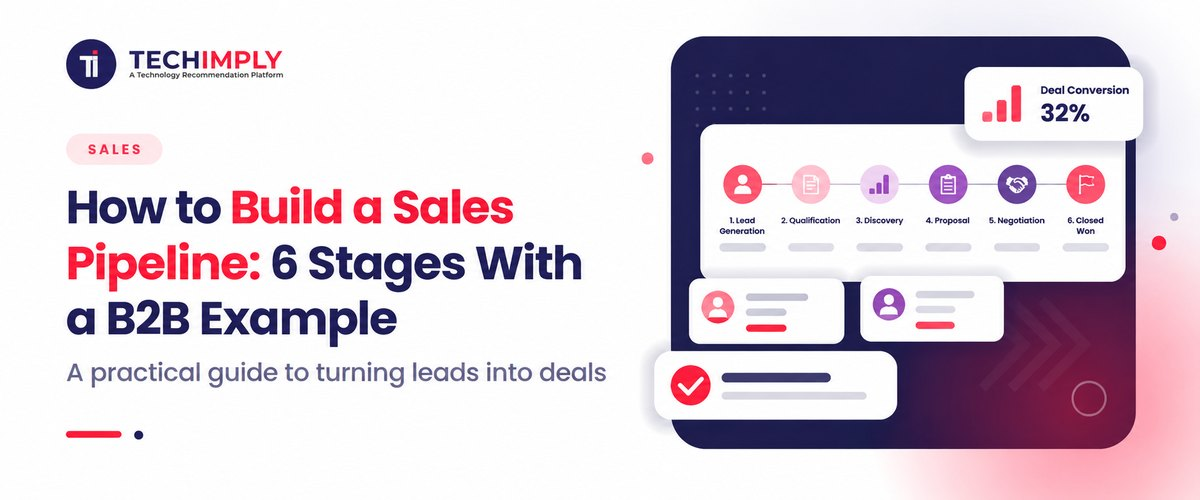
Most B2B groups choose six steps for their sales pipelines. While titles vary across firms, the sequence seldom changes. Each step requires an exit criterion, one clear statement determining if a deal can proceed further.
Stage 1: Prospecting
Here is where the process of sales prospecting takes place. First, identify businesses matching your target client profile, then locate specific individuals via recommendations, conferences, direct dialing efforts, and your online presence. The manual list of names becomes difficult to manage when it contains too many entries to update correctly. In this situation, business departments use computer programs to search for potential customers. The process stops when a salesperson identifies the name of an individual and writes a logical reason to communicate with them.
Stage 2: Qualification
Here is where lead qualification executes its role. Check budget, authority, need, and time through a short phone chat or web form. Tools that handle leads might rate and guide requests, but a separate list works better than the program. The finish line rule: the person has a real problem, and someone with money to spend was found.
Stage 3: Discovery and Demo
Discover how the buyer Shops today. Now, if I sold Payroll software to a Factory company, I would ask them four things for each question:
1.) How do you track your employees' time?
2.) How do you pay your employees today?
3.) What part of HR do you still make mistakes in? And only give them the part that applies to them as well.
Stage 4: Proposal
Send a single written quote with scope, price schedule, and payment terms. Decks, case studies,s and price sheets move faster when everyone is working from one up-to-date version; this is sales enablement software's job. Exit rule: decision maker (not just daily user) has seen the price.
Stage 5: Negotiation
Expect to be asked for a discount, to be asked security questions, and to be asked to find a second or third approver. Record each objection on the deal record. Exit rule: open points are listed; a date is scheduled to make a decision.
Stage 6: Closed Won or Closed Lost
Mark the outcome and log the reasons. Lost deals represent the cheapest but valuable market research you will ever conduct. The deal either goes to onboarding or returns to nurturing after a certain period.
How Does a B2B Sales Pipeline Look With Real Numbers?
Let's assume a company in Pune that provides salary and attendance management software to manufacturing organizations having 100-500 people. (The following figures represent examples of how past performance would be performed.) It is estimated that this company completes an average number of deals worth 3,00,000 per annum; quarterly targets of 30,00,000, or 10 closed deals, are targeted.
You start with the goal, and it's the best way to create a defensible sales pipeline during the review, because it puts mathematics over hunch. Work backward. If one in four proposals closes, you need 40 proposals. If half of qualified leads reach the proposal stage, you need 80 qualified leads. As one out of five potential customers meets the requirements to buy, you require 400 potential customers. Each stage represents a specific percentage of successful transitions. The stage with the lowest percentage of success indicates where a salesperson must direct their attention.
|
Stage |
Deals needed |
Assumed conversion rate |
|
Leads |
400 |
Starting point |
|
Qualified leads |
80 |
20% of leads |
|
Proposals sent |
40 |
50% of qualified leads |
|
Closed won |
10 |
25% of proposals |
Pipeline velocity is a measure of time as well. Opportunities x average deal size x win rate x sales cycle length. For 40 opportunities, $3 00 000 deals, 25% win rate, and a 60-day cycle time, you'll end up with $50,000 of expected value per day. But bring down that sales cycle to 45 days, and it jumps to just over $66,667.
Do You Know?
Having a win rate of 25%, you should have the open proposals in the amount of four times more than your sales goal. To achieve the goal of 3,000,000 for three months, you should have open proposals worth 12,000,000; that amount equals 40 open agreements, each of which you should have 30,000.
How Do You Know Whether Your Sales Pipeline Is Healthy?
Three figures take care of most small teams once you create a sales funnel. Stage-by-stage conversion rate reveals where transactions leak. Pipeline velocity indicates whether funds are in transit or held. Coverage contrasts the open value with the target, and the four-times rule from the illustration is a reasonable starting estimate until you have your own data.
Your prediction on sales using stage-weights will only be as honest as your exit criteria. When you do your quarterly sales forecast, for the open amount at each stage, multiply by the real conversion, not the fake optimistic one. Do it weekly rather than annually. For each stage, write it out, sort it by age, and inquire about every transaction older than your average: What is the following action and when? Pull that if nobody can respond to it.
Should You Manage the Pipeline in a Spreadsheet or CRM Software?
One or two sellers with a few dozen live deals may use a spreadsheet just fine. It's sufficient to have columns for company, contact, stage, value, next step, and date. When follow-ups fall, versions increase, and no one trusts the totals, difficulties start.
That is when one should switch to CRM software, which tracks every transaction, reminds reps of next steps, and displays stage movement. If your main needs are visual boards, forecasting, and stage reports, sales pipeline management software designed around that work could fit better than a complete suite. Moving too early locks in stages you have not tested.
Moving late costs deals. By choosing a specific method, you establish a repetitive routine for managing the sequence of potential sales. A thirty-minute meeting every seven days is more effective than a complex data display that employees do not view.
Why Do Most Sales Pipelines Stall?
The causes repeat, and most appear a few months after a team has rushed to build a sales pipeline. Teams add too many stages until reports turn muddy. Stages have no exit rule, so a hopeful conversation counts as progress. Dead deals sit open for months and flatter the totals.
New leads arrive in a burst once a quarter instead of every week. And reps update records only on the morning of a review. None of this needs new software to fix. It needs a short list of rules, a weekly habit, and a manager who asks the same questions every time.
When Is a Lead Ready to Move to the Next Stage?
To build a reliable sequence of sales, you must ensure that every requirement to move a deal forward is a question with a yes or no answer. The salesperson should answer this question in less than ten seconds. You must stop the progress of a deal until the answer to the question is yes.
Has finance already reviewed the pricing? Is there a date set for making a decision? Have you at least spoken to two people within the company? Having more than one contact point generally means whatever deal you are trying to put through will go more smoothly, because if one contact leaves the company, your deal will not stop. Lead qualification is just like discipline.

Pro-tip
Each existing rule must be posed in the form of a question with a yes/no answer. All of this must be viewable on a single page for every Sales Representative. If a deal does not have a yes value, the sales representative should keep it as it is, regardless of the friendly conversations with the Customers.
Conclusion
There is a sales pipeline to be used when it is simple enough to believe in. Determine six pipelines with a defining rule for each of the six pipelines, along with the use of your own conversion percentages to calculate how many leads to use. Make sure you are reviewing the pipeline on a weekly basis, taking out the leads that are not going to purchase, and continue to add to it. Once the spreadsheet that you have created becomes much more difficult to work with, then you can purchase software to help you with the sales pipeline. Any software will be a greater benefit for an organisation that has a successful sales team in creating a successful sales pipeline on paper.