


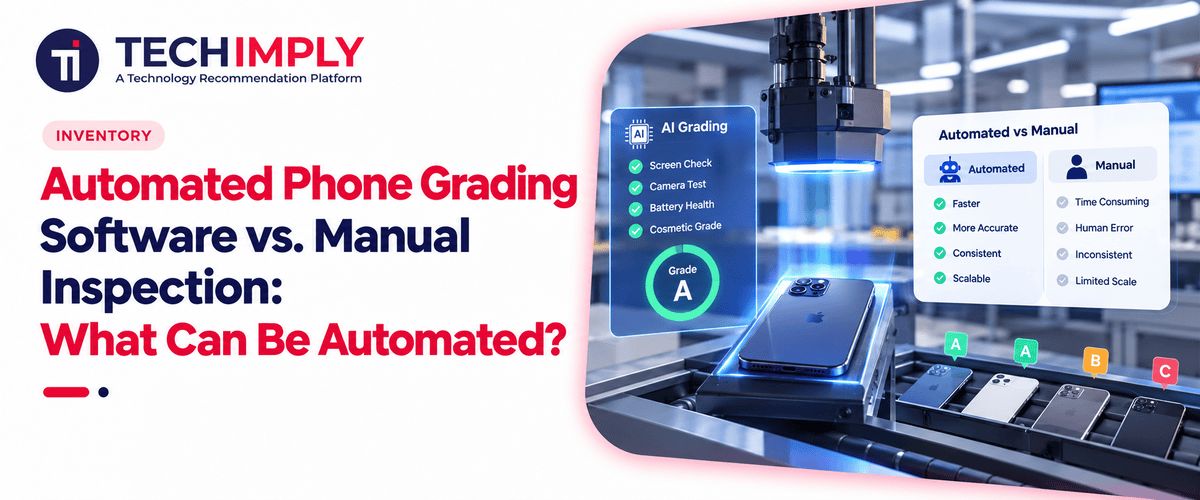
When a used phone is evaluated for resale, cosmetic condition can directly affect its grade and price. Traditionally, this process has depended on employees visually inspecting each device and deciding whether scratches, cracks, dents, chips, or other signs of wear meet the company's grading criteria.
Automated phone grading software changes this process by using AI to analyze device images, identify cosmetic damage, and assign grades according to predefined rules. However, automation does not necessarily mean removing people from the workflow entirely. Human review can still be useful for exceptions, validation, and business-specific decisions.
Quick Answer: Can Phone Grading Be Fully Automated?
A significant part of phone grading can be automated.
Automated phone grading software can capture or analyze images of a device, detect cosmetic defects, identify their locations, and assign a grade based on the grading system configured by the business.
However, businesses may still want people involved in areas such as exception handling, result verification, workflow management, and decisions that fall outside the software's defined grading criteria.
NSYS Autograding uses AI to automatically evaluate the cosmetic condition of used devices, provides qualitative and quantitative damage detection, and allows businesses to customize their grading system.
How Does Manual Phone Grading Work?
Manual grading typically involves an employee physically inspecting a phone and comparing its cosmetic condition with the company's grading criteria.
The process may involve:
- Examining the screen.
- Checking the housing and frame.
- Looking for scratches, cracks, chips, dents, and scuffs.
- Inspecting the device from different angles.
- Comparing the observed condition with grading guidelines.
- Assigning a grade.
- Recording the result.
- Taking photographs for documentation, where required.
The challenge is that cosmetic grading involves judgment.
Two employees can look at the same device and interpret the same defect differently. NSYS has identified subjectivity and inconsistency as recurring problems with manual device grading. Its case study with GoodCom, for example, describes employees incorrectly identifying scratches, chips, and scuffs when manually assessing devices.
This becomes more difficult when a business has multiple locations or processes large volumes of phones.
What Is Automated Phone Grading Software?
Automated phone grading software uses image analysis and AI to evaluate the cosmetic condition of a device.
Instead of relying entirely on an employee's visual judgment, the software can analyze photographs of the phone and apply predefined grading criteria.
Modern systems can go beyond simply assigning a grade. NSYS Autograding 2.0, for example, provides:
- AI-powered cosmetic inspection
- Qualitative and quantitative damage detection
- A map showing defective areas
- Photos of the device from different sides
- Customizable grading systems
- Automated grade assignment
The result is a more structured approach to cosmetic inspection.
What Parts of Phone Grading Can Be Automated?
Several repetitive parts of the grading workflow can be automated.
1. Image Capture
The first step is obtaining usable images of the device.
With an automated workflow, operators can capture photos using a smartphone rather than relying on specialized grading hardware. NSYS Autograding's current product page describes a portable approach where businesses can start grading using a smartphone, without dedicated hardware.
The quality and coverage of the images still matter. If important areas of the phone are not visible, the system cannot evaluate them reliably.
2. Damage Detection
AI can analyze the captured images and identify visible cosmetic defects.
Depending on the system and device, this can include:
- Scratches
- Cracks
- Chips
- Scuffs
- Housing damage
- Other visible signs of wear
NSYS Autograding 2.0 provides both qualitative and quantitative damage detection and displays defective areas through a damage-location map.
3. Grade Assignment
Once defects have been identified, the software can apply the business's grading rules.
For example, a company might define:
- Grade A: Excellent cosmetic condition with minimal signs of use
- Grade B: Good condition with visible signs of use
- Grade C: Noticeable cosmetic defects
- Grade D: Significant cosmetic damage
The exact criteria vary between businesses.
This is why customizable grading is important. NSYS Autograding allows businesses to adjust their grading system, including how many grades they use and how those grades are assigned.
4. Documentation
Automated grading can also create a record of the device's condition.
Photos can be stored alongside grading results, allowing employees or customers to review the condition later.
NSYS Autograding stores photos of graded devices and supports sharing photos of devices from six sides, which can help validate the assigned grade and resolve disputes.
5. Result Sharing
Once a phone has been graded, the result can be made available to other parts of the workflow.
For example, the grade can support:
Device inspection → Grade → Pricing → Inventory → Resale
NSYS Autograding can integrate with other NSYS solutions, including Diagnostics, Buyback, and Inventory.
What Still Requires Human Review?
Automation does not mean every decision needs to happen without human involvement.
People can still play an important role in:
Exception Handling
If an image is unclear, incomplete, or outside the conditions supported by the grading system, an employee may need to review the device.
Verification
Businesses may choose to have warehouse or quality-control staff verify automated grades, particularly for high-value devices or disputed results.
NSYS describes a workflow in which store staff capture device photos and AI generates the grade, while warehouse staff can verify the resulting grades.
Business-Specific Decisions
The software can apply predefined grading criteria, but businesses still decide what those criteria should be.
For example, one reseller may consider a particular level of scratching acceptable for Grade B, while another may classify the same condition as Grade C.
Physical Inspection Beyond Cosmetic Grading
Automated cosmetic grading should not be confused with functional diagnostics.
A grading system evaluates the visible physical condition of a device. Functional issues such as battery health, camera functionality, speakers, sensors, or connectivity require appropriate diagnostic testing.
For this reason, cosmetic grading can be one component of a broader device-processing workflow.
Automated vs. Manual Grading: Key Differences
|
Factor |
Manual Grading |
Automated Phone Grading |
|
Damage inspection |
Employee visually evaluates the device |
AI analyzes device images |
|
Grade assignment |
Employee interprets grading rules |
Software applies configured grading criteria |
|
Consistency |
Can vary between employees |
Same system applies the same configured rules |
|
Training |
Employees need to learn grading standards |
Operators primarily need to capture suitable images and follow the workflow |
|
Documentation |
Often depends on employee processes |
Photos and grading results can be stored digitally |
|
Scalability |
Requires additional staff as volume grows |
Can process higher volumes without increasing grading staff proportionally |
|
Human involvement |
High |
Lower, with people available for verification and exceptions |
|
Customization |
Based on company guidelines and employee judgment |
Grading rules can be configured in supported software |
The key difference is not simply speed. Automation moves the grading decision from individual visual judgment toward a standardized, repeatable process.
How Does AI Reduce Subjectivity in Device Grading?
Manual grading depends heavily on how an individual interprets the company's grading guidelines.
This can create problems when:
- Employees have different levels of experience.
- Different locations use slightly different standards.
- Staff become fatigued after inspecting large numbers of devices.
- A defect is difficult to classify.
- Employees disagree about the severity of damage.
NSYS's Autograding product page specifically highlights consistency as a benefit of its AI-based grading approach and notes that its system produces the same result when the same device is graded repeatedly.
The company's 2021 introduction to Autograding similarly described the product as a way to address subjectivity in used-phone grading and provide consistent results across repeated evaluations.
AI does not eliminate the need for a grading standard. Instead, it helps apply the defined standard more consistently.
What Should Businesses Consider Before Automating Grading?
Before adopting automated phone grading software, businesses should consider several practical factors.
1. What Devices Are Supported?
Make sure the software supports the phone models and device types processed by the business.
2. How Is Damage Detected?
Understand which cosmetic defects the system can identify and how those defects are presented.
3. Can Grading Rules Be Customized?
Different businesses can have different definitions of Grade A, B, C, and so on. Customization allows the software to fit the company's commercial requirements.
4. How Are Results Verified?
Look for workflows that allow employees to review results when necessary.
5. Are Images Retained?
Keeping device images alongside the grading result can be useful for quality control and resolving disputes.
6. Can Grading Connect With Other Systems?
Grading becomes more useful when the result can flow into pricing, inventory, diagnostics, or buyback processes rather than remaining in a separate system.
7. How Easy Is It to Train Staff?
An automated system should reduce the amount of subjective grading knowledge each employee needs to acquire.
NSYS says its Autograding solution includes an in-app tutorial and that staff can begin grading after a short onboarding process.
How NSYS Autograding Automates Cosmetic Inspection
NSYS Autograding is an AI-powered solution designed to automatically evaluate the cosmetic condition of used and refurbished devices.
The workflow is straightforward:
Capture device photos → AI analyzes condition → Damage is identified → Grade is assigned → Results are stored and shared
NSYS Autograding 2.0 adds a damage-location map, photos from all sides of the device, qualitative and quantitative damage detection, and customizable grading rules.
The system does not require dedicated grading hardware. Businesses can use the smartphone-based grading solution at multiple points of sale, while the results can integrate with other NSYS solutions.
It can also fit into a wider used-device workflow:
Diagnostics + Autograding + Buyback + Inventory
For example, diagnostics can evaluate functional condition, while Autograding evaluates cosmetic condition. The resulting information can then support pricing, inventory management, and resale decisions.
The important distinction is that automation handles the repetitive inspection and application of grading rules, while people can remain responsible for exceptions, verification, and business-level decisions.
Final Takeaway
Automated phone grading software can automate much more than simply assigning a letter grade.
It can capture device images, identify cosmetic defects, document the device condition, apply predefined grading rules, and share results with other parts of the used-device workflow.
Manual inspection can still have a role, particularly for exceptions and verification. The practical advantage of automation is that routine grading can follow a consistent process rather than depending entirely on the individual employee inspecting the phone.
For businesses processing large volumes of used devices, that distinction can make cosmetic grading easier to standardize across employees, locations, and batches.