


Artificial Intelligence (AI) has revolutionized industries by enabling automation and advanced analytics with predictive capabilities. However, developing AI-powered projects from the ground up is complex, time-consuming, and resource-intensive. AI frameworks simplify this process by providing pre-built tools, libraries, and optimization techniques that streamline the creation, training, and deployment of AI models. These frameworks enable organizations to scale AI solutions efficiently, reducing development time while enhancing performance.
This article explores AI frameworks, how they function, their benefits, key selection criteria, and the challenges of integrating them into AI-based projects.
What is an AI Framework?
The design and implementation of tools and libraries necessary for machine learning (ML) and deep learning model development is known as an AI framework. Frameworks with well-organized environments enable developers to focus on designing and optimizing models while minimizing low-level computational burdens.
Key Features of AI Frameworks
-
Model development tools provide pre-built architectures for ML and DL models.
-
Improved model efficiency and accuracy through optimization libraries.
-
Improved Scalability allows AI applications to effectively operate on large datasets.
-
Enhanced GPU and TPU utilization for faster computations through hardware acceleration.
-
Interoperability works with various programming languages and cloud-based platforms.
-
TensorFlow, PyTorch, Keras, Scikit-learn, and MXNet are all AI frameworks that offer varying capabilities for various purposes.
How Do AI Frameworks Work?
AI frameworks function by processing data, training models, optimizing them, and deploying the final version. The customary process for AI involves:
-
Data Preprocessing: The foundation of AI is clear and structured data. Frameworks contain tools that can handle missing data, normalize input, and enable feature engineering.
-
Model Training & Optimization: Algorithms are trained using either labeled or unlabeled data. Improved model accuracy is achieved through the use of optimization techniques like gradient descent.
-
Hardware Utilization: Frameworks are optimized for high-performance computing, with acceleration from both GPU and TPU systems.
-
Deployment and Integration: Practical implementations leverage trained models and their underlying methodologies. APIs that enable integration with cloud and enterprise platforms are available in various frameworks. Businesses can now deploy AI more quickly and efficiently with the help of AI frameworks, rather than having to develop models from scratch.
Advantages of Using AI Frameworks to Develop Projects
AI frameworks play a crucial role in AI-driven projects by offering several key advantages:
1. Faster Development Time
Frameworks that have pre-built components make it easier to develop AI models. This is because by using readily available libraries, developers can implement artificial intelligence software without the need to code every algorithm individually.
2. Improved Scalability
Big data and big data are made possible by AI frameworks that enable distributed computing. Multiple GPUs or cloud servers can be used to train models with the help of framework-based training, such as TensorFlow and PyTorch.
3. Enhanced Accuracy and Optimization
Improved optimization techniques are integrated into models to minimize errors and enhance predictive accuracy. Other techniques, such as dropout regularization, batch normalization, and hyperparameter tuning are also present within frameworks.
4. Cross-Platform Flexibility
Programming languages like Python, Java, and R are commonly used by AI frameworks to facilitate cross-platform development. This makes them highly adaptable. They also connect with cloud services such as AWS, Google Cloud, and Microsoft Azure.
5. Strong Community and Industry Support
A large community has been established to support leading AI frameworks, providing documentation and tutorials along with ongoing updates. Open-source contributions are essential in keeping frameworks up-to-date.
By leveraging AI frameworks, businesses can quickly and efficiently develop powerful applications with minimal programming complexity.
How to Choose the Right AI Framework for Projects
Selecting an AI framework depends on the project’s requirements, balancing expertise, scalability, and performance. Key factors to consider include:
-
Type of AI Model
Traditional ML models use scikit-learn for classification, regression, and clustering.
Neural networks: TensorFlow or PyTorch (Deep Learning)
-
Ease of Use & Learning Curve
Keras is more ideal for beginners because of its simplified syntax. PyTorch is more flexible, but you need to understand deep learning really well.
-
Performance and Hardware
You need AI frameworks that support GPU/TPU acceleration for performance-intensive or production-level AI applications.TensorFlow and MXNet allow more advanced parallel computing.
-
Integration Support for Cloud
The framework should also support easy integration with other tools and cloud platforms (AWS, Google Cloud, etc.)
-
Community and Industry-Wide Acceptance
An open source community will help you with more detailed documentation and long-term support. The AI framework you use simplifies the process with its robust features.
How to Integrate AI Frameworks into Projects
To ensure the successful deployment of AI, merging it along all touchpoints is essential. A structured approach includes:
-
Define AI Goals & Use-Cases: Find out how to custom AI on autopilot, either using automation, predictive analytics, or recommendation systems.
-
Choose the Right Framework: Projects based on performance and scalability need to choose the corresponding framework.
-
Build out a Data Pipeline: Use the auto tools that come with the framework for cleaning and processing data. Maintain real-time data for the continuous learning models.
-
Training and Tuning the Models: Using huge datasets for training models and tuning hyperparameters at the same time. Make use of GPU acceleration for fast calculations.
-
Deployment and Continuous Monitoring: Cloud-based APIs or edge computing are used to deploy models. Set up monitoring systems for, amongst other things, monitoring model performance and retraining as required.
Challenges When Using AI Frameworks in Projects
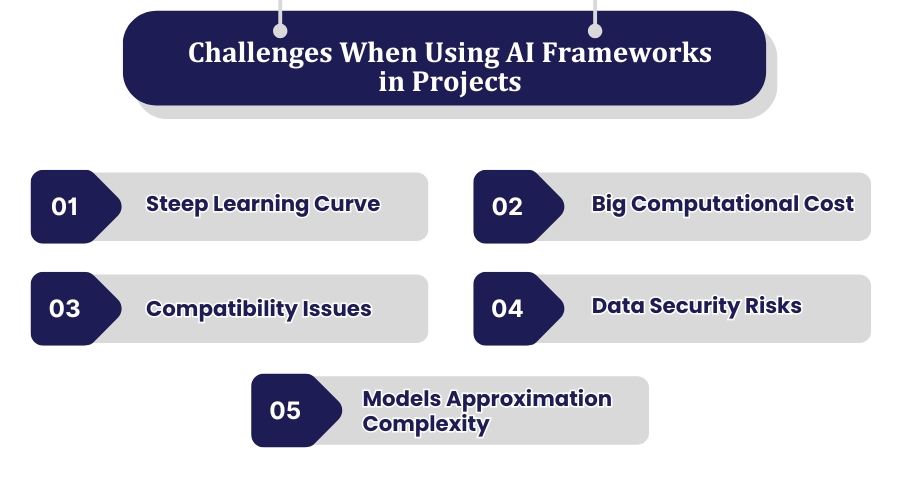
While they provide advantages, using AI frameworks also has challenges for which organizations must navigate:
1. Steep Learning Curve
Many AI frameworks require a strong understanding of AI and data science. PyTorch and TensorFlow, for example, offer extensive functionalities, making them more complex to learn.
2. Big Computational Cost
AI model training demands significant computing power, often requiring costly cloud resources. Organizations must balance performance with budget constraints.
3. Compatibility Issues
Legacy systems may face compatibility issues with AI frameworks. Additionally, updates to frameworks can sometimes disrupt existing applications.
4. Data Security Risks
AI often processes highly sensitive data, making robust security measures essential. To be compliant with systems such as GDPR, adequate encryption and access controls need to be in place.
5. Models Approximation Complexity
Hyperparameter tuning for deep learning models is challenging, often requiring extensive empirical experimentation to achieve optimal performance. These challenges should be resolved to ensure the seamless inclusion of AI and optimal project output.
Conclusion
AI frameworks are required to build robust, extensible AI solutions. They simplify model development, optimize GPU performance, and enable cross-platform integration. Framework selection, feature identification, and addressing the pain points are the hallmarks of successful AI execution. As organizations seek to stay competitive and innovative, leveraging AI frameworks becomes essential. These frameworks streamline AI adoption, enhance efficiency, and enable businesses to scale AI solutions globally. A well-chosen AI framework can drive innovation and accelerate AI-powered transformation.


.png "10 Best Employee Monitoring Software to Boost Productivity")


