


 0.0
0.0


What is Brevo? Brevo, previously known as Sendinblue, is a strong marketing and communication platform that helps businesses connect with customers through email, SMS, and automation tools. It provides a complete...
View ProfileFind The Best Email Encryption Software
Are you looking for Email Encryption Software for your business in India? Techimply brings you the best Email Encryption Software to ease your worries. In order to make your work smooth and swift, Techimply has compiled a list of the best software available. Compare the Best software features, pricing, free demo, and trial to select the best Email Encryption Software for your organization.

Researched and Written by
Akash Patel
List of 20 Top Email Encryption Software For Your Business - Get Free Demo, Pricing & Reviews
Filter

What is Moosend? Moosend is an email marketing platform that helps businesses create, automate, and track effective marketing campaigns easily. The Moosend app is designed for both beginners and professionals....
View Profile
FREE TRIAL

What is iContact? iContact is an effective e-mail advertising and marketing, and communication solution designed to help organizations create, automate, and control professional e-mail campaigns. While broadly known as an email...
View Profile
Starting From:
$ 16.00

Freshmarketer provide customer services, HR management, Sales automation, IT service management and Marketing automation services. It makes fast and easy for business to delight their customers and employees.
View Profile
FREE TRIAL

What is web.com? Web.com is a US-based corporation (now merged with Network Solutions) focusing on website construction, website hosting, area registration, and numerous online advertising services designed to assist individuals and...
View Profile
Starting From:
$ 1.99

SenditCertified is a cloud-based file storage system that offers electronic signatures, voice and video messaging, detailed reporting, message recall, and more. With no costly IT investments or lengthy installation processes,...
View Profile
FREE TRIAL

Virtru is a tool that provides secure email and attachment protection with end-to-end encryption and advanced controls. The tool has a thoughtful and user-friendly interface, which makes it easy to...
View Profile
What is Wrike ?Wrike is a powerful and versatile project management software designed to enhance collaboration, improve productivity, and streamline workflow processes for teams and organizations of all sizes. Founded...
View Profile
FREE TRIAL

Find best ProtonMail price, usability & features from verified user experiences. Read reviews from Indian business users & discover similar tools.
View Profile
NeoCertified is a secure messaging platform that helps companies to send emails through a secure channel without leaving their own browser. The platform can be integrated with Office 365, Outlook,...
View Profile
FREE TRIAL

Email encryption makes it easier to securely communicate and gives you more control. With email encryption, all policies are managed centrally and enforced at the gateway. This makes it easy...
View Profile
FREE TRIAL

Tutanota is an end-to-end encryption email service which provides its users with a safer email environment. It has built-in encryption which they guarantee cannot be decrypted by anyone. The goal...
View Profile
Paubox makes emailing secure and easy by eliminating the need for extra steps on the part of the recipient. This way, there is no wasted time or errors associated with...
View Profile
FREE TRIAL

What is Xendy? Xendy is a effective e mail signature control tool designed to assist businesses create, personalize, and manage expert e-mail signatures across all departments. With an intuitive interface and...
View Profile
FREE TRIAL

Malifence is an encrypted email service providing software that facilitates private and secure email communication. The software is operated under the Belgian privacy law. Emails exchanged within the portal get...
View Profile
EmailOctopus makes marketing easier and provide more intuitive, and better value, great deliverability, great service with personal touch.
View Profile
FREE TRIAL

Egress Protect is an intuitive email encryption management software that offers a plethora of influential tools to protect vital information. With this government and industry-certified secure software, companies can prevent...
View Profile
FREE TRIAL

ZixEncrypt is email encryption and data loss prevention software that offers individuals, their workforce, and their administrators unrivalled support in overcoming the issues of protection and regulation. The software safeguards...
View Profile
SendSafely is a highly secure file sharing platform that allows users to send encrypted files and information to anyone, regardless of the platform. The robust OpenPGP encryption with AES-256 creates...
View Profile
FREE TRIAL

What is Hunter? Hunter is a powerful email finder and verification tool that allows businesses, entrepreneurs, and recruiters to quickly find and confirm expert email addresses. It makes a specialization of...
View Profile
FREE TRIAL

Page Last Updated On August 27, 2026
Do you need the best email encryption software in India to protect your business communications? Techimply has put together a list of the best encrypted email software to help you keep your private information safe and make your business run more smoothly. Easily compare features, prices, as well as free demos and trials on all solutions! It’s easy to select email encryption software in India with expert advice. Doing so will maintain your business’s privacy, compliance, and peace of mind.
1. What is Email Encryption Software?
Email encryption software is a cybersecurity tool which assures the protection of sensitive data being transmitted and stored by means of encrypting email messages. Readable content changes into an unreadable ciphertext that can only be decrypted by authorized individuals possessing secure keys to read the message. It, therefore, becomes a very important technology for ensuring secure business communication from not only hackers but also cybercriminals and even insider threats.
Banks, hospitals, and law firms use email encryption programs to maintain the confidentiality of the data they handle, prevent breaches, and comply with data protection regulations. Businesses of any size can implement encryption software for email security and gain its benefits, whether it is free email encryption software or a high-end solution.
2. Criteria for Selecting the Right Email Encryption Software
When selecting the best email encryption software for your business, note the following key factors:
-
User Experience: Adoption rate of email encryption system improves across departments if it has intuitive UI
-
Encryption Method: Choose between symmetric and asymmetric encryption based on your needs.
-
Ease of Integration: Ensure that the software integrates easily with your existing email applications-for example, Outlook, Gmail, or other business mail servers.
-
Scalability: The email encryption system should be able to expand with your business.
-
Compliance: Ensure that the email encryption program complies with regulations like HIPAA, GDPR, ISO 27001, and others. Businesses evaluating compliance tools often also look at an email archiving software comparison to ensure secure storage alongside encryption.
-
Deployment Type: Considering your IT infrastructure and data sensitivity, select whether to go with cloud-based or on-premise deployment.
-
Customer Support: Go for vendors that offer regular updates and responsive support
These things will help you make sure that the chosen encryption software for email fits with your business objectives.
3. Benefits of Email Encryption Software
Putting in place email encryption programs has benefits that go far beyond just the safety of emails. They help keep the reputation of a firm, stay on the right side of compliance, and enhance smooth running of operations.
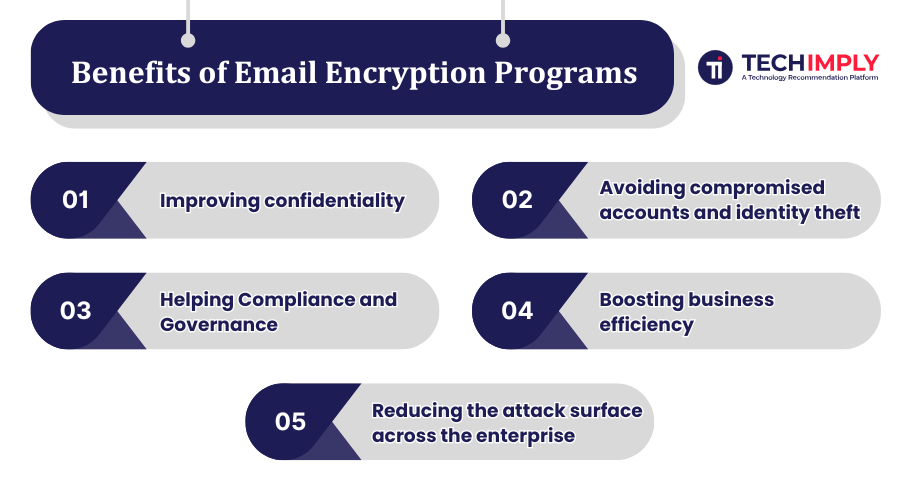
1. Improving Confidentiality
Email encryption software guards against any unauthorized access to sensitive data- be it financial statements, client details, or for that matter any legal documentation. In the BFSI, healthcare, and government sectors, this makes it very critical because a data breach can lead to high losses and also legal actions. Some email encryption software has now been integrated with email tracking software making it possible for one to track when a secure email has been opened without breaking confidentiality.
2. Avoiding Compromised Accounts and Identity Theft
Encrypted email software thwart hackers from accessing your emails hence lowering their chances of carrying out phishing attacks and identity theft. The best email encryption solutions secure both content and metadata thereby protecting your digital identity across networks. Numerous latest email encryption tools have joined hands with anti-spam software to block any form of malicious content as well as reduce on phishing threats before they get to someone's inbox.
3. Helping Compliance and Governance
Regulatory bodies require that emails with sensitive information be encrypted. Using mail encryption software that is compliant helps you meet industry standards and avoid big fines. Tools with audit trails and digital signatures make governance and transparency even better.
4. Boosting Business Efficiency
With advanced email encryption tools that give automatic encryption, users don’t have to be concerned about securing messages manually. This brings with it a higher level of efficiency, as it reduces the human error that might cause breaches in security.
5. Reducing the Attack Surface Across the Enterprise
End to end encryption software helps reduce your organization’s overall attack surface. With secure email gateways, DLP features, and automatic threat detection, encrypted email software provides layered protection against evolving threats.
4. Challenges in Best Email Encryption Software
Email encryption software is very useful for protecting information, but enterprises should think about its limitations before implementing it.
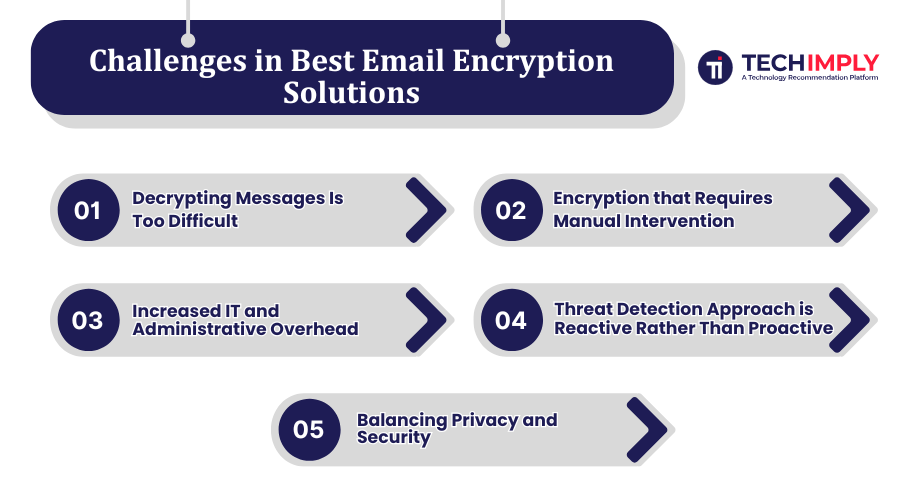
Decrypting Messages Is Too Difficult
Extremely complex processes of decryption irritate users and slow down communication. Email encryption tools that can manage keys simply and decrypt messages with no difficulty should be chosen. Even the top notch encrypted email software can slow down daily tasks and make it harder for users to adopt if the decryption process isn't smooth.
Encryption that Requires Manual Intervention
Manual processes are prone to error. Opt for email encryption programs with automatic or rule-based encryption to reduce the burden on users and IT teams. Using an Email Encryption System that lacks automation increases the chances of sensitive data being sent without proper protection.
Increased IT and Administrative Overhead
Maintaining a robust email encryption system can strain IT resources, especially in SMEs. Cloud-based solutions or encrypted email free tools may offer a more efficient, affordable approach. High-maintenance Email Encryption Solutions often create unnecessary complexity and increase operational costs for small teams.
Threat Detection Approach is Reactive Rather Than Proactive
Some email encryption software lacks proactive threat detection. Pick email encryption solutions that use AI and ML to keep an eye on threats and stop them in real time. Even the most secured encryption software for email won't stop advanced cyberattacks if your defense is not proactive. To maintain proactive security, organizations can pair encryption programs with email testing tools that simulate attacks and verify encryption effectiveness.
Balancing Privacy and Security
While securing data, organizations must also ensure that encryption doesn’t compromise user privacy or internal audits. The best email encryption tools strike a balance between compliance and ethical data use. A comprehensive Email Encryption Program should deliver robust security without sacrificing user privacy or regulatory transparency.
5. Features of Best Email Encryption Software
The features that an Email Encryption Software has to fulfill different company demands and keep communication safe are what make it useful.
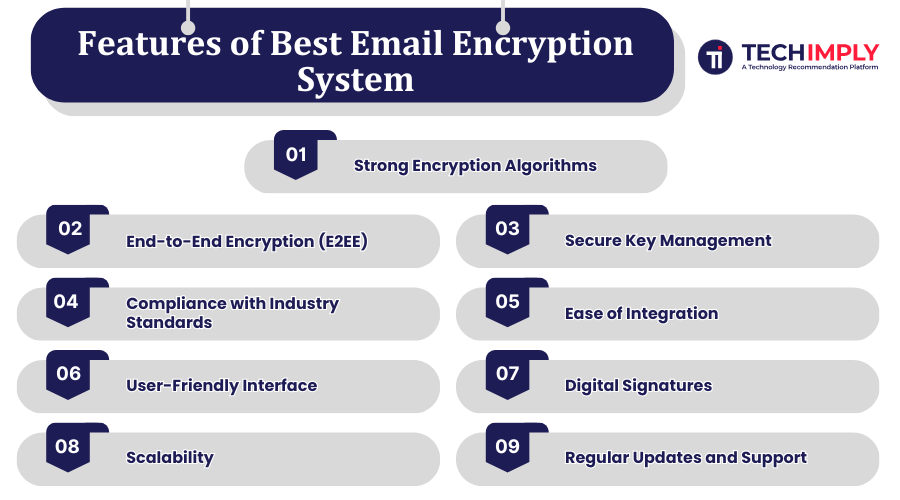
Strong Encryption Algorithms
Look for solutions that are able to work with AES-256, RSA, or Elliptic Curve Cryptography. These algorithms keep your business communications safe at a high level. To protect against brute-force attacks, advanced encryption software for email and business email software should have multi-layered encryption. Most top-notch Email Encryption Programs use advanced algorithms to keep your data safe and generally secure; some even use military-grade algorithms.
End-to-End Encryption (E2EE)
End-to-end encryption software ensures that only the sender and recipient can read the email. Not even the service provider can access the message. This keeps your confidential data safe throughout the entire communication process with encrypted email software. In addition to tools like an email finder app that help you reach the right contacts, a solid Email Encryption Solution with E2EE provides privacy by default, especially in regulated industries.
Secure Key Management
A reliable email encryption system should offer secure key generation, exchange, and storage processes—preferably with zero-trust principles. Poor key management can compromise even the most advanced mail encryption software. Free email encryption tools may offer basic key handling, but enterprise-grade systems provide enhanced control and automation.
Compliance With Industry Standards
Make sure that mail encryption software is GDPR, HIPAA, CCPA, ISO, and all data privacy regulatory compliance by industry. Firms avoid getting into trouble and also retain confidence when they use compliant email encryption solutions. Industry-norm aligned encrypted email software sustains the long run to keep being accountable and ensures reliability.
Ease of Integration
The email encryption software has to integrate with major email clients for businesses, such Office 365, Google Workspace, and others. Easy integration reduces deployment time and boosts ROI from your Email Encryption System. Top Email Encryption Tools support API and plugin-based connections to fit into existing IT ecosystems. The best email encryption software seamlessly integrates with email management software, providing inbox workflows with high security levels maintained.
User-Friendly Interface
A clean UI with guided encryption workflows makes the software accessible even for non-technical users. The best email encryption software makes secure communication feel like second nature. Email encryption free solutions with a simple design often see higher adoption in small businesses.
Digital Signatures
Modern encryption software for email must have digital signature capabilities. It is the sender’s identity that needs to be verified as well as maintaining the integrity of the message. This feature has to be enabled in order to determine the source of emails and thus avoid any form of phishing or spoofing activities. Digital signing is an important part of numerous email encryption programs because it makes sure that messages are real for all users. Some encrypted email programs also support email signature software features to ensure brand consistency along with verified identity and message integrity.
Scalability
See that the software can scale up with your business. Look for multi-user plans and enterprise-level configurations. Whether you're a startup or a large corporation, scalable encrypted email software adapts to your growth. Free email encryption may serve startups initially, but scalable Email Encryption Tools offer better long-term value.
Regular Updates and Support
Continuous support, updates on features, and bug fixes are very much part of quality email encryption solutions. Keeping regular updates makes your encryption software for email safe from new cyber threats. Email encryption systems with 24/7 support make sure that business-critical communication is always available and has as little downtime as possible.
6. Top 5 Best Email Encryption Tools in India
Communication security forms part of the growing digital corpus in India and these constitute the best email encryption tools that are used by businesses of all sizes. Where there are email encryption tools emphasizing on security, many businesses also use email marketing software India for outreach—making it important that both coexist and not compromise data safety.
1. ProtonMail
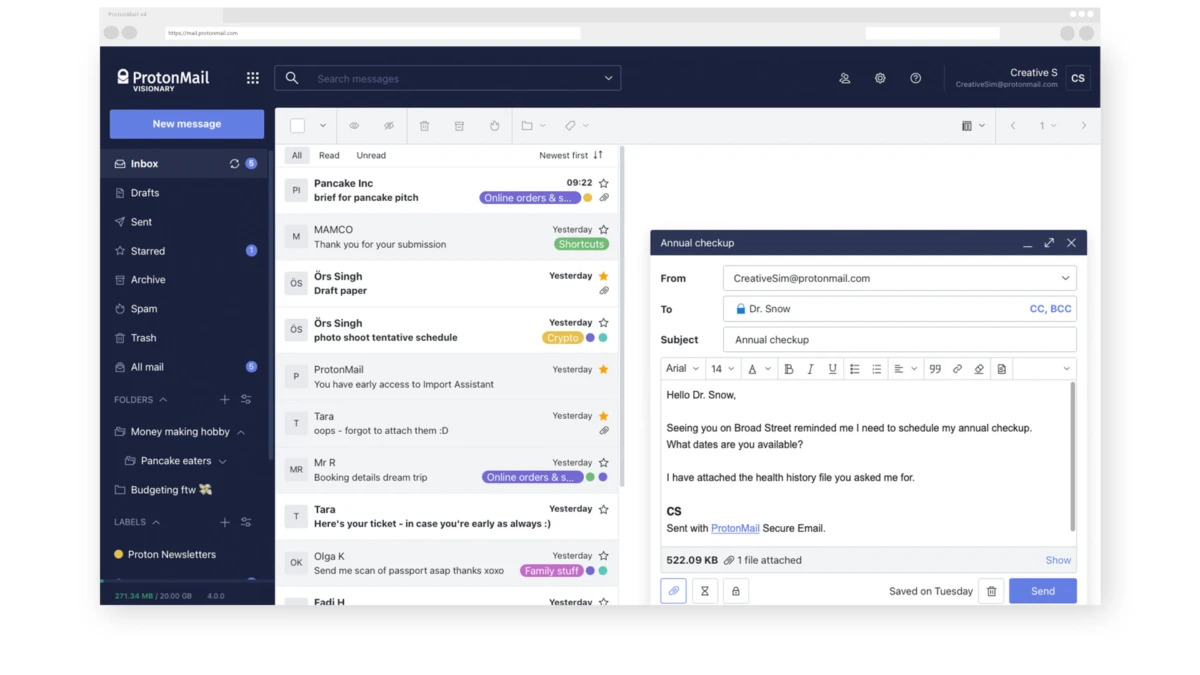
ProtonMail is encrypted email software based in Switzerland that offers secure email services to users all over the world, that includes India. It has been designed such that only the recipient and sender would be able to read the content of the mail—not even Proton itself. In simple terms, it uses end-to-end encryption for its emails.
Features
Zero-access encryption
PhisGuard for blocking phishing attacks
One-click unsubscribe
Automatic email encryption
Hide-my-email aliases
Pros
Tracking is blocked and disabled by using images in email
User-friendly interface
Cons
Lack of advanced features
No Desktop App
Pricing: Free plan is available. Mail Plus plan costs Rs. 404.18/month. Proton Unlimited plan costs Rs. 1011.98/month. Proton Duo plan costs Rs. 1518.47/month.
2. Tutanota
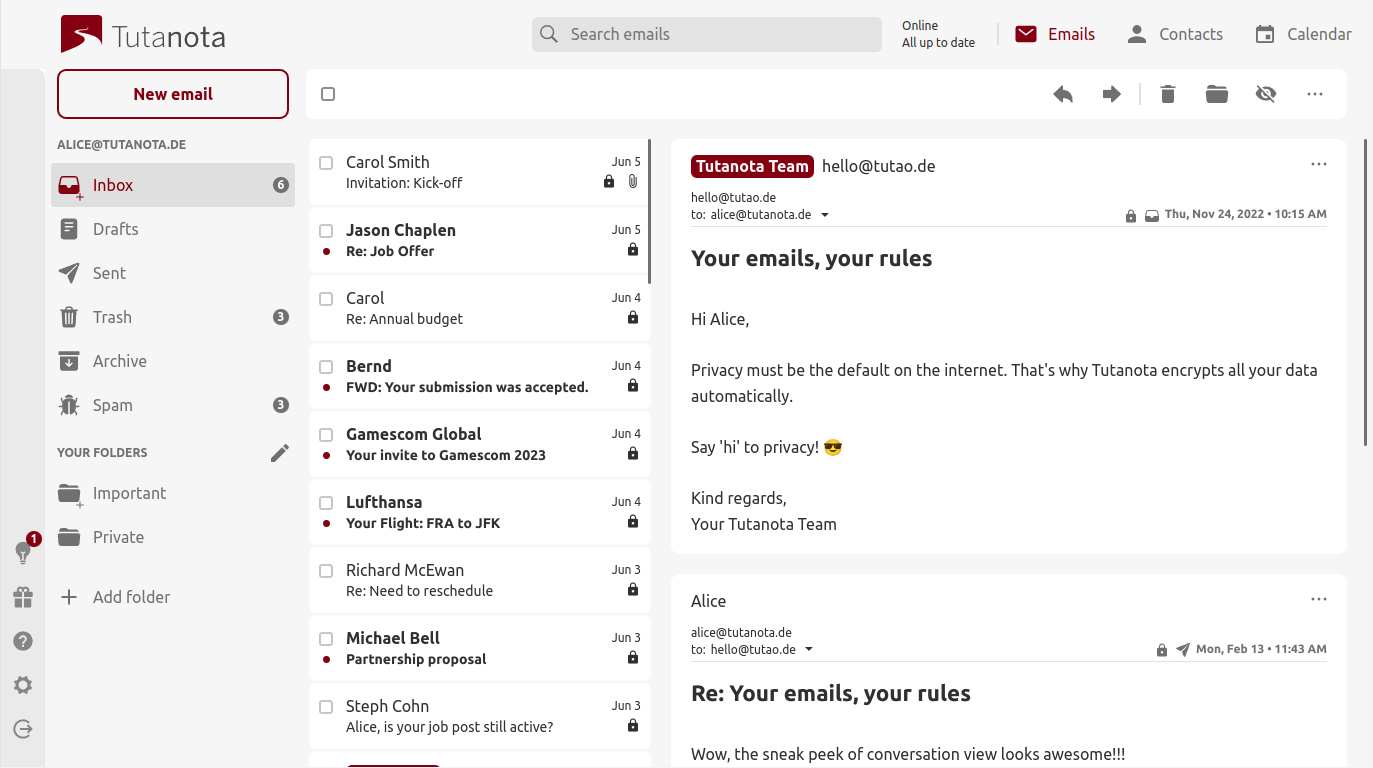
Tutanota is a Germany-based mail encryption software that is popular for open-source architecture and privacy-first approach. Tuta is designed to secure user data from unauthorized access, that includes email provider too, committing to privacy and security.
Features
End-to-end encryption
Best value custom domain accounts
Offline mode
Smart filters
Secure connect
Pros
User-friendly Interface
Mobile Accessibility
Cons
Limited search functionality
Limited calendar functionality
Pricing: Free plan is available. Revolutionary plan costs Rs. 364.68 monthly and Rs. 303.90 yearly. Legend plan costs Rs. 972.47 monthly and Rs. 810.39 annually.
3. Startmail
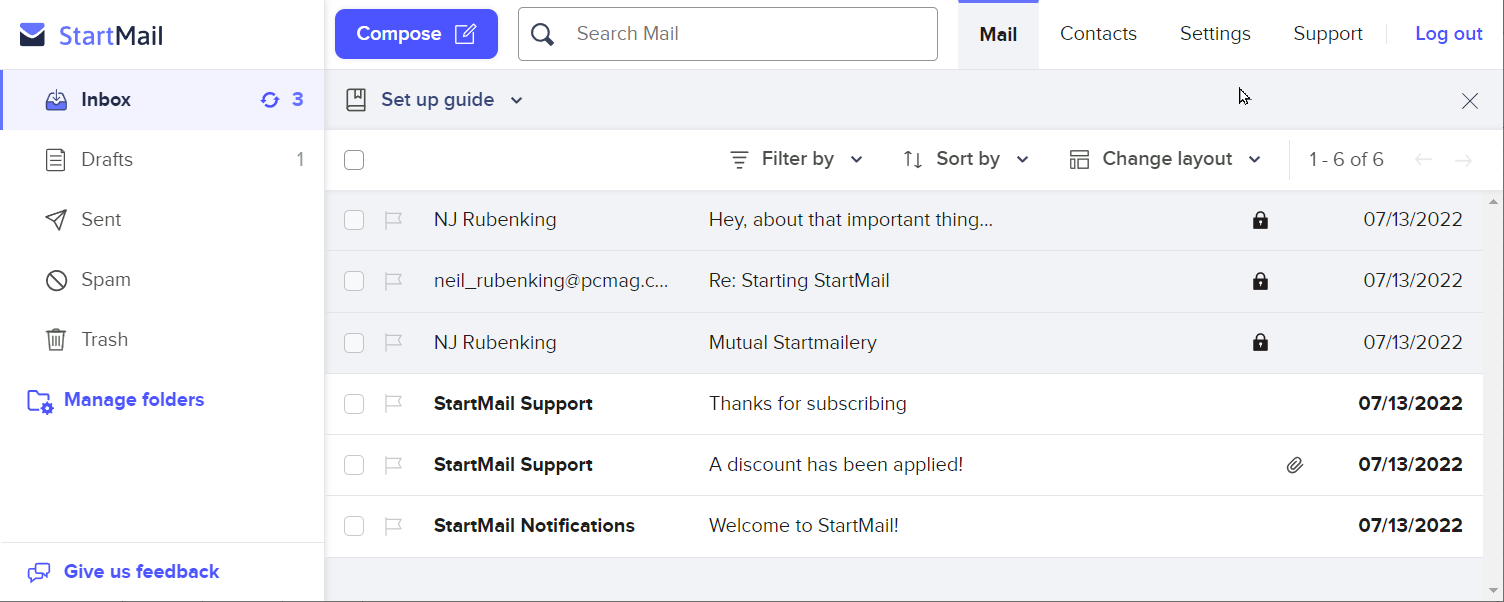
Startmail is a privacy-focused encrypted email software designed for individuals and small businesses who want simple, secure communication. With startmail, you can create disposable email addresses for every signed up service by you. Paired with the best email verifier tool, Startmail ensures that encrypted messages only reach valid, verified recipients—minimizing bounce rates and misdeliveries.
Features
World-class encryption
Custom domains
Flexible storage options
Manage multiple users with group subscriptions
Accessibility from any device
Pros
User-friendly Interface
No Ads or Tracking
Cons
Limited customization options
Payment details required for trial
Pricing: Free trial is available. Personal plan costs Rs. 614.20 monthly and Rs. 438.46 annually. Business plan costs Rs. 789.94 monthly and Rs. 614.20 annually.
4. Mailfence
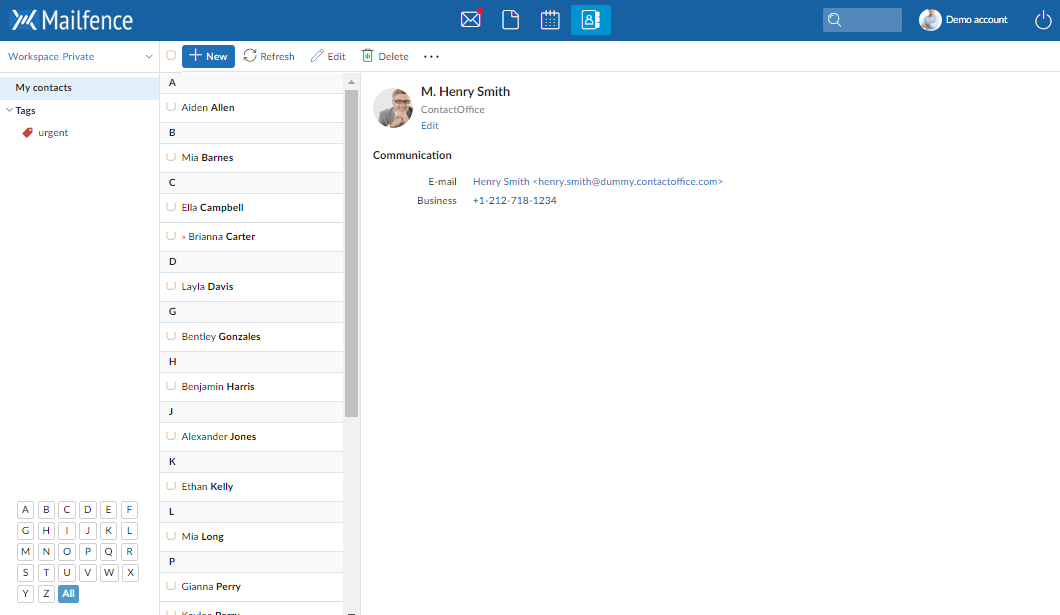
Mailfence is Belgium-based email encryption software that offers full suite of features for secure messaging, file storage, and contacts. The software was launched by ContactOffice Group that has been operating open collaboration suite since 1999.
Features
End-to-end encryption
Calendar and contact management
Third-party integrations
Third-party restrictions
Collaboration tools
Pros
User-friendly Interface
Strong Encryption
Cons
Limited advanced features
Some features like POP3/IMAP access to download emails is available only on paid plans
Pricing: Free plan is available. Entry plan costs Rs. 354.64/month. Pro plan costs Rs. 962.61/month. Ultra plan costs Rs. 293848.30/month.
5. Skiff
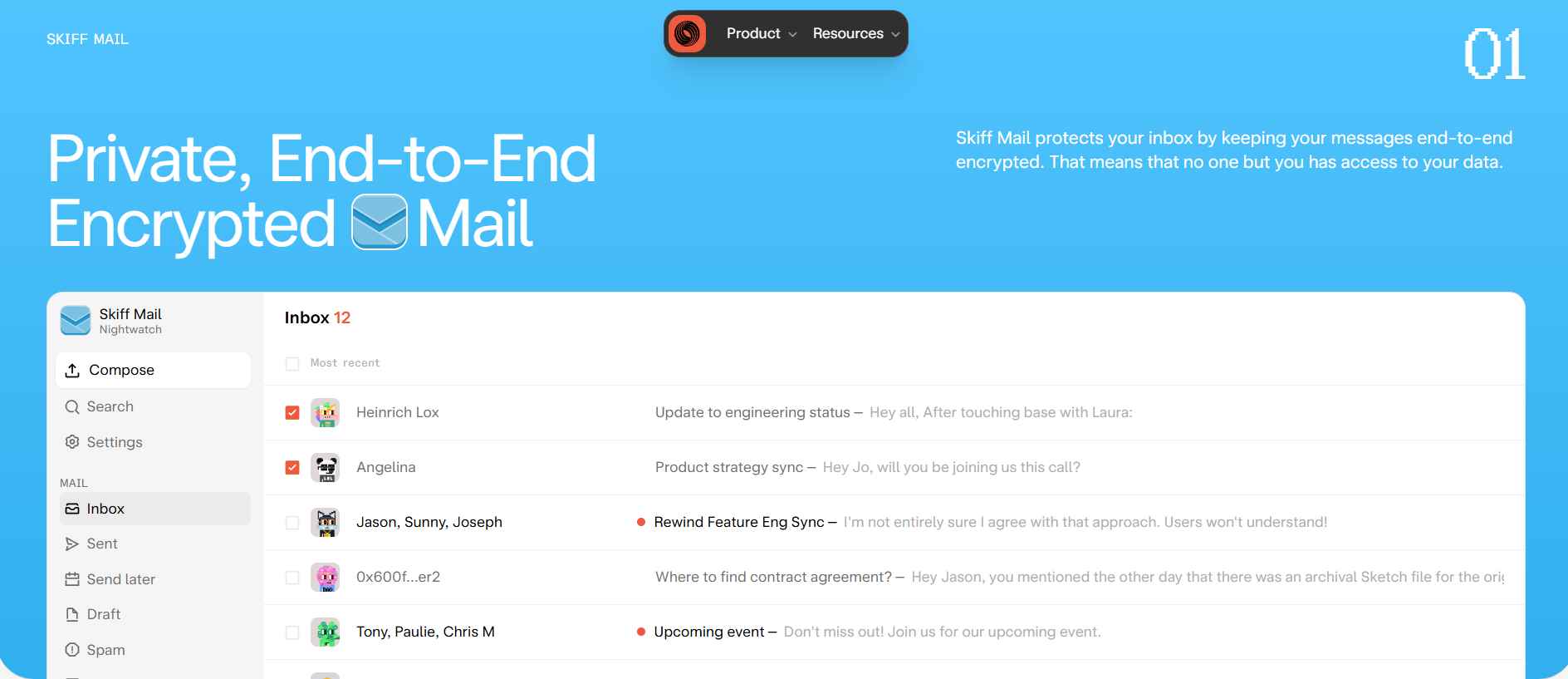
Skiff (now acquired by Notion) is an end to end encryption software that is designed on zero trust architecture and emphasizes on privacy and productivity. Skiff protects your inbox and gives you power to communicate freely.
Features
10GB of Free Storage and 1-click Migration
Custom Domain
Quick Aliases
Advanced Security
Custom Signature
Pros
User-friendly interface
Free tier with essential features
Cons
Limited email alias system
No encrypted email with non-Skiff users
Pricing: Free plan is available. Essential plan costs Rs. 351.36 monthly and Rs. 263.52 annually. Pro plan costs Rs. 878.40 monthly and Rs. 702.72 annually. Business plan costs Rs. 1317.60 monthly and Rs. 1054.08 annually.
7. Latest Market Trends in Best Email Encryption Software
As India's digital economy grows, trends for advanced Email Encryption Software are changing how businesses protect their communications and follow the law.
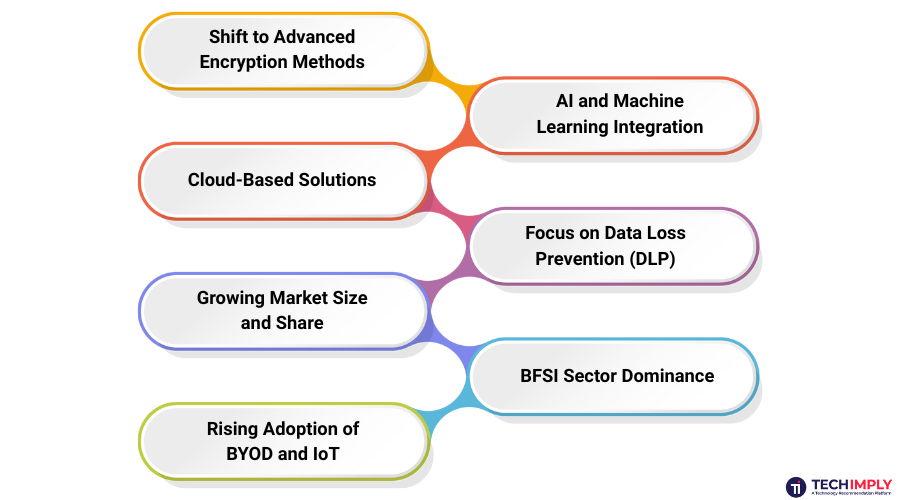
Shift to Advanced Encryption Methods
Email encryption tools are increasingly adopting post‑quantum and homomorphic encryption to stay ahead of emerging threats. This shift ensures that mail encryption software is future‑proof, with encryption software for email evolving beyond traditional RSA and AES standards. Encrypted email software using these advanced methods delivers stronger protection for sensitive data and reinforces user trust.
AI and Machine Learning Integration
Modern encryption software for email is embedding AI and ML to detect phishing, malware, anomalous behaviour, and content-based risks in real time. AI-enhanced Email Encryption Programs dynamically determine when encryption is necessary, reducing manual intervention and improving usability. By using intelligent threat assessment and contextual analytics, the Email Encryption Solutions of today proactively safeguard inboxes before breaches occur.
Cloud-Based Solutions
Cloud-based email encryption software has become very popular because it is cheaper to set up, easier to maintain, and can grow with your needs. Email encryption systems are delivered through the cloud support remote teams, mobile access, and integration with platforms like Office 365 and Google Workspace. Firms in India can implement encrypted email software over the cloud quickly as well as receive frequent updates and all management from a single place.
Focus on Data Loss Prevention (DLP)
DLP features that stop sensitive information from leaking by accident or on purpose are now built into the best email encryption tools. Encrypted email free and paid versions help enforce rules like blocking attachments or auto-encrypting certain content by using encryption and DLP together. These integrated systems significantly reduce risks posed by outbound errors and human mistakes—major causes of data breaches. With rising demand for transactional email services in India, integrating reliable email encryption tools becomes critical for protecting order confirmations, invoices, and sensitive communication.
Growing Market Size and Share
The global email encryption market is expected to be valued at USD 23.33 billion by 2030, accelerating from around USD 9.30 billion by 2025 at a CAGR of 20%. The encryption software market in India will grow from USD 826.8 million in 2024 to well above USD 3.29 billion by 2033, soaring at a CAGR of 15%. This surge further fuels the requirement and need for email encryption software plus email encryption solutions across different industrial sectors which include BFSI, retail as well as healthcare.
BFSI Sector Dominance
Because they have to follow strict rules and face a lot of cyber threats, Indian financial institutions are still the biggest users of email encryption programs. Banks and insurance companies are using enterprise-grade encrypted email software to keep customer information and transaction records safe. Sector-specific email encryption tools now have custom workflows and audit features to meet regulatory mandates like RBI directives.
Rising Adoption of BYOD and IoT
As BYOD policies and IoT devices become more common, businesses need strong email encryption systems that work with a various endpoints. To enforce security policies, encryption software for email now often comes with mobile apps, secure containers, and easy key management across endpoints. Encrypted email software safeguards communications through all hybrid workspaces and linked gadgets. They use end-to-end encryption alongside a control in one place.
8. Conclusion
Choosing the Right Email Encryption Software is important for keeping private business communications safe and ensuring regulatory compliance. While there are plenty of email encryption tools, from encrypted email free offerings to full-featured enterprise systems, the choice will have to do with your company’s size, budget, and security requirements. This way, whether you’re running a startup or a huge business, your digital communication over email will be kept private, tamper-proof, and secure from prying eyes with credible mail encryption software.
Frequently Asked Questions (FAQs)
How Does an Email Encryption Key Work?
The recipient's public key is used by the sender to enact encryption of the email, making it unreadable for anybody who does not have the corresponding private key.
How is Email Encryption Done?
Email Encryption is done by utilizing a pair of cryptographic keys: a private key for decryption and public key for encryption.
Why is Email Encryption Important?
Email remains one of the most exploited communication channels for data breaches. Encryption protects sensitive information such as financial details, personal data, and corporate secrets, maintaining confidentiality and regulatory compliance.
How Big is the Email Encryption Market?
Increasing demand for secure email communication amid increasing threats through emails-as a surge in ransomware and phishing attacks is driving the Global Email Encryption Market.
Why Do Businesses Use Email Encryption?
To safeguard sensitive data, protect against cyber threats, comply with regulations, and ensure private communication between senders and recipients.
Who Needs Email Encryption Software?
Organizations in healthcare, finance, legal, government, and any industry that handles sensitive or regulated information.
Can Encrypted Emails be Accessed on Mobile Devices?
Yes, most modern solutions support mobile apps or browser access for seamless use.
How Difficult is it to Implement Email Encryption?
Cloud-based solutions are quick to deploy. On-premise options may require more setup, IT support, and server management.
Is it Suitable For Small Businesses?
Yes. Cloud-based solutions make enterprise-level encryption affordable and easy to deploy for SMBs.
What Happens if an Encrypted Email is Sent to the Wrong Recipient?
While content is encrypted, access may still be possible if the recipient is authorized. Some systems allow recall or expiration of encrypted emails.
Best Email Encryption Software for Every Business
Find The Best Email Encryption Software in the Following Countries
Find The Best Email Encryption Software in the Following States
Find The Best Email Encryption Software in the Following Cities
Find The Best Email Encryption Software in the Following Industries


