The pattern is predictable. Companies start with everything in AWS—simple, clean, manageable. Then sales brings in Salesforce. Marketing adds HubSpot. Finance demands NetSuite. Before long, data lives in 14 different places while backup strategies cover only three.
This isn't just technical debt—it's an existential risk. Your core backup solution works for what it was designed for, but specialized platforms create critical gaps. Modern businesses need protection that spans multiple clouds, not just one.
This article reveals why traditional backup strategies must evolve, which providers work best together, and how to protect all your critical data without overwhelming your IT team or budget.
What Is a Multi-Cloud Backup Strategy?
So what exactly is multi-cloud backup? Think of it as spreading your backup data across totally different cloud providers—not just different regions of the same provider. We're talking AWS and Azure, or Google Cloud and Wasabi. The whole point is that when (not if) one provider has a bad day, your backups are sitting pretty somewhere else, completely unaffected.
This isn't like traditional backup where you're just using different data centers from the same provider—that's like hiding your spare key under a different rock in the same yard. And it's not hybrid backup either, where you've got some stuff on-premise and some in the cloud. With multi-cloud, you're creating totally separate recovery paths through competing providers. When AWS goes down, your Azure backups keep running normally.
Why Do Businesses Need Multi-Cloud Backup in 2025?
The operating environment for growing businesses has fundamentally changed. Several converging factors now make multi-cloud backup a critical requirement rather than an optional enhancement:
Your customers won't tolerate downtime anymore. Two years ago, "technical difficulties" bought you patience. Today, extended outages drive customers to competitors—and they share their experience on social media while switching.
Insurance companies have caught on to the risk. Getting cyber coverage with all your eggs in one basket now costs significantly more—if they'll cover you at all. Insurers have seen too many total losses from single points of failure.
Auditors and regulators demand proof of resilience. "Trust us, we have backups" no longer passes compliance reviews. They want evidence of independent recovery options, successful tests, and geographic distribution.
Your biggest deals require it. Enterprise contracts increasingly include disaster recovery requirements that are difficult to meet with a single-cloud approach. No multi-cloud strategy means losing out on valuable opportunities.
The financial consequences of downtime. Downtime costs have multiplied tenfold in just a few years. But the real damage often comes from secondary effects that don't show up immediately on balance sheets: the enterprise client who quietly removes you from their vendor list, the social media backlash that haunts search results, and the momentum competitors gain while you're scrambling to recover
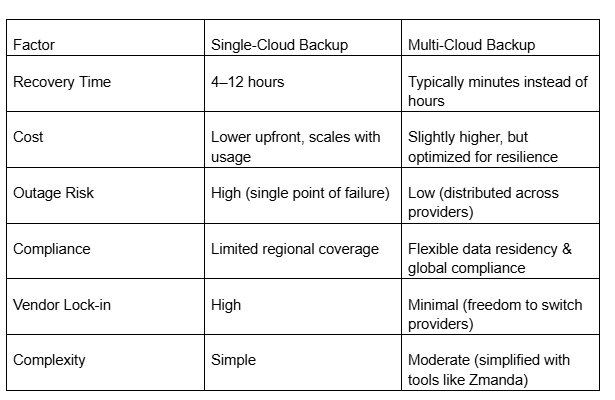
Here's what the data shows us: companies using single-cloud backup typically need 4-12 hours to recover from major incidents. Compare that to multi-cloud setups where we're seeing recovery times under an hour for critical systems. When you're burning through thousands of dollars every minute you're down, the difference between one hour and eight hours isn't just operational—it can determine whether you come out stronger or struggle to recover market position.
There's also a compliance benefit worth noting. During audits, companies with documented multi-cloud recovery capabilities typically move through the process 40-60% faster. Having multiple recovery paths has become a key differentiator during audits. It signals mature risk management that goes beyond checking boxes.
Comparing Single-Cloud and Multi-Cloud Backup Approaches
The architectural differences between these strategies create distinct operational realities:
Talk to our backup experts to assess your current recovery time gaps
Why Multi-Cloud Backup Has Become Non-Negotiable
Several converging trends have transformed multi-cloud backup from a nice-to-have into a business imperative. Here's what's driving this change:
1. Cloud Provider Outages Are Inevitable
Major cloud providers experience multiple significant outages annually. The risk is simple: when your cloud provider goes down, so do your backups.
December 2021's AWS US-East-1 outage showed this clearly—companies lost access to both production and backup systems simultaneously
2. Your Data Already Lives in Multiple Clouds
The average growing business uses 7-15 different cloud services. Your CRM is in Salesforce, emails in Microsoft 365, payments in Stripe, analytics in Snowflake. Single-cloud backup only protects a fraction of your actual data.
3. Compliance Demands Geographic Distribution
Data residency laws require local storage in dozens of countries. GDPR requires EU data to stay in EU. China's PIPL requires data localization. Healthcare data has state-specific rules. No single cloud provider covers all requirements.
4. Ransomware Targets Backup Systems First
Modern ransomware destroys backups before encrypting production data. Multi-cloud architecture defeats this through separate authentication systems and isolated storage—when attackers breach one cloud, your other backups remain untouchable. This is why immutable, air-gapped backups across multiple clouds have become the gold standard for ransomware protection backup.
Backup resilience starts before recovery by shrinking your attack surface across every cloud workload. Pair multi-cloud backups with centralized patch management that inventories assets, prioritizes CVEs, and automates safe rollouts across Windows, macOS, and Linux. Explore the best tools for patch updates to schedule, test, and roll back patches at scale while maintaining compliance so your backups remain recoverable even as threats evolve.
5. Customer Expectations Have Changed
B2B customers increasingly require proof of multi-cloud backup in vendor assessments. Companies without documented disaster recovery capabilities often lose deals to better-prepared competitors.
Ready to protect your business from these risks? Start your free trial or talk to our backup experts.
How Multi-Cloud Security Protects Your Backups
Multi-cloud security ensures backups remain encrypted, accessible, and recoverable across providers through:
-
Independent authentication systems per cloud
-
Separate encryption keys for each provider
-
Immutable storage preventing deletion
-
Cross-cloud monitoring for unified visibility
Multi-Cloud Backup Tools That Actually Work
After evaluating dozens of solutions, here are the tools that growing businesses successfully deploy:
For Growing Businesses (10-100TB)
Zmanda Pro
-
Best for: Companies prioritizing ease of management alongside comprehensive functionality
-
Strengths: Covers 15+ clouds, predictable pricing without egress fee surprises, actual human support
-
Why it works: Unlike enterprise tools that require specialists, Zmanda Pro can be managed by your existing IT team
-
Start your free trial today to see multi-cloud backup in action
Veeam Backup & Replication
-
Works best for: Companies already invested in VMware infrastructure
-
What it does well: Proven platform with extensive capabilities
-
Trade-offs: Expect a learning curve and budget for training
Making the Multi-Cloud Decision in 2025
Most growing businesses face a dangerous mismatch: data scattered across multiple clouds, backups concentrated in one. This gap, combined with rising outage frequency, stricter compliance demands, and zero-tolerance customers, has transformed multi-cloud backup from optional to essential.
Early adopters of multi-cloud security gain more than just protection—they gain competitive resilience. Late adopters will inevitably implement the same strategies, but under duress and at far greater cost."
Conclusion
In 2025, data is the backbone of every growing business, and protecting it is no longer optional—it’s essential. A multi-cloud backup strategy not only ensures greater reliability and scalability but also provides a safety net against outages, cyber threats, and compliance risks. By diversifying storage across multiple cloud providers, businesses gain flexibility, cost efficiency, and peace of mind. Investing in a multi-cloud backup approach today means building a stronger, more resilient foundation for tomorrow’s growth.