In the rapidly evolving digital landscape today, different business have a growing demand to nurture their relationships with customer effectively. Conventional methods of nurturing relationships are being enhanced by electronic customer relationship management (eCRM). As technology continues to evolve, eCRM systems have become necessary tools for business to streamline their interactions with customers, encourage loyalty and ultimately boost sales. This blog dives into the concept of eCRM, its benefits, types and how it can revolutionize customer relationship management for businesses.

Looking for Best CRM softwares?
Check out Techimply's Best CRM Software for your business.
What is eCRM?
Electronic Customer Relationship Management (eCRM) refers to the use of digital technology to oversee and evaluate customer interactions and data throuhout the customer journey. It harness the internet, email, mobile apps and other web tools to create and mantain relationships with customers. The target is to improve customer contentment, increase sales and improve business perfomance by using customer data to offer personalized interactions and services.
The eCRM definition is often closely related to customer relationship management (CRM). However, with a greater emphasis on utilizing digital platforms. It merges various communication channels such as inbox advertising, social media, online surveys and customer support chatbots to facilitate smooth customer interactions. Primarily, eCRM makes customer relationship management better by using modern technologies to automate and analyse data. Many of these modern capabilities are now powered by advanced AI development services that enable smarter decision-making and predictive customer insights.
Differences Between CRM and eCRM
Whilst both CRM and eCRM aim to enhance customer relationships, the key difference lies in the use of technology.
-
CRM (Customer Relationship Management) usually involves the management of customer relationships through established practices like face-to-face interactions and phone calls.
-
eCRM, on the other hand, uses e-platforms such as websites, mobile apps and social social media marketing strategies media marketing strategies to manage and enhance relationships with customer.
The main benefit of eCRM is its ability to gather, process and alayse real time data various digital touchpoints, providing business with in-depth understanding of customer relationship behavior.

Pro-tip
Did you know? Company using CRM systems sees growth over 40% in sales ad 70% in customer satisfaction.
Benefits of eCRM for Business
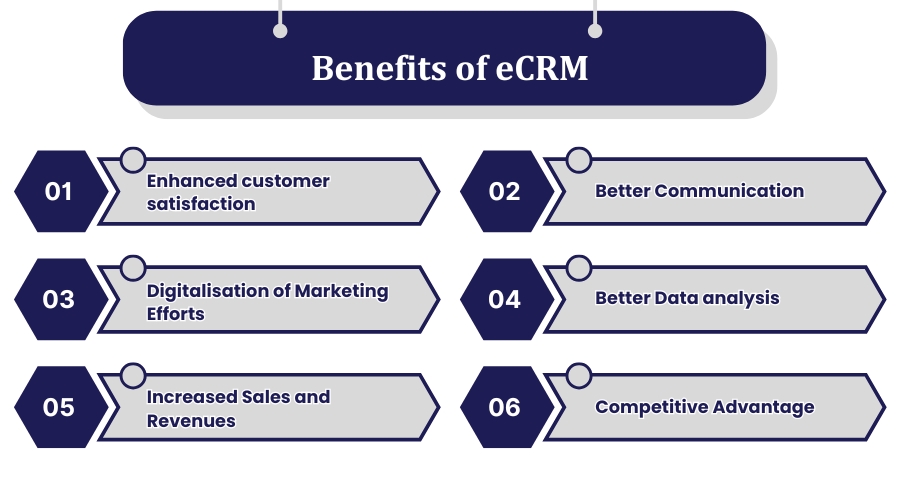
Executing an eCRM system give numerous advantages for business of all sizes. These advantages can convert customer interaction and improve overall business performance:
1. Enhanced customer satisfaction:
This can be achieved by collecting and analysing customer data, business can modify their offerings to meet indivudal customer requirements. This leads to more personalised and fulfilling experience for the customer, resulting in increased loyalty and preservation. Moreover, we can continuously monitor customer feedback and choices so business can stay ahead of changing needs. This agile method will not only boost customer keeping but will also nurture long-term relationships In addition, sharing motivational business quotes within internal teams or on customer-facing platforms can inspire a growth mindset and enhance brand connection.
2. Better Communication:
eCRM allows effortless communication across various channels, including email, live chat, social media and many more. This secures that customers can reach business via their preferred medium, leading to quicker response times and greater customer satisfaction. Also, eCRM enables businesses to track customer needs in realtime, ensuring persistent and persoanlised communication. This will create a health relation and customer loyalty.
3. Digitalisation of Marketing Efforts:
eCRM tools can organise marketing strategies, making it easier to send targeted offers, reminders and foolow-ups. This helps businesses save their time and resources while enhancing the impact of their marketing strategies. We can automate the tasks which are repetitive, eCRM enables business to focus on creating more engaging relevant content.
4. Better Data analysis:
eCRM systems allow businesses to analyse customer interaction and behaviours in real time. This helps companies identifies trends, track customers choices and make data driven decisions that can improve their product and services. With advanced report filing features, eCRM provides insights to customer preferences allowing businesses customise their offerings even more efficiently.By integrating eCRM data with marketing mix modeling, businesses can better understand the impact of each marketing channel on their sales and adjust their strategies accordingly to maximize ROI.
5. Increased Sales and Revenues:
By tapping into customer knowledge, businesses can create targeted sales strategies that drive higher conversion rates and revenue. eCRM system also help in cross-selling and up-selling products, boosting sales potential of existing customer. Additionally, eCRM gives businesses with the best of its ability to identify high-value customers which helps in creating personalised offers and rewards.
6. Competitive Advantage
Businesses utilizing ECRM can gain an aggressive advantage in their enterprise. By turning in advanced customer reviews and extra-focused marketing campaigns, groups can differentiate themselves from the competition and attract and keep more customers.
Key Features of eCRM for Business
The success of eCRM mostly depends on the features it offers. Some key features of eCRM that businesses should look for when choosing are:
-
Customer segmentation
eCRM allows businesses to categorise customer based on their behaviours, population characteristics and choices. This segmentation helps create personalised marketing campaigns and customer service experiences. We can segment customers into specific groups, this can help businesses by redirecting their messages to customers unique choices. This will result in better lead distribution and higher customer conversion rates.
-
Data Integration
eCRM systems integrate data from various channels such as websites, mobile apps, social media and emails, often secured through IPSec VPN connections, providing a complete view of each customer. For businesses with legacy on-premise servers or multiple physical branches, implementing a VPN site-to-site network architecture ensures that this data is transferred securely and continuously to the central eCRM hub. This combination allows businesses to monitor and assess customer interactions across multiple platforms safely, leading to more informed, data-driven decisions.
-
Campaign Management
With the help of eCRM, businesses can easily manage marketing campaigns, observe their performance and make adjustments as required. Automated tools helps in sending timely and relative messages to customer which increases customer engagement. The eCRM system allows split testing enabling business to enhance campaign content and deliver maximum impact.
-
Customer Support
eCRM systems comes with built-in tools such as live chats, issue tracking system and FAQs to streamline customer support. The organisation will be able to take faster and efficient decisions. With combining customer interactions in one platform, the eCRM system helps customer care team to reply more effectively and personalised way. This will lead to quicker solutions.
-
Analytics and Reporting
eCRM solutions offer detailed reporting capabilities that provide business with insights into customer behaviour, campaign performance and overall business. This data helps businesses fine tune their strategies and make better decisions.This data helps businesses fine-tune their strategies and make better decisions. To get the most out of this data, many organizations work with Excel consulting services that specialize in integrating CRM analytics into custom dashboards and advanced reporting systems.
4 Types of eCustomer Relationship Management (eCRM)
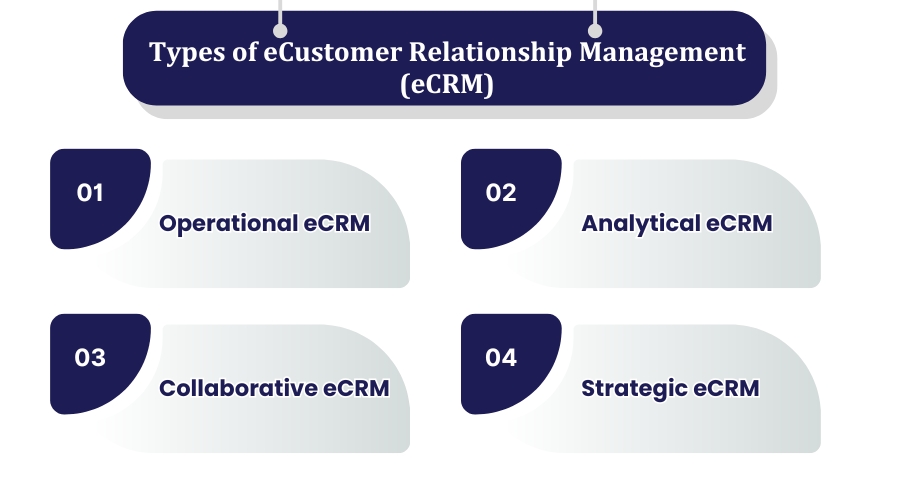
There are many types eCRM that provides assistance to different business needs. Each type has its own unique feature and functionalities which are designed to address specific goals. The four main types of eCRM are:
-
Operational eCRM: This type mainly focuses on automating business processes like customer management, order management and customer support. It helps in simplify daily operations and provide real time data to improve customer meetings.
-
Analytical eCRM: This systems are designed to analyse customer data generate insights that help business understand customer behaviour, choices and trends. This gathered information( data ) is used to make strategic choices and maximise marketing strategies.
-
Collaborative eCRM: This is a type of eCRM which focuses on improving the level of communication and collaboration between different departmentof organisation/businesses such as sales, marketing and customer support. It create an environment so that team can work together more efficiently and deliver consistent customer experiences across all platforms.
-
Strategic eCRM: It aims to align the organisation ‘s long term goals with customer relationship management strategies. It involves the use of customer data to drive the business growth, improve customer loyalty and enhance overall experience.
Pro-tip
Recent studies shows that over 80% of customer interactionc can be automated with CRM systemsFun fact: Recent studies shows that over 80% of customer interactionc can be automated with CRM systemsConclusion
As we can see businesses continue to adapt to the digital advancement, eCRM has become very important tool for maintaining and enhancing customer relationships. The use of eCRM’s not only improves customer satisfaction and customer loyalty but also increases sales and revenue growth. Along with the benefits such as automation, personalised communication and data driven insights, eCRM systems have been proven critical for businesses seeking to stay ahead of their competition. With understanding different types and features of eCRM, businesses can choose right solution to meet their required needs.
Blending eCRM software into your business strategy can lead to more enhanced customer interactions, better marketing performance and a higher return on investment which ultimately drive businesses on the path of success.