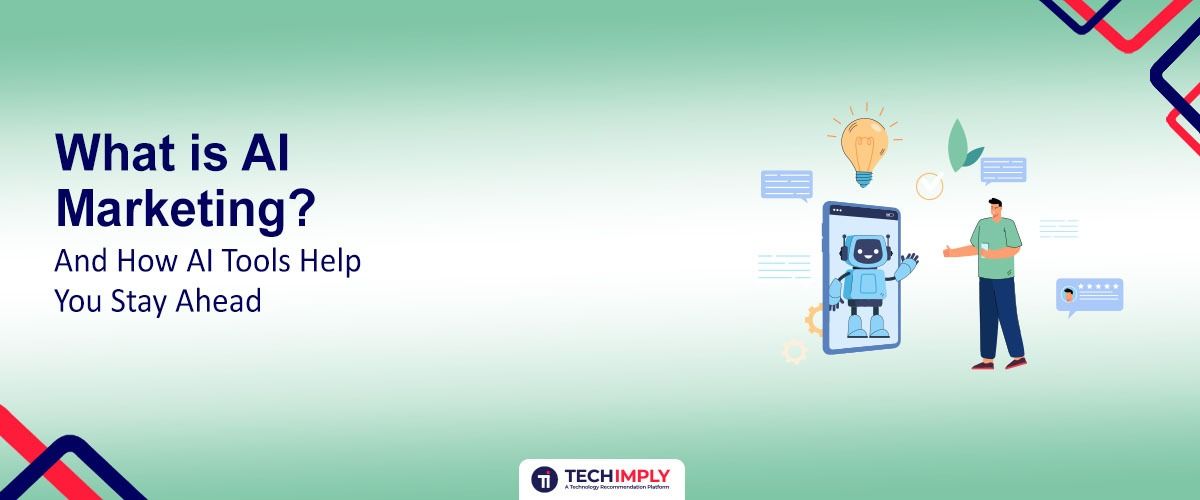
Marketing has always been about understanding people, what they want, when they want it, and how they want to be reached. AI marketing takes that understanding to an entirely new level by using machine learning, data analysis, and automation to make every marketing decision smarter and faster. Whether you are a startup spending ₹50,000 a month on ads or an enterprise running campaigns worth crores, AI marketing helps you stretch every rupee further by targeting the right audience at the right time with the right message.✖

Looking for an AI Marketing Platform?
Check out Techimply's List of the Best AI Marketing Platform in India for your business.
The relationship between marketing and artificial intelligence is no longer a future concept, it is happening right now, across industries, team sizes, and budgets. Businesses that embrace AI for marketing are seeing measurable improvements in conversions, customer retention, and campaign efficiency. You will get a clear, practical breakdown of what AI marketing is, how it works, why it matters, and how you can start using it to grow your business with confidence.
What is AI Marketing?
AI marketing refers to the use of artificial intelligence technologies, such as machine learning, natural language processing, and predictive analytics, to automate and optimize marketing activities. Instead of relying solely on human judgment, AI marketing uses data-driven insights to make decisions about targeting, content, timing, and budget allocation.
Simply put, AI marketing means letting intelligent systems do the heavy lifting so your team can focus on strategy and creativity.
-
How Marketing and Artificial Intelligence Work Together
Marketing and artificial intelligence work together by combining the creativity of human marketers with the processing power of intelligent algorithms. AI handles data collection, pattern recognition, and repetitive tasks. Meanwhile, your team focuses on crafting stories, building relationships, and setting strategic direction.
For example, while a human marketer designs a brand campaign, AI analyzes which audience segment is most likely to convert, picks the best time to serve the ad, and adjusts the budget in real time, all without manual intervention.
-
How AI in Marketing Has Evolved Over the Years
AI in marketing started with basic rule-based automation, think email autoresponders and scheduled social posts. Over time, it evolved into smarter recommendation engines like the ones you see on e-commerce platforms. Today, AI in marketing powers everything from dynamic ad bidding to real-time personalization engines that adapt your website content based on who is browsing it.
The shift has been significant. Moreover, as AI tools become more accessible, even small businesses in India can now use platforms that were once reserved for global enterprises with multi-crore technology budgets.
Do You Know?
Amazon's recommendation engine, one of the earliest examples of AI for marketing, reportedly drives around 35% of the company's total revenue. That is the power of showing the right product to the right person at the right time.
How Does AI in Marketing Work?
Understanding the mechanics behind digital marketing AI helps you use it more effectively. Here is how the core technologies function:
-
Machine Learning and Predictive Analytics
Machine learning allows AI systems to learn from past data and improve their predictions over time. In marketing, this means AI studies historical campaign performance, customer behaviour, and purchase patterns to forecast what will work next. For instance, predictive analytics can tell you which leads are most likely to convert this month, so your sales team knows exactly where to focus.
-
Natural Language Processing (NLP) in Marketing
Natural language processing enables AI to understand, interpret, and generate human language. Therefore, it powers tools like chatbots, sentiment analysis engines, and AI writing assistants. When a customer types a query on your website, NLP helps the chatbot understand intent and respond meaningfully, not just match keywords.
-
How AI Processes Customer Data to Drive Decisions
AI marketing tools process enormous volumes of customer data, browsing history, purchase behaviour, email engagement, social interactions, and find patterns that humans simply cannot spot manually. Consequently, these patterns drive smarter decisions about what content to show, which offer to promote, and how much to bid for an ad placement.
Key Benefits of AI for Marketers
AI for marketers delivers value across every part of the marketing function. Here are the five benefits that make the biggest difference:
-
Faster and Smarter Decision-Making
AI eliminates the lag between data collection and action. Instead of waiting for weekly reports, your team gets real-time insights and automated recommendations. As a result, you can respond to market shifts instantly rather than after the opportunity has passed.
-
Improved ROI on Marketing Campaigns
By targeting more precisely and optimizing bids automatically, AI marketing significantly reduces wasted ad spend. A business spending ₹2,00,000 per month on paid ads can often achieve the same or better results for ₹1,20,000 once AI-driven optimization is in place, freeing up ₹80,000 to reinvest elsewhere.
-
Better Customer Personalization at Scale
Personalization used to require enormous manual effort. With artificial intelligence in marketing, you can deliver individualized experiences to thousands of customers simultaneously, personalized emails, product recommendations, dynamic landing pages, without adding headcount.
-
More Accurate Measurement of KPIs
AI marketing tools track and attribute conversions more accurately across touchpoints. Furthermore, they surface which channels and campaigns are driving real business outcomes, so you stop investing in tactics that look good on vanity metrics but deliver little actual value.
-
Enhanced CRM Capabilities
AI integrates with your CRM to score leads, predict churn, identify upsell opportunities, and trigger personalized follow-ups automatically. This means your sales and marketing teams always have context-rich, up-to-date customer profiles to work from.

Pro-tip
Before choosing any AI marketing tool, map out your customer journey first. Knowing where friction points exist helps you pick AI solutions that solve real problems, rather than buying tools that sound impressive but do not address your specific needs.
Top AI Marketing Use Cases
AI for marketing applies across almost every function your team handles. Here are the most impactful use cases:
-
AI for Content Generation and Copywriting
AI tools now generate ad copy, blog drafts, email subject lines, and social captions in seconds. While you still need human editing and brand oversight, AI dramatically speeds up the content production process, especially useful for teams managing campaigns across multiple platforms and languages.
-
Audience Segmentation and Targeting
Instead of broad demographic segments, AI analyses behavioural data to create micro-segments with precision. Therefore, your messages reach people who actually want to hear from you, reducing unsubscribers, improving click-through rates, and lowering your cost per acquisition.
-
Programmatic Advertising and Artificial Intelligence
Programmatic advertising and artificial intelligence go hand in hand. AI automates the buying and placement of digital ads in real time, evaluating thousands of variables per impression, audience match, context, time of day, device, to serve the most relevant ad at the lowest possible cost.
-
AI-Powered SEO and Digital Marketing
Digital marketing AI tools analyze search trends, content gaps, competitor rankings, and SaaS backlinks to guide your SEO strategy. Additionally, they help you identify high-intent keywords, optimize on-page content, and monitor your rankings, all without hours of manual research.
-
Sentiment Analysis and Social Listening
AI scans social media, reviews, and forums to understand how your audience feels about your brand in real time. Consequently, you can catch reputation issues early, identify product feedback worth acting on, and tailor your messaging to match the current mood of your market.
-
AI Chatbots and Customer Service Assistants
AI chatbots handle customer queries around the clock, qualifying leads, answering FAQs, processing orders, and escalating complex issues to human agents. For businesses receiving hundreds of enquiries per day, this saves significant time and improves response speed dramatically.
-
Predictive Analytics for Campaign Optimization
Predictive analytics uses historical data to forecast future campaign outcomes. As a result, you can allocate budget more confidently, know which channels to prioritize, and avoid investing heavily in campaigns that the data suggests will underperform.
-
Workflow Automation for Marketing Teams
Beyond customer-facing applications, AI marketing automates internal workflows, approvals, reporting, A/B test management, and content scheduling. This frees your team from repetitive administrative tasks and gives them more time to focus on high-value creative and strategic work.
Best AI Marketing Tools in 2026
Choosing the right AI marketing tools depends on your goals, team size, and budget. Here is a breakdown by category:
-
AI Tools for Content Creation
Platforms like Jasper, Copy.ai, and Writesonic help teams generate marketing copy, blog posts, and email drafts quickly. They are especially useful for teams managing high content volumes without proportional headcount.
-
AI Tools for Email Marketing
Tools like Mailchimp's AI features, ActiveCampaign, and Klaviyo use AI to optimize send times, personalize subject lines, and predict which subscribers are most likely to convert, improving open rates and revenue per email.
-
AI Tools for Social Media Marketing
Platforms like Hootsuite Insights and Sprout Social use AI for scheduling, sentiment analysis, and performance recommendations. Furthermore, tools like Canva's AI features help non-designers produce professional visuals quickly.
-
AI Tools for SEO and Analytics
Semrush, Ahrefs, and Surfer SEO all incorporate AI to guide keyword research, content optimization, and competitive analysis. Google Analytics 4 also uses machine learning to surface predictive insights about your audience.
-
AI Tools for Advertising and Artificial Intelligence
Google's Performance Max and Meta's Advantage+ campaigns use advertising and artificial intelligence to automate creative testing, audience targeting, and bid management, delivering better results with less manual input from your team.
How to Integrate AI Into Your Digital Marketing Strategy
Improve email open rates? Increase conversion rates on your landing pages? Clear goals ensure Adopting AI for marketing does not require a massive budget or a dedicated data science team. However, it does require a thoughtful, structured approach.
Step 1: Define Your Goals and KPIs
Start by identifying the specific marketing problems you want AI to solve. Are you trying to reduce cost per lead? Improve email open rates? Increase conversion rates on your landing pages? Clear goals ensure you pick tools that deliver measurable outcomes.
Step 2: Clean and Organize Your Data
AI is only as good as the data you feed it. Therefore, before deploying any AI marketing tool, audit your customer data for completeness, accuracy, and consistency. Messy data produces unreliable AI outputs, no matter how sophisticated the platform.
Step 3: Choose the Right AI Marketing Tools
Based on your goals, shortlist two or three AI tools for marketing that address your highest-priority challenges. Start small, one tool done well delivers more value than five tools used poorly.
Step 4: Test, Monitor, and Optimize
Run A/B tests to validate AI-generated recommendations against your existing benchmarks. Additionally, monitor performance weekly in the early stages and give the algorithms enough data to learn before drawing conclusions.
Step 5: Train Your Marketing Team
AI tools are only effective when your team knows how to use them. Invest in onboarding and training so your marketers understand the outputs, trust the insights, and know when to override the algorithm with human judgment.
Challenges and Best Practices of Using AI in Marketing
Like any technology, artificial intelligence in marketing comes with challenges worth planning for.
-
Data Privacy and Compliance
AI marketing depends on customer data, and collecting, storing, and using that data responsibly is non-negotiable. Ensure your AI tools comply with relevant data protection regulations, including India's Digital Personal Data Protection Act. Always give customers clear opt-in choices and be transparent about how their data is used.
-
Avoiding Over-Reliance on AI
AI is a decision-support tool, not a replacement for human thinking. Moreover, algorithms can reinforce existing biases in your data if you are not careful. Review AI recommendations critically and involve your team in evaluating outputs regularly.
-
Maintaining Brand Voice With AI-Generated Content
AI content tools are powerful but generic by default. Consequently, you need clear brand guidelines, tone-of-voice documentation, and a human review process to ensure AI-generated content sounds like your brand, not like every other brand using the same tool.
Conclusion
AI marketing is not a trend to watch from a distance, it is a practical set of tools and strategies that are reshaping how businesses connect with their customers. From predictive analytics and programmatic advertising and artificial intelligence, to chatbots and AI-powered SEO, the applications are broad, proven, and accessible. Furthermore, as AI tools for marketing continue to improve in 2026 and beyond, the gap between businesses that adopt them and those that do not will only widen. Start by identifying one area of your marketing where AI can solve a real problem. Build from there, keep your data clean, train your team, and measure everything.