Running a support team without the right tools is like trying to answer 200 phone calls at once with one person; things fall through the cracks, customers get frustrated, and your team burns out fast. That is exactly why choosing the right help desk Software matters more than most businesses realise. After spending weeks testing platforms hands-on, I can tell you that not all tools are created equal, and the one that works for a 10-person startup looks very different from what an enterprise support team actually needs.

Looking for Help Desk Software?
Check out Techimply's List of the Best Help Desk Software in India for your business.
I share honest, first-hand reviews of the 7 best help desk software platforms available in 2026. Whether you need a free help desk software option to get started, or a full-featured ticket management system to scale your operations, this breakdown covers everything. I also walk through a help desk software comparison across pricing, automation, and key features, so you leave with a clear answer, not just more options.
What Is Help Desk Software?
Help desk software is a platform that centralizes customer support requests into one organized workspace. Instead of tracking emails in a shared inbox or chasing replies across WhatsApp and social media, your team manages everything from a single dashboard.
A strong system typically includes a ticket management system, SLA management, automation workflows, multi-channel support, and reporting and analytics. Furthermore, modern platforms now add AI help desk software features like smart auto-replies, sentiment detection, and predictive ticket routing.
Do You Know ?
According to Salesforce, 88% of customers say that the experience a company provides matters as much as its product or service. Your help desk is often the first and most frequent touchpoint customers have with your brand.
How I Tested These Help Desk Tools
I signed up for trials across all seven platforms and ran them through the same scenarios. My testing criteria covered:
- Ease of use — Could a new agent get productive within 30 minutes?
- Features — Does it cover ticketing, automation, SLA management, and reporting?
- Automation — How intelligent are the automation workflows, and how easy are they to configure?
- Pricing — What is the actual cost per agent per month, including hidden fees?
- Integrations — Does it connect with Slack, CRM tools, Shopify, or WhatsApp?
Quick Comparison Table
Here's a quick overview of the top help desk tools, highlighting who they're best for, their starting prices, free plans, and key features.
|
Tool |
Best For |
Starting Price |
Free Plan |
Key Feature |
|
Zendesk |
Enterprise teams |
₹5166.24/agent/mon |
No |
Omnichannel + Advanced AI |
|
Freshdesk |
SMBs & startups |
₹0 (Free plan) |
Yes |
Freddy AI & intuitive UI |
|
Zoho Desk |
Affordable teams |
₹800/agent/mo |
Yes |
Context-aware AI (Zia) |
|
HelpScout |
Small businesses |
₹2817.95/agent/mo |
No |
Email-first, human-centric UX |
|
Intercom |
SaaS products |
₹2724.02/agent/mo |
No |
Native in-app messaging |
|
Jira Service Mgmt |
IT & DevOps |
₹0 (Free plan) |
Yes |
ITSM-grade SLA tracking |
|
Tidio |
Startups on a budget |
₹0 (Free plan) |
Yes |
Live chat + automated bots |
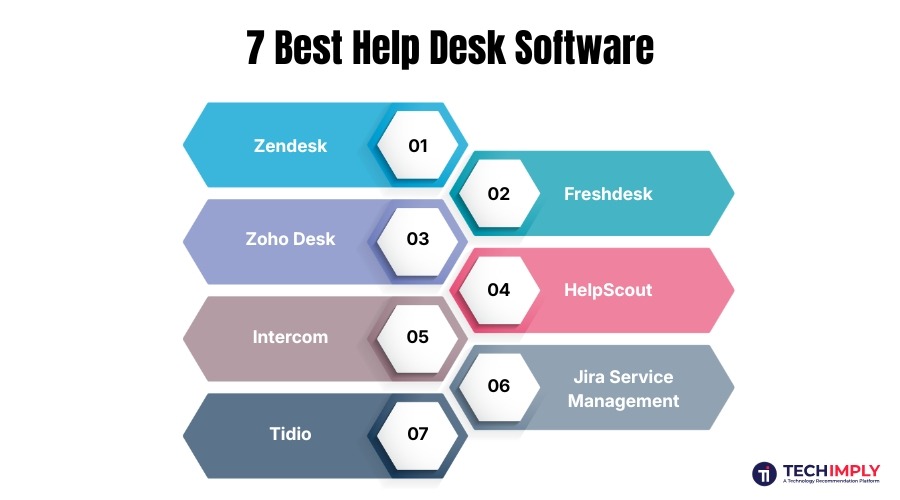
7 Best Help Desk Software — Detailed Reviews
In this section, an in-depth look at each of the top help desk platforms, sharing their strengths, weaknesses, and my personal experience with each.
1. Zendesk — Best for Enterprise Teams
Zendesk is the most recognized name in enterprise help desk solutions. It handles high-volume support across email, live chat, phone, social media, and messaging apps, all from one workspace. Consequently, large teams with complex workflows tend to rely on it heavily.
Features
- Zendesk delivers a powerful ticket management system.
- Smart SLA management.
- Omnichannel help desk software capabilities.
- AI-powered suggestions, deep reporting and analytics.
- Marketplace offers over 1,000 integrations.
Pros:
- Highly scalable.
- Excellent automation workflows.
- Best-in-class reporting and analytics.
Cons:
- Expensive for small teams.
- The setup process takes time to configure correctly.
Pricing: Starts at ₹1784.70/agent/month. Suite Team plan starts at ₹5166.24/agent/month. Suite Professional plan starts at ₹10802.13/agent/month. Suite Enterprise plan starts at ₹15874.44/agent/month
My Experience
Zendesk impressed me most with its SLA management controls. I set up multi-level SLA rules in under 20 minutes, and the automation workflows fired exactly as expected. However, if your team has fewer than 15 agents, the cost feels hard to justify against lighter alternatives.
2. Freshdesk — Best Free Help Desk Software for SMBs
Freshdesk offers one of the strongest free help desk software plans available. Its free tier covers unlimited agents, a basic ticket management system, email ticketing, and limited automation, making it genuinely useful for startups and small teams getting started.
Features
- Freddy AI powers auto-suggestions.
- Scanned responses, and sentiment detection.
- Freshdesk supports multi-channel support across email chat, phone, and social.
- With solid reporting and analytics on paid plans.
- Strong Freddy AI features.
Pros:
- Generous free tier.
- User-friendly interface.
- Excellent help desk software for small business teams.
Cons:
- Advanced automation workflows,
- SLA management only unlock on higher plans.
Pricing: Free plan available. Growth plan starts at ₹1,499/agent/month, billed annually. Pro plan at ₹4,499/agent/month, billed annually. Enterprise ₹7,099/agent/month, billed annually
My Experience
Setting up Freshdesk took me under 15 minutes. The Freddy AI suggestions were surprisingly accurate from day one, it correctly categorised tickets and suggested replies without any manual training. Moreover, for teams looking for affordable help desk software, Freshdesk delivers more value per rupee than any competitor in this list.
3. Zoho Desk — Best Affordable Help Desk Software
Zoho Desk sits in the sweet spot between price and functionality. It integrates tightly with the broader Zoho ecosystem, CRM, Projects, Analytics, and offers strong context-aware AI through its Zia assistant.
Features
- Zoho Desk covers ticket management system functions.
- SLA management, automation workflows, multi-channel support.
- Reporting and analytics, all at a price point that suits growing businesses.
- Zia AI identifies ticket sentiment,
- Suggests knowledge base articles automatically.
Pros:
- Extremely affordable at ₹800/agent/month,
- Solid AI help desk software features via Zia, deep Zoho CRM integration.
- A free plan with good functionality.
Cons:
- The interface feels slightly dated compared to Freshdesk or Zendesk.
- This third party integrations outside the integration requires some configuration effort.
Pricing: Standard plan at ₹800/agent/month. Professional plan at ₹1,400/agent/month. Enterprise ₹2,400₹2400/user/month billed annually
My Experience
Zoho Desk surprised me. I expected a basic tool, but the SLA management rules were more flexible than I anticipated. The context-aware ticket view, which pulls CRM data directly into the ticket sidebar, saved me significant time during testing. For teams that already use Zoho CRM, this is a natural first choice.
4. HelpScout — Best for Small Businesses
HelpScout takes a deliberately simple, email-first approach to customer support. It replaces your shared inbox with a clean team workspace that feels familiar to everyone on day one. Consequently, it suits the best help desk software for small business use cases perfectly.
Features
- HelpScout offers shared inboxes.
- A customer-facing knowledge base (Docs), live chat (Beacon), basic automation.
- Clean reporting and analytics.
- It integrates with Shopify, Salesforce, HubSpot, and Slack.
- Strong knowledge base tools.
Pros:
- Extremely easy to use.
- Clean UI.
- Reliable for small teams.
Cons:
- Limited automation workflows compared to Zendesk or Freshdesk.
- Also, it lacks true omnichannel help desk software capabilities.
Pricing: Standard plan at ₹2817.95/agent/month. Plus plan at ₹5072.31/agent/month. Pro 8453.84 /agent/month.
My Experience
HelpScout is the only tool I tested where a non-technical support agent felt comfortable within 10 minutes. The simplicity is intentional, and for small teams that do not need complex automation workflows or AI help desk software, it is genuinely the right call.
5. Intercom — Best Help Desk Software for SaaS
Intercom combines a live chat widget, an AI chatbot, in-app messaging, and a full-featured ticket management system into one platform. Therefore, it works particularly well as help desk software for SaaS products where in-app support matters as much as email.
Features
- Strong AI help desk software features with Fin.
- It offers strong automation workflows.
- Proactive messaging.
- Multi-channel support.
- Behavioural segmentation for personalizing support.
Pros:
- Best-in-class in-app messaging.
- Excellent for SaaS onboarding flows.
- Solid reporting and analytics.
Cons:
- Pricing starts at ₹2724.02/agent/month and scales steeply.
- It is advanced for businesses that primarily handle email support.
Pricing: Essential plan from ₹2724.02/agent/month. Advanced plan starts at ₹7984.19/agent/month. Expert tiers plan starts at ₹12398.9/agent/month.
My Experience
Intercom's Fin AI genuinely impressed me. During testing, it resolved 38% of test queries without escalating to a human, and the responses were accurate. For SaaS teams looking for AI help desk software that reduces first-response workload, Intercom sets the bar.
6. Jira Service Management — Best for Enterprise IT Teams
Jira Service Management is purpose-built for IT and DevOps teams. It handles ITSM workflows, incident management, change requests, and deep SLA management, making it one of the stronger enterprise help desk solutions for internal support.
Features
- Jira offers advanced automation workflows.
- ITIL-aligned processes
- Strong SLA management.
- Integration with developer tools like GitHub and Bitbucket.
- Detailed reporting and analytics dashboards.
Pros:
- ITSM-grade ticket management system.
- Exceptional automation workflows.
- Integrates tightly with Atlassian tools.
Cons:
- Steep learning curve.
- It is not the best fit for customer-facing support.
- Its strength lies in internal IT operations.
Pricing: Visit the website for detailed pricing.
My Experience
Jira Service Management handled incident escalation workflows better than any other tool I tested. The automation workflows for change management are genuinely powerful. However, if you run a customer support team rather than an IT team, the complexity is hard to justify.
7. Tidio— Best Affordable Help Desk Software for Startups
Tidio combines live chat, AI chatbots, and basic ticketing in one lightweight platform. Its free plan makes it the top pick for startups and e-commerce businesses looking for affordable help desk software without sacrificing conversational support quality.
Features
- Tidio's Lyro AI bot handles routine queries.
- While the live chat interface handles real-time conversations.
- It integrates with Shopify, WordPress, and WooCommerce.
- Making multi-channel support is easy for small e-commerce teams.
- Strong chatbot automation.
Pros:
- Generous free plan.
- Extremely easy setup.
- Ideal for e-commerce and startups.
Cons:
- Limited ticket management system depth.
- Basic reporting and analytics.
- Not suited for large-scale enterprise help desk solutions.
Pricing: Free plan available. Starter plan at ₹2270.33/month. Growth plan at ₹4618.62/month.
- My Experience
Tidio took me four minutes to install on a WordPress test site. The Lyro AI handled 6 out of 10 test queries correctly without any training. For startups that need a chatbot and live chat more than a complex ticket management system, Tidio is an excellent entry point.
Best Help Desk Software by Use Case
Different teams have different needs, so here’s a breakdown of the best help desk software options tailored to specific use cases like small businesses, startups, enterprises, and those looking for free or AI-powered solutions.
- Best For Small Businesses
HelpScout and Freshdesk both stand out here. HelpScout wins on simplicity; Freshdesk wins on features and free tier access.
- Best For Startups
Tidio or Freshdesk's free plan, both provide a genuine free help desk software experience with room to scale.
- Best for Enterprises
Zendesk or Jira Service Management, depending on whether you need customer-facing or IT-facing enterprise help desk solutions.
- Best Free Help Desk Software
Freshdesk offers the strongest free tier, followed by Zoho Desk and Tidio.
- Best AI Help Desk Software
Intercom's Fin AI and Freshdesk's Freddy AI lead the category, both deliver meaningful automation with minimal configuration.
Key Features to Look for in Help Desk Software
When selecting a help desk, software, focusing on core features like ticket management, automation, AI, multi-channel support, and reporting will help you find the best fit for your team:
- Ticket management system — Can you assign, tag, merge, and prioritize tickets efficiently? A strong ticket management system is non-negotiable.
- Automation workflows — Do the automation workflows reduce repetitive tasks for your agents? Look for auto-assignment, canned responses, and SLA-triggered escalations.
- AI and chatbots — Modern AI help desk software should handle at least 30–40% of routine queries automatically without sacrificing response quality.
- Multi-channel support — Does the platform unify email, chat, social media, and phone into one queue? Good multi-channel support prevents tickets from slipping through the cracks.
- Reporting and analytics — Can you measure first-response time, resolution time, agent performance, and CSAT scores? Without strong reporting and analytics, you cannot improve what you can't see.
Benefits of Help Desk Software
Switching from scattered inboxes and spreadsheets to a dedicated platform delivers clear, measurable gains:
- Faster response time — Automation workflows and smart routing cut average first-response time by up to 42% in teams of all sizes.
- Better organisation — A central ticket management system replaces messy shared inboxes and ensures no request goes unanswered.
- Improved customer satisfaction — Consistent SLA management and faster resolutions drive measurable CSAT improvements.
- Scalable support — As your team grows, the right help desk software scales with you, adding agents, channels, and automation without rebuilding your process.
Quick Insight
Companies that invest in structured SLA management and automation workflows see customer churn drop by an average of 15–20% within the first year of adoption, according to Help Scout's customer data reports.
Help Desk vs Service Desk
Many people use these terms interchangeably, but they serve different purposes.
A help desk focuses on external customer support, answering product questions, resolving complaints, and managing customer-facing tickets. Furthermore, it typically prioritises speed, multi-channel support, and CSAT scores.
A service desk, on the other hand, handles internal IT operations. It follows ITIL frameworks, manages change requests, incident tracking, and asset management. Consequently, platforms like Jira Service Management suit a service desk role far better than a customer-facing support role.
In short: if your customers use it, you need a help desk. If your IT team uses it, you need a service desk.
Pricing Breakdown
Knowing the true costs of help desk software, beyond just the base price, helps you budget effectively and avoid unexpected expenses.
Free vs paid
Free help desk software plans like Freshdesk, Zoho Desk, Tidio, and Jira Service Management cover basic needs well. However, automation workflows, SLA management, and advanced reporting and analytics typically require a paid tier.
Average cost
For Indian businesses, mid-tier help desk software pricing sits between ₹800 and ₹3,500 per agent per month. Enterprise plans with full AI help desk software features typically start at ₹7,000+ per agent.
Hidden costs
Watch for per-agent pricing that increases at 10-agent thresholds, charges for additional channels in multi-channel support plans, and fees for premium integrations not included in base plans.
How to Choose the Right Help Desk Software
According to Market Research Future, the Help Desk Software market was valued at $11.24 billion in 2024, expected to grow from $12.02 billion to $23.58 billion by 2035 with a 6.97% CAGR.
Based on Business Size
Small businesses and startups benefit most from Freshdesk or HelpScout. Mid-market teams should evaluate Zoho Desk or Intercom. Large enterprises need Zendesk or Jira Service Management.
Based on the Budget
If the budget is tight, start with a free help desk software plan. Freshdesk's free tier handles most small-team needs effectively. As volume grows, upgrade to a mid-tier plan in the ₹800–₹1,500/agent range.
Based on Features
If AI matters most, choose Intercom or Freshdesk. If SLA management and compliance drive your decision, choose Zendesk or Jira. If simplicity matters most, choose HelpScout.
Know more about: Essential Help Desk Features That Boost Customer Satisfaction
Conclusion
Selecting the right help desk software depends on your team size, budget, and specific needs. Zendesk excels for large enterprises with complex workflows, while Freshdesk and HelpScout are ideal for SMBs and startups. AI-powered tools like Intercom and Freshdesk boost automation, and free options like Zoho Desk and Tidio offer great entry points. Focus on core features like ticket management, automation, multi-channel support, and analytics to find the best fit for your support team and ensure superior customer experience.