
Advancements in software and systems have changed how property investment companies raise capital, select projects to invest in, monitor investments, and keep investors informed about the performance of their portfolios. According to a report on the NAIOP website, the PropTech market is expected to grow from $34 billion in 2023 to a whopping $90 billion by 2032.
However, there is another dimension to the role that the rise of technology plays in the real estate investment sector. Property investment firms are deploying ever larger sums in tech infrastructure.
This article will look at how digital innovations influence real estate investment trends and lead to asset managers deploying funds in commercial properties linked to the tech sector. We will also examine how these investment firms use technology to keep investors better informed about the performance of their investments.

Real Estate Investment Shifts Towards Digital Infrastructure
The recent boom in artificial intelligence has had a direct effect on commercial real estate investments. Ever-larger sums are being allocated to the physical infrastructure that supports AI. Global management consulting firm McKinsey & Co estimates that by 2030, an investment of $5.2 trillion will be required for data centers that handle AI processing loads. Another $1.5 trillion will be needed for traditional IT application capex.
Savvy real estate investment firms are seeing the writing on the wall and increasingly focusing on earmarking funds for data centers and other facilities connected to the digital economy.
Investment Software That Provides Investors With Access to a Range of Information
Advances in technology in recent years have significantly transformed the landscape of real estate investing. Take, for example, the processes used by syndicators to raise capital from investors and to subsequently keep investors updated on the status and the financial performance of their portfolios.
Many modern investment firms now rely on an advanced real estate investor portal to streamline capital raising and give investors real-time access to reports and data.
Here are the benefits that a good investor portal can provide:
-
Allow investors to contribute capital directly through the portal.
-
Give investors the ability to view agreements, K-1s, and distribution notices.
-
Furnish reports with updates on the project’s performance.
-
Present investors with details about new investment opportunities.
-
Provide advanced security measures that ensure that communications between the investment firm and the investor remain private and inaccessible to hackers and cybercriminals.
Integrations - A Boon for Syndicators and Investors
While on the subject of real estate investment portals and the advantages investor software provides, it is important to mention the benefits that third-party integrations can offer. The better real estate investment platforms can sync with a wide range of apps and services. The popular integrations that are most commonly used are:
-
QuickBooks
In fact, many real estate investment portals can integrate with thousands of third-party apps. This can be a tremendous advantage. The portals do not need to reinvent the wheel, and users get to work with apps they are familiar with and have stood the test of time.
Casting a Wider Net
In recent times, real estate investment firms have leveraged technology to broaden the investor base. Investors no longer need deep pockets to benefit from commercial real estate investments. Even a small amount is enough. Some firms offer opportunities if you can afford as little as $1,000.The firms with low investment thresholds are fintechs that have found new ways to leverage applicable regulations as well as technology to attract a new class of investors.
An individual deploying a small sum–say, $1,000–could have a wide range of real estate investment options to choose from. Firms offer specific products that invest in income-generating properties, properties that hold the promise of long-term appreciation, or a balance of the two. To make the selection process easier for these new investors, some platforms now present curated stock lists focused on real estate-backed assets, helping users navigate options that match their financial goals and preferred risk levels. An online investment vehicle that has gained popularity in recent times is the electronic version of the REIT. While REITs are a traditional real estate investment product, the electronic or online version offered by several fintechs differs in two crucial ways:
-
Electronic REITs are sold directly from the investment firm’s platform. Traditional REITs could be publicly traded.
-
Typically, the online version of REITs carries lower costs.
A quick word of caution is warranted here. A publicly traded REIT could be more liquid than the electronic or online version offered by an online investment firm. If the REIT is listed on a stock exchange like the NYSE or NASDAQ, the investor could place a sell order and liquidate their holding. In an electronic REIT, the sale would be through the fintech and subject to their rules.
Generative AI: A Game Changer in the World of Commercial Real Estate Investments
Generative AI has the potential to fundamentally change commercial real estate investing. Gen AI’s standout feature is that it can learn from the data it is fed and spot structures and patterns that it can use to create unique outputs. In the context of CRE investing, here are some of the areas where Gen AI could play a crucial role:
Identifying Investment Opportunities
Gen AI can analyze vast amounts of data to produce incisive reports that answer potential investors’ questions, a capability that any forward-thinking real estate company in Dubai could leverage. CBRE, a commercial real estate services and investment firm, has developed Ellis AI, an artificial intelligence platform with access to the company’s extensive data repository. Ellis AI can generate in-depth research reports that provide a wide range of information for investor prospects.
Drafting Lease Agreements
LegalZoom and similar platforms allow users to generate lease agreements using structured templates and AI-assisted tools, significantly reducing time and cost. There is no need to hire an attorney.
Virtual Site Visits
An AI photo editor can further enhance these visuals by automatically adjusting lighting, removing distractions, and improving overall image quality to create a more polished presentation.
There are numerous other use cases for Gen AI. This nascent technology can help prepare FAQs and power chatbots and even generate customized previews of yet-to-be-developed properties that allow prospective investors to get a feel for what the completed project will look like.
Artificial Intelligence in Property Management
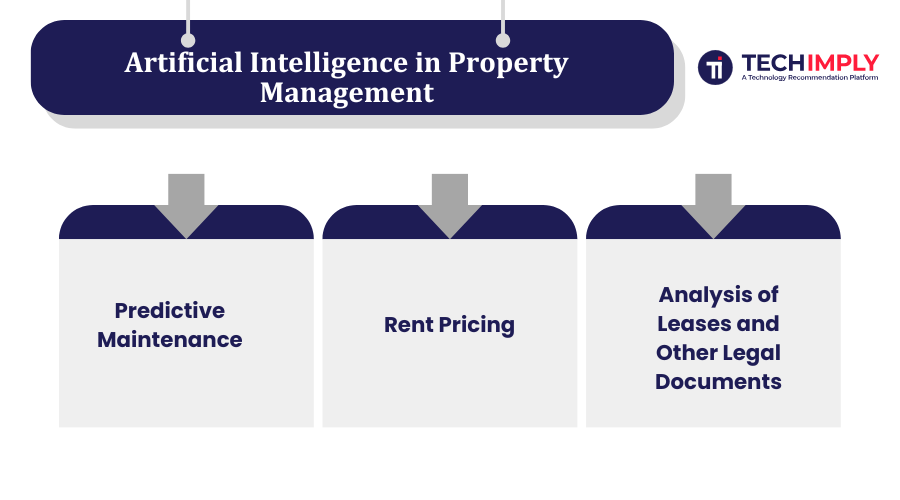
The success of a commercial real estate investment often hinges on the efficiency with which the acquired property is managed. Artificial intelligence is playing an increasingly important role in this area. Currently, AI finds use in a wide variety of diverse fields that fall under the umbrella of real estate management:
-
Predictive Maintenance: AI can analyze data from sensors in different building systems. This information can be used to carry out repairs before a breakdown occurs.
-
Rent Pricing: AI can review vast datasets related to market information, occupancy rates, and tenant behavior to generate a pricing recommendation that maximizes rentals.
-
Analysis of Leases and Other Legal Documents: The use of AI can significantly reduce errors and speed up the process of lease audits and compliance reviews.
With the rapid advances in AI, you can be sure that real estate investment firms will think of plenty of new ways to use AI to transform the manner in which commercial properties are managed.
Geospatial Analytics
Geospatial analytics–the analysis of data linked to specific geographic locations–can offer real estate investors crucial information about the investment potential of a property. Specifically, geospatial data provides details that can address many of the following areas:
-
What is the population density in the area? What are the income levels and age distribution?
-
What is the proximity to schools, hospitals, and shopping centers?
-
Is the area exposed to environmental risks? Is it in a wildfire-risk area or an earthquake-prone zone?
-
What are the zoning regulations that apply?
Combining spatial data with other relevant information can provide deep insights into the suitability of a property for investment. CBRE and a host of other real estate investment firms use geospatial technology to appraise properties and arrive at valuations that consider location-specific factors.
Technological advances have made geospatial analytics more widely available, and this technology will grow more sophisticated in the coming years.
PropTech as a Strategic Advantage, Not Just a Trend
There is another crucial effect that technology has had on how property investment firms operate. Many of these firms are deploying additional resources to fund PropTechs.
Why are they investing in the PropTech sector?
Startups in the real estate space have several advantages over the incumbents. For one, they do not carry any preconceived notions about the CRE investment process or any other aspect of the commercial property market. They approach traditional issues in a fresh manner. At times, this course of action can lead to meaningful innovation or disruption and result in the emergence of disruptive technologies. Instead of allowing new firms to steal a march on them, the incumbents are protecting themselves by funding new PropTechs themselves.
The Bottom Line
Tech breakthroughs have an outsized influence on how real estate investment firms function and deploy funds. More and more processes are being automated, making life easier for syndicators and investors. Additionally, investment firms are deploying capital in tech-related areas at an increasing rate. In the coming years, we will likely see an acceleration of this trend.