
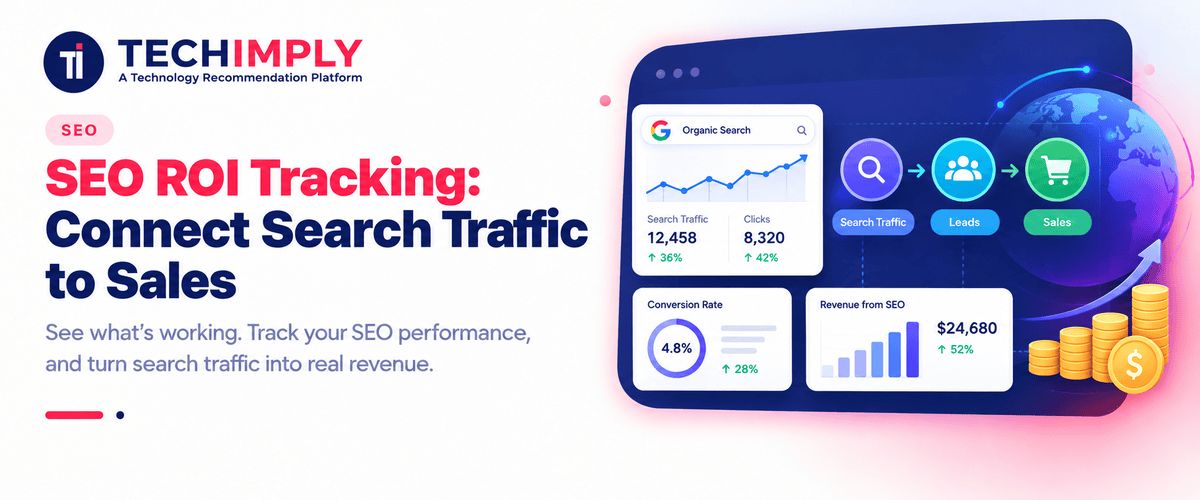
Your website traffic increased by 40% this quarter, and your SEO dashboard shows hundreds of new keyword rankings. That sounds like excellent progress. But when the sales manager asks how many paying customers came from those visitors, nobody has a clear answer. This is one of the biggest problems in digital marketing: businesses measure search visibility without connecting it to actual revenue.
SEO performance tracking requires more than monitoring website visits and Google rankings. Businesses need reliable analytics, customer relationship management (CRM) software, and consistent lead qualification to understand whether their investment produces profitable results.
Why Search Rankings Do Not Tell the Complete Story
Google Search Console provides data about impressions, clicks, click-through rates, and average search positions. According to Google's official documentation, an impression generally occurs when a website link appears in qualifying search results, while a click records user interaction with that link.
Neither metric establishes that someone became a paying customer. A business might generate thousands of visits from informational searches while attracting very few buyers.
For example, a software company ranking for general industry definitions might receive more traffic than a competitor targeting specific purchasing questions. However, the competitor's smaller audience might generate considerably more qualified inquiries.
Connect SEO Performance With CRM Data
The first step toward accurate SEO attribution is connecting website inquiries with sales records. Businesses need to identify which pages generate leads and whether those inquiries eventually become customers.
Digital marketing agencies such as Hennessey Digital combine search optimization, conversion rate optimization, paid advertising, and analytics to connect marketing activity with measurable business outcomes. This approach becomes particularly valuable in competitive industries where generating qualified customers matters more than attracting general website traffic.
A CRM should record the original lead source, inquiry date, qualification status, and eventual sales outcome. Without those details, marketing teams cannot reliably connect search performance with business growth.
Measure Qualified Leads Instead of Every Inquiry
Not every website visitor who completes a contact form represents a genuine sales opportunity. Some inquiries involve irrelevant services, unrealistic budgets, or customers outside the company's target market.
Consider a hypothetical B2B software provider receiving 120 organic search inquiries in one month. After reviewing business requirements, the sales team identifies only 24 qualified opportunities.
The actual lead qualification rate is 20%, even though the marketing dashboard initially reports 120 conversions.
TechImply's guide to building a sales pipeline explains why defining qualification criteria matters. Clear sales stages help teams distinguish interested visitors from prospects who possess the budget and authority to purchase.
Calculate SEO ROI Using Real Financial Numbers
SEO return on investment measures the financial benefit generated relative to the total cost of the campaign. The calculation becomes more meaningful when businesses use gross profit rather than counting every dollar of revenue as a financial gain.
Suppose a company spends $6,000 on SEO during a quarter and acquires six customers through attributable organic leads. Each customer generates $2,500 in gross profit, producing $15,000 in total attributable profit.
SEO ROI = ($15,000 - $6,000) ÷ $6,000 × 100 = 150%.
This hypothetical calculation assumes those customers are correctly attributed to the campaign. Expenses must also include content production, technical improvements, software subscriptions, and internal labor where applicable.
TechImply's CRM ROI calculation guide demonstrates why including implementation costs and realistic financial assumptions produces more dependable results.
Track Conversion Events Across the Customer Journey
Google Analytics 4 allows businesses to designate important user actions as key events. According to Google Analytics documentation, these events help organizations measure activities such as completed forms, purchases, and other valuable interactions.
However, a submitted form is not equivalent to a completed sale. Marketing teams need to connect website events with subsequent CRM outcomes rather than treating every conversion as revenue.
Call tracking, form integrations, and consistent campaign attribution help establish which interactions generate genuine opportunities. Duplicate leads and returning customers require additional attention to prevent inflated reporting.
AI Search Creates New Attribution Challenges
Google AI Overviews and conversational search platforms increasingly influence how customers discover businesses. A user might encounter a company through an AI-generated recommendation and later visit its website directly.
That journey creates attribution challenges because traditional analytics do not necessarily identify the original recommendation.
AI search visibility and attributable website traffic are different measurements. Businesses benefit from monitoring referral patterns, branded searches, and information collected during customer intake without assuming every increase originated from AI.
Review SEO Performance Every Month
A useful monthly report connects organic visibility, qualified inquiries, sales opportunities, acquired customers, and associated profit. Marketing teams also need to compare performance against previous periods and investigate changes in lead quality.
When traffic increases but qualified leads decline, search intent deserves attention. When qualified leads increase but sales remain unchanged, the problem might involve pricing, follow-up procedures, or the sales process.
The strongest SEO reporting system explains which marketing activities generate profitable customers, not simply which keywords gained positions. Businesses that connect analytics with verified sales records make better decisions about where to invest their next marketing dollar.