


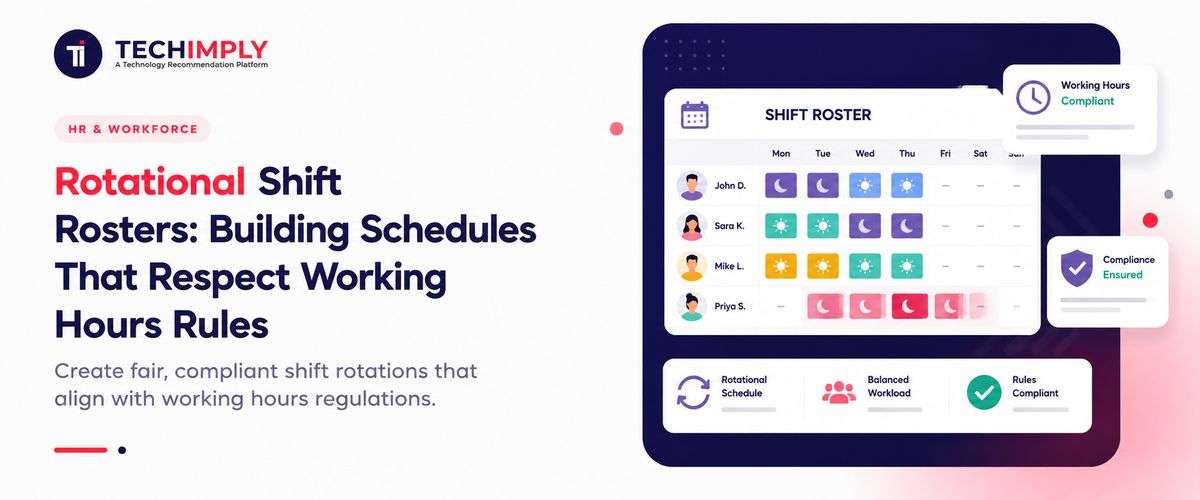
Operating a factory or office round-the-clock in India entails meticulous operational arrangements. Be it Information Technology Enabled Services, manufacturing logistics, healthcare, or aviation, it is practically impossible to shut down these fast-paced operations overnight. Enterprises have to keep an uninterrupted workflow manage to satisfy their overseas customers as well as keep pace with the fierce market competition. To distribute these long, irregular working hours among staff, business heads depend heavily on a rotational shift roster. However, managing a continuous operation is never easy.

Looking for Employee Scheduling Software?
Check out Techimply's List of the Best Employee Scheduling Software in India for your business.
To handle these core challenges, modern Indian enterprises are completely changing how they track and support their workforce. Instead of pushing employees into fixed, exhausting schedules, companies are adopting systems that properly monitor performance during tough night shifts. Integrating an enterprise Employee Reward Software into the operational framework has become highly effective.
What Is a Rotational Shift Roster?
A rotational shift roster is a dynamic workforce schedule where employees cycle through a series of different shifts over a set period. Instead of an individual staying permanently on one specific daily timeline, they move through a predefined loop of varying hours. This arrangement ensures that a company can keep its business running continuously without forcing the same small group of workers to handle permanently irregular or unsociable hours.
1. Rotational vs fixed shifts
The choice between fixed and rotational frameworks deeply impacts long-term employee retention and daily operational flexibility. Fixed shifts mean an employee works the same hours every single day, just like a standard 9-to-6 office desk job. While this provides excellent predictability for an individual’s personal life, it limits a company's ability to handle sudden workload shifts.
2. Examples of morning, evening, and night rotations
A standard twenty-four-hour continuous operation in India usually splits the entire day into three consecutive eight-hour blocks. The morning shift typically runs from six in the morning to two in the afternoon, which operations managers generally label as Shift A. The evening shift takes over right after, running from two in the afternoon until ten at night, commonly called Shift B or the afternoon slot. The night shift operates from ten at night to six the following morning, which is referred to as Shift C or the overnight graveyard shift. In a routine rotational setup, a staff member will handle the morning shift for one full week, move to the evening shift the next week, and take on the night shift during the third week before the entire cycle resets.
Working Hours Rules HR Must Check Before Creating a Roster
Indian human resource professionals and plant managers must design every single rotational shift roster around strict legal boundaries. Failing to follow these regulations results in harsh statutory penalties, sudden union disputes, and serious employee health issues.
1. Daily working hours
Under the central guidelines of the new code and existing labor regulations, the standard daily working limit for an adult employee is capped strictly at eight hours per day. This number refers only to active working time and completely excludes required lunch or tea breaks. Roster planners must also calculate the total spread-over.
2. Weekly working-hour limits
The legal limit for standard adult labor is strictly forty-eight hours per week. Any scheduling configuration within a rotational shift roster that pushes an individual's active working hours past this forty-eight-hour ceiling is completely non-compliant without formal overtime tracking.
3. Mandatory breaks
Continuous, unbroken labor without a proper rest period is illegal across all Indian states. Employers must design shift schedules to include a mandatory rest interval of at least thirty minutes after a maximum of five hours of continuous active work. Operations leads must build these break windows clearly into the daily roster to maintain absolute compliance on the floor.
4. Weekly rest/off
Every single employee is legally entitled to a minimum of one full rest day each week, which must be a continuous twenty-four-hour break from all duties. While this rest day is traditionally scheduled on Sundays, businesses running a continuous rotational shift roster can substitute it for any other day of the week. This substitution must be communicated to the employee well in advance and must align with local labor department guidelines.
5. Overtime
Any operational hours clocked past the standard eight-hour daily limit or the forty-eight-hour weekly limit are classified as overtime. Statutory rules state that overtime cannot be compensated at standard wage rates; it must be paid at exactly twice the ordinary rate of wages. To protect workforce planning from systemic exhaustion, central rules cap total overtime at one hundred and forty-four hours per quarter.
6. State-specific rules
Labor being part of the Concurrent List under Article 246 of the Indian Constitution, each State Government can alter some provisions of that legislation with its own state law. A case in point is states like Maharashtra, Karnataka, Tamil Nadu, and Haryana, which have strict requirements for female workers doing night shifts. The conditions include providing safe transport arranged by the companies with proper route mapping, female security staff in night cabs, and surveillance via CCTV at premises.
Common Rotational Shift Patterns
2-shift rotation
Two-shift working patterns are very common in many industries, mostly domestic logistics, retail warehouses, and banking back offices, where continuous operations are not required but at the same time daily operating hours need to be longer than normal. Such arrangements usually have one group of staff working during the morning, followed by the other group taking over in the evening.
3-shift rotation
This pattern provides full twenty-four-hour operational coverage by using three separate teams working across consecutive eight-hour blocks. It is the standard setup within Indian IT service desks, continuous manufacturing lines, and major hospitals.
4-team rotation
Often called a continuous four-shift or four-brigade system, this layout utilizes four separate teams to manage a twenty-four-hour cycle across a seven-day week. While three teams handle the active morning, evening, and night shifts on any given day, the fourth team is on a scheduled rest day or compensatory leave.
Weekly rotation
In a weekly rotation framework, an employee remains assigned to one specific shift block for six consecutive working days, takes their scheduled weekly off, and then transitions to a different shift block the next week.
Monthly rotation
A monthly rotation extends the stability of a single shift pattern over an entire calendar month. While this gives employees excellent predictability for managing their family lives, it has a major drawback.
How to Build a Compliant Rotational Shift Roster
Creating a compliant and productive schedule that meets the needs of a business takes a thoughtful process that matches daily operational needs with labor regulations. For companies that want to fine-tune their Shift Scheduling, it is a good idea to maintain a well-defined process to keep operations stable and audit-compliant.
Identify required coverage
First, you will have to figure out exactly how many people are required at each minute to perform what jobs. Reviewing workload data of past periods allows companies to avoid hiring extra workers in off hours as well as not get caught by surprise without enough workers during peak hours, resulting in significant savings of labor costs.
Define shift timings
The second step involves establishing fixed start and end times for each shift block. Managers must ensure these times align with local transport availability and leave management realistic windows for handovers between teams, so incoming and outgoing workers are not forced into working unpaid minutes.
Calculate employee working hours.
In the third step, the system tracks individual work hours of each worker to make sure no employee exceeds the eight-hour per day or forty-eight hours per week limitations. Sophisticated scheduling software not only helps to record all the information but also stops people from entering details that are in violation of employment laws.
Schedule weekly offs
The fourth step requires embedding a continuous twenty-four-hour rest period for every employee after a maximum of six consecutive days of work. This calculation must track individual timelines meticulously across changing rotation cycles to make sure no employee is accidentally scheduled for ten or twelve days straight without a break.
Add required rest/break periods.
The fifth step is to schedule the required 30-minute rest within every eight-hour work period. These rest breaks should be rotated across the team so as not to interrupt the smooth running of the facility, and at the same time employees get their lawfully entitled rest time.
Check overtime
The sixth step focuses on auditing the roster draft to catch any instances where an individual's scheduled hours exceed standard limits. Any planned overtime must be logged transparently, approved by operations heads, and sent to payroll to ensure the double-wage multiplier is applied accurately.
Review night-shift requirements
The seventh step requires verifying that all overnight shift assignments meet state-specific legal protections. This means checking that transport logs, emergency helpdesks, and security guard allocations are active and fully operational, especially for female employees working between 22:00 and 06:00.
Publish and communicate the roster.
The last step is to deliver the complete timetable to the workforce far in advance, at least seven to fourteen days before the commencement of the new cycle. A good Shift scheduling system ensures that you give your employees notice of their shift at least a couple of days or so beforehand, so that they may take care of things like their personal transport, family, and other household matters, etc. Such foresight by the employee usually prevents last-minute absences from work.
How to Prevent Back-to-Back and Excessive Shifts
Avoiding unsafe shift changes
Poor planning often leads to dangerous scheduling errors like "clopening," where an employee works a late evening shift and is then scheduled for an early morning shift the very next day. This extreme lack of rest creates a massive safety hazard, especially in factories.
Minimum rest between shifts
To protect worker health and minimize workplace accidents, companies should enforce a mandatory rest buffer of at least eleven to twelve consecutive hours between the end of one shift and the start of the next.
Managing night-to-day rotation
Moving a worker directly from a night shift straight to a day shift without a substantial recovery window completely scrambles their circadian rhythm and tanks productivity. A safe, well-designed rotational shift roster always utilizes a forward rotation pattern moving workers from morning to evening, and then to night, and provides an extended forty-eight-hour rest window when transitioning employees off night duty.
Handling emergency replacements
When an employee calls at the last minute to say he's not coming in, the supervisor is often left in a spot where he feels that he has to call up the worker from the previous shift and extend his hours. The right way to go is not to put pressure on the existing staff but rather to create, through the Employee Scheduling Software, a pre-arranged, dedicated list, which one can call on an emergency.
Example of a Rotational Shift Roster
Sample 3-shift schedule
We can look at what comes next, an example, and describe how it would work in practice for a business continuously open twenty-four hours a day. The organization's total staff is divided into four even teams that work on rotation: Team A, Team B, Team C, Team D.
Employee-wise weekly example
Using Team A as our example to explain the movement of workers in a normal week, all of Team A's members start their working day at the same time every week from Monday to Saturday during the morning shift. The evening shift is covered by their coworkers - Team B, and Team C is assigned nighttime work.
Show how total hours are calculated.
To verify that this arrangement satisfies central regulations, managers calculate the cumulative hours for each team member. An employee in Team A works six consecutive days from Monday to Saturday, with each shift lasting exactly eight gross hours. Multiplying six days by eight hours results in exactly forty-eight weekly hours.
Common Shift Roster Mistakes
Exceeding weekly hours
Organizations often break the 48-hour work week rule during busy periods or big festive sales seasons. Without an effective time tracking system, such small errors in planning add up rapidly and put a company at high risk of heavy legal fines and also increase workers leaving the company just because they are too tired.
Forgetting weekly offs
In a dynamic, high-production environment, supervisors may forget to schedule a complete 24-hour rest period for temporary, casual, or contract workers. Such an omission breaches the most fundamental Indian labor regulation statutes and will likely provoke a union's written complaint, employees' public demonstration, or official sanctions.
Poor night-shift rotation
If you keep an employee on the night shift for too many consecutive weeks, it will not only permanently harm their health but also affect their long-term performance. Best practices today recommend that you do not let an employee work consecutive night shifts for more than five to seven days. After that, you have to give them a mandatory rest day and get them to go back on a daytime schedule.
Unplanned overtime
Relying on ad-hoc, unrecorded overtime to meet sudden production targets inflates an organization's operational costs and masks deeper staffing shortages. It also creates massive financial unpredictability for the finance department, given that overtime must legally be paid at double the regular wage rate.
Last-minute shift changes
This kind of change in the work schedule that is less than twenty-four hours' notice totally ruins an employee's personal commitments, childcare arrangements, and regular commutes. This kind of unpredictability in work completely demotivates employees, causes a very high rate of unexcused absenteeism, and eventually results in a high turnover rate among employees who work in operations teams.
Managing everything in disconnected spreadsheets
According to the traditional, isolated method of using paper or digital records to manage the work schedule of the company is just asking for a lot of problems. Problems like incorrect versions of documents, incorrect spreadsheets, and completely missing out on timely legal validation make it almost impossible to pick up on the legal compliance risks or to handle any changes to the personnel needs in big multi-location teams.
Conclusion
Designing and maintaining an efficient, legally airtight rotational shift roster requires a careful balance between meeting business targets, enforcing strict compliance, and protecting human well-being. In India’s highly competitive business environment, relying on manual systems and outdated spreadsheets exposes a company to heavy compliance risks, inflates operational leakages, and drives up costly employee burnout.



.png "Ways to Manage Accounting for your Startup in 2022")


