Payroll trends in today's fast-paced business environment encompass automation, compliance, international integration, employee wellness, and advanced payroll technology trends alongside timely wage payments. The global payroll trends are impacting how companies compensate their staff as well as how they retain staff, stay compliant, and boost productivity as we enter 2025.

Looking for Payroll Software?
Check out Techimply's List of the Best Free Payroll Software for your business.
The payroll industry is in the midst of a drastic change, from AI-based systems to pay models that are flexible.
Top Payroll Trends to Watch in 2025
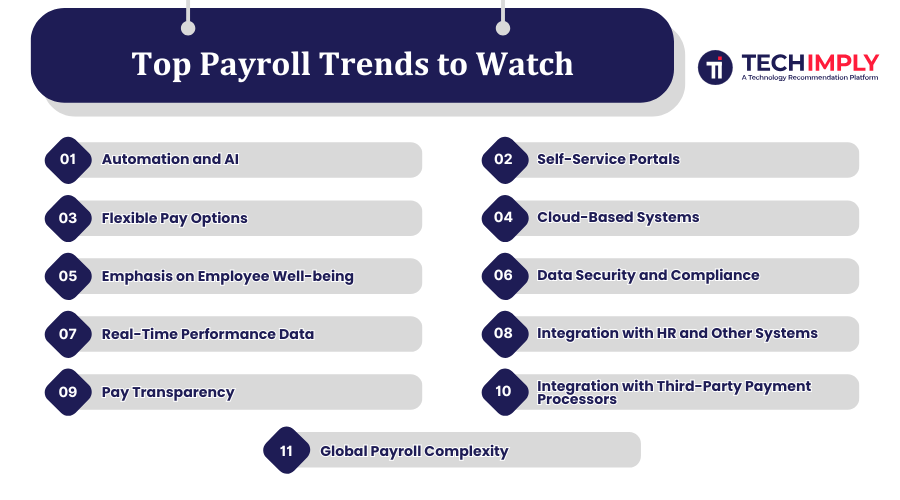
The trends payroll is the most important for 2025, examines how they're changing the payroll landscape, and explains why contemporary businesses must stay ahead of the curve.
1. Automation and AI
Payroll automation is now a need rather than a luxury. Payroll systems with AI capabilities can now process data, identify irregularities, and manage compliance checks without the need for human intervention.
Benefits
-
Repetitive tasks are eliminated by automated payroll.
-
AI systems are able to identify and fix discrepancies instantly.
-
Everybody is using data to forecast payroll trends.
AI payroll tools will enable organizations to forecast cash flow requirements, investigate overtime trends, and anticipate potential compliance issues before they arise.
2. Self-Service Portals
Employees now expect access to their payroll data at any time. Employees can see paystubs, modify personal details, and track tax withholdings without HR support due to self-service payroll platforms.
Benefits
-
Lessens the workload for HR.
-
Increases openness.
-
Raises worker satisfaction.
3. Flexible Pay Options
The concept of hr payroll trends is changing. Employees, especially gig workers, demand flexible pay structures such as weekly or on-demand pay. In Payroll trends 2025 directly solves that challenge. This focused approach ensures smoother adoption, measurable ROI, and better employee trust.
Benefits
-
Promote financial stability.
-
Appeals to tech-savvy, younger employees.
-
It aids in keeping freelance talent and gigs
4. Cloud-Based Systems
The core of payroll transformation is now cloud payroll technology. It streamlines global payroll management, easing program updates, as well as enabling remote capabilities. One platform minimizes vendors and manual effort.
Benefits
-
Scalable for companies growing globally.
-
Integration with other HR systems is simple.
-
Improved data recovery and backup.
5. Emphasis on Employee Well-being
Payroll and employee satisfaction are closely related. Payment errors or delays can seriously erode trust. As part of their well-being strategies, companies are concentrating on accurate, timely, and transparent payroll in 2025.
Benefits
-
Builds trust and loyalty
-
Reduces financial stress
-
Boosts engagement and productivity
6. Data Security and Compliance
Payroll systems must safeguard sensitive employee information with the rise of cyberattacks and stricter regulations. In today's time, compliance with global payroll trends legislation like the CCPA and GDPR is of prime concern.
Benefits
-
Multi-factor verification.
-
Payroll data storage that is encrypted.
-
Constant observation for questionable activity.
7. Real-Time Performance Data
Payroll and performance measurements are more and more combined. Companies can link compensation with productivity, project milestones, and corporate KPIs by utilizing real-time measurement.
Benefits
-
Propels pay models that are based on performance.
-
Enhances workforce planning.
-
Promotes equitable and open remuneration.
8. Integration with HR and Other Systems
These days, the top payroll systems don't work alone. They offer a single source of truth since they are connected with time-tracking devices, benefits management platforms, and HR software. Employee details entered once are reflected across all systems.
Benefits
-
Eliminates duplicate data entry
-
Saves time for HR teams
-
Provides a full employee view
9. Pay Transparency
Workers prefer to understand the formula behind their pay. Pay transparency makes it equitable and fosters trust, particularly for multicultural, global staffs. Employers can give employees varying payment choices, thereby increasing convenience and satisfaction.
Benefits
-
Encourages equality.
-
Minimizes pay disputes.
-
Conforms to worldwide compliance trends.
10. Integration with Third-Party Payment Processors
Payroll solutions are now becoming more integrated with payment processors so as to simplify crossborder payments. This is particularly important for companies that have global, remote staff. Cloud technology allows payroll processes to be worked on remotely by global teams with access to data in real time.
Benefits
-
Faster global payments
-
Lower transaction costs
-
Enhances financial flexibility.
11. Global Payroll Complexity
As a result of varying regulations, currencies, and tax regulations, payroll management across multiple countries is more complicated as companies expand worldwide. In 2025, centralized systems that handle payroll for multiple countries using a single system will be the primary focus of global payroll trends.
Benefits
-
Centralized compliance management
-
Consistent employee experience worldwide
-
Better reporting and insights.

Pro-tip
Make your employees part of the decision-making process before committing to a new payroll system. Ask your employees what they want most in a payroll system, if it's self-service portals, flexible pay, mobile capabilities, or something else.
How These Trends Are Defining the Future of Payroll
The latest trends in payroll management is becoming a strategic business driver rather than a back-office necessity. Trending payroll teams are operating more effectively due to automation, cloud computing, and integration, and employees and companies are safeguarded by security and compliance steps.
Payroll in 2025 will be:
-
Proactive instead of reactive-anticipating issues ahead of time.
-
Global-first-able to manage operations in multiple countries with ease.
-
Employee-centric-centered on openness, adaptability, and welfare
The Evolution of Payroll: From Traditional to Technology
Payroll has evolved far from dusty books, calculators, and perpetually stacked paper forms. The payroll outsourcing market size is expected to grow by $6.15 billion by 2025. One typo could disrupt the whole process, resulting in late payments, angry employees, and overtime to correct errors.
At the time, payroll was viewed solely as an administrative function something that needed to be done in order to keep the lights on and keep workers paid. There was little opportunity for strategy or innovation just a never-ending loop of data entry and compliance checks.
-
The Turning Point
The advent of computers during the late 20th century began to make a difference in predicting the payroll trend. Payroll software in the early days made the calculation easier and minimized mistakes, though much of the data still had to be manually inputted. Subsequently, the advent of the internet and cloud computing game-changers that ushered in remote access, quicker updates, and connectivity with other business systems also became the norm.
Suddenly, payroll staff were able to process wages without being fixed to one office machine. Rules for compliance could be revised in real-time. And reports that used to take hours to prepare now took but seconds.
-
The Rise of Intelligent Payroll
Payroll is longer merely paying people. It has become a strategic function that leverages automation, AI, and data analytics. Contemporary payroll solutions are tied in with HR and finance, perhaps even performance management, to form an ecosystem in which much more than mere pays calculation becomes possible.
With automation eliminating the time consumed on recurring tasks, payroll professionals may devote their energy to problem-solving and compliance strategy.
Artificial Intelligence also predicts payroll trends, detects anomalies, and aids in law compliance in various nations.
Do You Know?
- 40% of employees stated that payroll mistakes negatively impacted their trust in their employer.
- The global payroll services market, as a direct relationship with there being a Monday and a paycheck, is expected to reach $8.3 billion in the next 10 years, showing how important it is to manage the complexity of paying overseas employees and contractors today.
- As many as 51% of small businesses still use spreadsheets for payroll even though payroll automation is widely available.
From Back Office to Strategic Partner
Payroll now has a direct impact on employee satisfaction and retention in this new world. On-time, open, and flexible payment modes have become part of the employee culture. An effective payroll system can be a source of competitive advantage-aiding organizations to attract top talent and continue to have their workforce's trust.
Payroll's transformation echoes a larger shift in the workplace: technology is not diminishing human numbers but enabling people to work smarter. Payroll groups now are strategic business partners, not behind-the-scenes number crunchers.
Conclusion
Payroll in 2025 will be a rapid-paced, technology-driven, and employee-focused arena. Businesses will enhance their employer reputation and streamlined systems through the use of payroll trends like automation, cloud technology, on-demand pay, and globalism. Through the adoption and utilization of these payroll industry trends, businesses can make themselves more competitive, more attractive to potential top talent during the recruitment process, and establish a payroll process that enables growth and compliance while delighting employees.