It's wonderful to receive your salary, but the gross amount isn't what ends up in your bank account. What remains in your pocket after different deductions tells the true tale. The precise moment at which those deductions take place plays a significant role in deciding that ultimate figure. Your total take-home payroll and tax obligation are greatly impacted by whether money is disbursed before or after taxes are computed. While payroll deductions immediately cut your net compensation, pre-tax deductions might lessen your taxable income. You may better manage your funds by being aware of this distinction.
What Are Payroll Deductions?
How often do you find yourself looking at your paycheck and wondering why the amount that you really take home is lower than the amount that you earned? It all boils down to pay deductions, which is the difference. Another way of putting this is that these are specific amounts of money that are deducted from your total salary, which is what is known as your gross pay. After deducting these amounts, you are left with your net pay, which is the actual amount of money that is deposited into your bank account on the day of your paycheck. To begin making sense of where your money, which you have worked so hard to get, goes before you even see it, the first step is to have an awareness of these reductions from the beginning.
To have a better understanding of how this operates, it is helpful to see what the pretax meaning is. When money is taken out of your paycheck "pretax," it implies that those monies are withheld before the government calculates the taxes that you owe. This really results in a reduction of your overall taxable income. On the other hand, everyone is still required to provide their fair share of contributions through a forced deduction from their payroll tax. The payments that are automatically withdrawn for federal and state income taxes, as well as contributions to critical public programs such as Medicare and Social Security, are included in this category.
In addition to the taxes that are required to be paid, your paystub will most likely include a long list of deductions that are either optional or connected to the perks that you receive as an employee. The premiums for your health insurance, the payments you make to your retirement savings account, and even the charity donations you choose to make are examples of these expenditures. Keeping a careful check on this data will help you understand exactly what you are supporting, despite the fact that it may be irritating to watch your gross income decrease. The practice of keeping track of these numbers on a regular basis is a prudent step for your overall financial well-being. This will ensure that your money is actively working for your health and future in the manner that you had planned.
How do Payroll Deductions Work?
Payroll deductions are payments that are taken from the gross salary of an employee in order to satisfy various responsibilities, such as taxes, benefits, and many others. The pretax and posttax deductions are the two categories that these deductions come under. For example, payments to retirement plans or health insurance premiums are examples of pretax deductions. These deductions are taken out before taxes are calculated, which results in a reduction in taxable income.
Deductions that take place after taxes have been deducted include things like garnishments and payments to charity organizations. With a better understanding of the list of deductions that appear on a paycheck, employees are better able to evaluate how their earnings are distributed.
Payroll tax deductions are among the most important deductions. These deductions help cover Social Security, Medicare, and federal and state income taxes. There is also the possibility of deductions being made by employers for various programs, including retirement plans, incentives, and other initiatives. Having a clear understanding of the distinction between pretax and posttax deductions is essential if you wish to know the impact that these two types of deductions have on the amount of money that you take home.
What Are the Types of Payroll Deductions?
Before an employee receives their net pay, certain sums are deducted from their gross wage. These deductions are known as payroll deductions. In general, they may be divided into two primary categories: statutory deductions, which are required, and voluntary deductions.
-
Statutory Deductions
The government mandates that companies remove certain sums from their employees' paychecks. These statutory deductions include income tax, social security, unemployment tax, and provident fund payments. Statutory deductions are called required deductions.
-
Voluntary deductions
A written authorization from the employee is required for any voluntary deductions, which are monies that an employee decides to have removed from their pay. These deductions are typically made for personal arrangements or advantages. Premiums for comprehensive health, dental, or vision insurance. Contributions to retirement plans (such as 401(k)s and EPF voluntary top-ups) will be considered.
-
There is a federal and state income tax
In addition to payments to Social Security and Medicare, India's Employee Provident Fund, often known as EPF, is a mandatory deduction that must be taken out of the paychecks of all employees who are eligible for such benefits. Secondary keywords that are related to this topic include payroll tax deduction, pay deductions, and a list of deductions.
-
Using payroll to make charitable contributions
Due to the union, there are two types of deductions: pre-tax deductions, which lower taxable income, such as health insurance, and post-tax deductions, which are received after taxes, such as certain gifts or contributions in a Roth-style.
What Is the Difference Between Pre-Tax and Post-Tax Payroll Deductions?
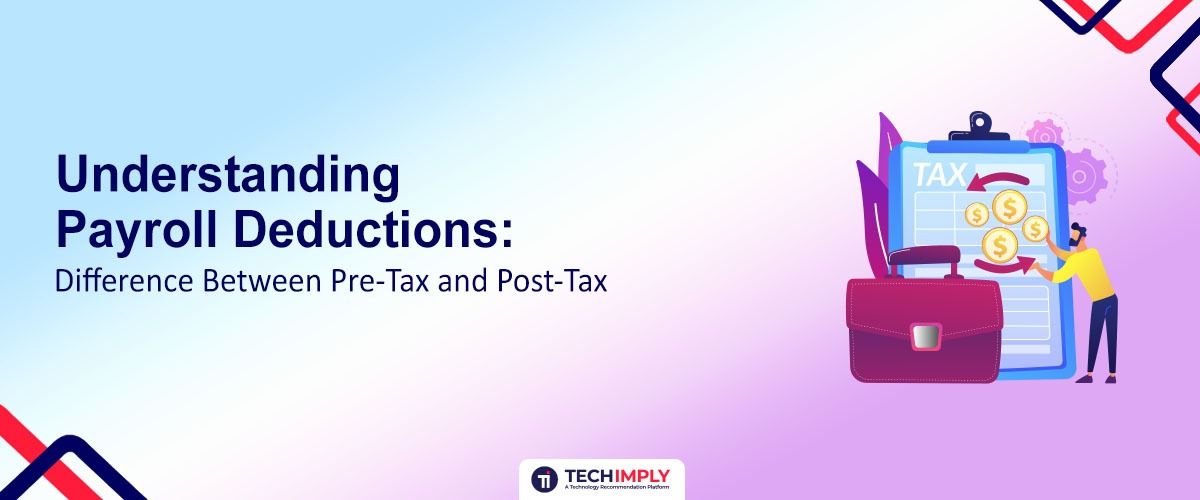
Your current tax bill will be lower as a result of pre-tax deductions since they reduce the amount of income that is subject to taxation before taxes are computed. Post-tax deductions, on the other hand, are deducted from your pay after taxes have already been deducted. As a result, they do not have any effect on the total amount of taxes that are owed.
-
Pre-tax Illustrations
The first thing that is deducted from the gross salary is these.
Among the most common ones are donations to recognized retirement schemes such as the Employees Provident Fund (EPF) or the National Pension System (NPS) (up to specific restrictions), qualified health insurance premiums, and some investments that save money on taxes according to Indian regulations.
-
Example of Post-Tax Work
After taxes, these are applicable.
Loan repayments, voluntary provident fund (VPF) contributions that exceed the statutory restrictions, charity gifts, and wage garnishments are all covered by these policies.
-
Discretionary Tax Deductions
Generally calculated based on gross salary, mandatory by law, such as income tax, professional tax, EPF (12% of basic), ESI, or labor welfare fund; sometimes known as employee social insurance.
Pre-Tax vs Post-Tax Payroll Deductions (Comparison Table)
|
Feature |
Pre-Tax Deduction |
Post-Tax Deduction |
|
Timing |
Deducted before income taxes (federal, state) and often FICA taxes are calculated |
Deducted after all taxes are withheld from gross pay |
|
Taxable Income Impact |
Reduces taxable wages, lowering current tax liability (e.g., 401(k), HSA, health premiums) |
No reduction in taxable income; taxes apply to the full gross pay first |
|
Common Examples |
401(k)/HSA/FSA contributions, health insurance, commuter benefits |
Roth 401(k), garnishments, union dues, and excess life insurance |
|
FICA Taxes (SS/Medicare) |
Often reduces employer/employee FICA liability (Section 125 plans) |
No effect on FICA; full amount subject to FICA |
|
W-2 Reporting |
Often reduces employer/employee FICA liability (Section 125 plans) |
Included in gross wages; deducted from net pay only |
|
Employee Benefit |
Immediate tax savings; higher net pay for the same deduction amount |
Future tax advantages possible (e.g., Roth tax-free withdrawals) |
List of Common Payroll Deductions
On the Indian payroll, deductions may be broken down into two categories: mandatory deductions and voluntary deductions. contributions to the Employees' Provident Fund (EPF), contributions to Employee State Insurance (ESI), contributions to professional tax, and contributions to income tax (TDS) are all examples of statutory deductions that are required to be taken.
To guarantee that social security and tax requirements are met, these deductions are mandated by Indian labor laws and ensure compliance with those duties. Contributions to the Employees' Provident Fund (EPF) allow workers to prepare for their retirement, while the Tax Deductions (TDS) system guarantees that income tax is paid on time.
On the other hand, voluntary deductions are not considered mandatory and are determined by the choices of the employee. Some examples of this are payments to voluntary provident funds (VPF), premiums for health or life insurance, monthly installments on loans, and donations to charity organizations.
Employees need to have a thorough understanding of the list of deductions that appear on their wage slips in order to efficiently manage their budgets and keep track of their financial obligations. The management of employee benefits and the guaranteeing of financial security are both significantly impacted by the presence of both mandatory and voluntary deductions.
Conclusion
It is essential to have a strong grasp of the difference between pre-tax and post-tax payroll deductions in order to be able to effectively prepare for one's investments and finances. You can reduce the amount of income that is subject to taxation and save a significant amount of money on taxes by taking pre-tax deductions, which include payments to retirement programs and health insurance. After-tax deductions, such as loan EMIs and gifts that are not exempt from taxation, have a direct influence on take-home pay without lowering the amount of tax due. Our company, Techimply, offers software solutions that simplify the process of managing payroll, guaranteeing that deductions are exact and that we are in accordance with the requirements of the law. Facilitate the simplification of payroll procedures and the enhancement of employee happiness through transparent wage administration by utilizing our solutions to empower your organization.