Payment gateway fees in India are the charges a business pays to accept and process online payments. The headline rate may look simple, but the final cost can include a percentage platform fee, 18% GST on that fee, international-card charges, currency conversion, chargebacks, instant settlement, and optional services. Comparing only one percentage can therefore lead to the wrong choice. A gateway with a low promotional rate may become more expensive when the offer ends. Another may cost slightly more but deliver better payment success, faster reconciliation, or stronger support for UPI, RuPay, net banking, and Indian wallets.

Looking for Payment Gateway Software?
Check out Techimply's List of the Best Payment Gateway Software in India for your business.
Businesses comparing payment gateway software should therefore look at the complete payment experience rather than focusing only on the advertised transaction percentage. This guide explains payment gateway fees in India and compares public pricing from Razorpay, PayU, Cashfree, Stripe India and PayPal India. It also covers UPI, MDR, GST, promotional rates and a simple method for estimating real payment costs. Pricing note: The rates below were checked on August 25, 2026. They are public India rates or offers, not personalised quotes. Pricing can vary by payment mode, merchant category, volume, risk, settlement speed and account terms. Promotional rates have eligibility limits and expiry dates. Confirm the latest provider page before deciding.
What Is a Payment Gateway?
A payment gateway securely sends payment information from a customer’s checkout to the systems that authorize the transaction. It is the digital equivalent of the technology that carries card details from a physical card terminal.
When a customer pays online, the gateway encrypts or tokenizes sensitive information and passes the request through the payment network. The customer’s bank approves or declines the transaction. If approved, the payment is later settled to the merchant, minus applicable fees.
Modern payment gateway services may also provide checkout pages, UPI support, recurring payments, payment links, reporting, settlement tools and integrations with ecommerce platforms.
The terms gateway, payment processor, payment aggregator and merchant account are often used together. They describe different parts of the flow, but Indian providers commonly bundle several functions. RBI describes payment aggregators as entities that help merchants accept multiple payment instruments without building separate integrations.
This bundled approach is convenient, but it means a rate described as payment gateway fees may actually include gateway access, processing and other services in one transaction charge.
What Do Payment Gateway Fees Include?
The total cost may contain several components.
Percentage fee
The provider takes a percentage of the transaction value. At 2%, the platform fee on a ₹1,000 payment is ₹20 before GST.
Fixed transaction fee
Some international products add a fixed charge to each payment. This affects small orders more heavily. Many Indian gateways instead publish a percentage-only standard rate for domestic payments.
GST on gateway charges
Payment providers generally add 18% GST to their service or platform fee, not to the full customer payment. If the fee is ₹20, GST on that fee is ₹3.60, making the total deduction ₹23.60.
International and currency conversion fees
An international card may add a percentage surcharge. If the payment must be converted into another currency, a separate conversion charge or exchange-rate spread may apply.
UPI, cards and other payment modes
Standard bank-to-bank UPI and RuPay debit-card payments have zero MDR under Indian policy. However, a payment gateway may still charge a platform or technology fee for checkout, reporting and infrastructure. Credit card on UPI, EMI, wallets and BNPL can have different rates.
Dispute and chargeback fees
If a cardholder disputes a payment, the merchant may pay a fee. The provider may return that fee when the merchant wins, depending on its policy and the type of dispute.
Optional product fees
Invoicing, recurring billing, fraud protection, instant payouts, buy-now-pay-later services and premium checkout tools can create additional costs. These are easy to miss when comparing only payment processing fees.
For subscription-based companies, charges connected with subscription billing software may also matter because recurring payment management, retries, invoicing and subscription analytics can sometimes be priced separately from standard gateway transactions.
Payment Gateway Fees in India: Public Rate Snapshot
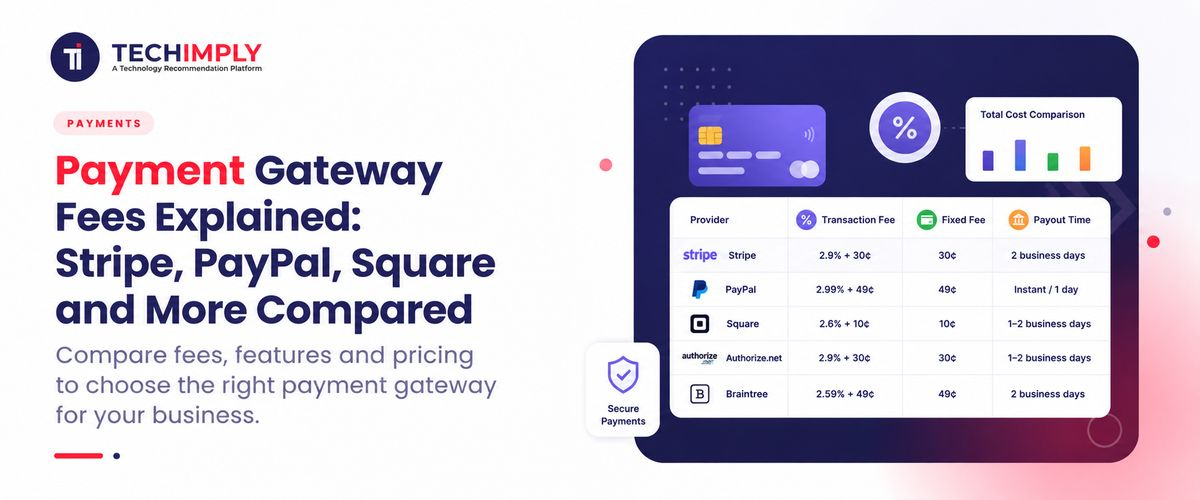
The table summarises selected public India rates and offers as of the date above. GST and special-product charges may be additional, and the table is not a complete pricing schedule.
|
Provider and payment type |
Example public rate |
Important detail |
|
Razorpay standard payment gateway |
2% + GST |
Public page covers cards, UPI, wallets and net banking; special modes can differ. |
|
PayU domestic Visa, Mastercard, net banking, BNPL and wallets |
2% + GST |
PayU lists 3% for Diners, Amex, EMI and international transactions. |
|
Cashfree standard domestic rate |
1.95% |
Cashfree advertises a limited 0% domestic offer for eligible merchants up to ₹20 lakh GMV per month through March 31, 2027. |
|
Stripe cards issued in India |
2% |
Stripe India payments remain invitation-only; cards issued outside India are listed at 3%. |
|
Stripe international sales |
4.3% |
Stripe lists an additional 2% when currency conversion is required. |
|
PayPal India international receipt |
4.40% + fixed fee |
PayPal says India users are supported only for international payments. |
The snapshot shows why there is no universal cheapest option. Razorpay fees and PayU fees are simple at the standard domestic rate. Cashfree fees currently include a time-limited promotion. Stripe India fees depend on card origin and use case, while PayPal India fees apply to cross-border collections rather than normal domestic checkout.
Stripe Fees Explained
Stripe India fees start at 2% for cards issued in India and 3% for cards issued outside India on the public pricing page. Stripe lists no setup or monthly fee for standard pay-as-you-go payments.
For goods or services sold outside India, Stripe lists a 4.3% international rate and an additional 2% when currency conversion is required. Product-specific charges can also apply for Billing, Connect, instant payouts and other services.
Stripe can suit Indian software companies and exporters that need developer tools, subscriptions or global payments. However, its India payments page says access is invitation-only. A business should confirm onboarding eligibility before planning its checkout around Stripe.
For a ₹1,000 domestic card payment at 2%, the base Stripe fee is:
2% of ₹1,000 = ₹20; adding 18% GST to the fee makes the total deduction ₹23.60.
The settlement would be approximately ₹976.40 before any other applicable charge or adjustment.
PayPal Fees Explained
PayPal India fees are designed for international collections. PayPal’s India merchant-fee page states that India users are supported only for international payments. The published rate for receiving an international commercial transaction is 4.40% plus a currency-based fixed fee.
The fixed fee depends on the currency received. PayPal lists ₹3 when the payment currency is INR and US$0.30 when it is USD. Micropayments and other products have different pricing.
For a ₹10,000 international commercial payment received in INR, the published transaction calculation is:
4.40% of ₹10,000 (₹440) + ₹3 fixed fee = ₹443, before any applicable tax, conversion spread or other charge.
PayPal’s advantage is familiarity among overseas buyers. It can be useful for Indian freelancers, agencies and exporters, but it is not a replacement for a domestic UPI-and-card gateway.
When estimating PayPal India fees, check the receiving currency, conversion treatment, withdrawal terms and export documentation requirements relevant to your business.
Razorpay Fees Explained
Razorpay fees are listed at 2% + GST per successful payment on its standard public plan. The page says this includes cards, UPI, wallets and net banking, with no standard setup, annual maintenance, refund or settlement fee. Optional products such as instant settlement can cost extra.
Razorpay explains that standard bank-to-bank UPI has zero MDR, but its 2% platform or technology fee can still apply for the gateway infrastructure. Credit cards on UPI are listed separately at 2.15% + GST. High-volume merchants may request custom pricing.
At the standard rate, a ₹1,000 payment creates a ₹20 fee plus ₹3.60 GST, for a ₹23.60 total deduction. This illustrates why zero MDR does not always mean zero total gateway cost.
PayU Fees Explained
PayU fees are listed at 2% for domestic Visa, Mastercard, net banking, BNPL and wallets. The published rate is 3% for Diners Club, American Express, EMI and international transactions, with 18% GST applicable. PayU states that there is no setup fee and merchants pay for usage.
Cashfree Fees Explained
Cashfree fees show a 1.95% standard domestic rate on the public comparison page. Cashfree is also advertising a limited 0% MDR offer on eligible domestic payment-gateway transactions up to ₹20 lakh GMV per month, valid through March 31, 2027.
Treat promotional pricing separately from long-term cost. Confirm eligibility, GST treatment, settlement rules, excluded payment modes and the rate that applies after the offer. Cashfree lists international Visa and Mastercard transactions at 2.99% standard and separate rates for other methods.
How GST Changes Payment Gateway Fees in India
GST is normally charged on the gateway’s service fee, not on the full customer payment. Consider a gateway charging 2% + 18% GST on that fee.
On a ₹1,000 payment, the gateway fee is ₹20. GST is ₹3.60, so the total deduction is ₹23.60 and the effective cost is 2.36%.
On ₹1,00,000 of eligible transactions at the same rate, the fee is ₹2,000 and GST is ₹360, producing a ₹2,360 deduction before other charges.
GST-registered businesses may be able to claim input tax credit subject to applicable law and documentation, but that is an accounting and tax matter, not a discount at settlement. Confirm the treatment with a qualified tax professional.
Other Payment Gateway Pricing Models
Razorpay, PayU, Cashfree, Stripe and PayPal publish flat or mode-based rates for many merchants. Enterprise contracts may use different models.
Interchange-plus pricing
The merchant pays the card network’s interchange cost plus a processor markup. This model is more transparent but can produce a statement with many different rates. It may be attractive for businesses with higher volume and a favorable transaction mix.
Subscription pricing
The business pays a monthly membership plus interchange and a small per-transaction charge. It can reduce markup at sufficient volume, but the monthly fee continues even during a slow period.
Tiered pricing
Transactions are placed into categories such as qualified, mid-qualified and non-qualified. The final cost can be difficult to predict because the processor determines which transactions enter each tier.
Custom enterprise pricing
Large merchants may negotiate rates based on volume, risk, payment methods and product usage. A custom quote should be compared using real transaction data, not only the lowest possible rate in a sales proposal.
Hidden Costs to Check Before Choosing a Provider
Read the full fee schedule and contract. Specifically check:
- International card and currency conversion charges
- Dispute, chargeback and retrieval fees
- Refund treatment, including whether the original processing fee is returned
- Instant settlement and cross-border payout costs
- GST, TDS treatment and the availability of proper invoices
- Platform fees on zero-MDR UPI or RuPay transactions
- Subscription, e-commerce platform, and fraud-tool charges
- Onboarding, minimum-volume, migration or annual fees
Also consider operational cost. A low transaction rate may not save money if the system requires expensive integration, creates manual reconciliation or lacks support when payments fail.
Businesses using multiple gateways or payment methods may also benefit from payment management software to monitor transactions, settlements, reconciliation and payment performance from a more organised workflow.
How to Calculate Your Real Payment Processing Fees
Use recent business data rather than one example sale. Collect monthly volume, number of payments, average order value, the mix of UPI, RuPay, other cards and net banking, international share, refunds and disputes.
Then calculate:
Percentage cost = monthly payment volume × percentage rate
Fixed cost = number of transactions × fixed fee
Plan cost = monthly software or gateway fees
Additional cost = international, conversion, dispute, payout and optional-service fees
Add these amounts and divide the total by processed volume to find the effective rate.
When comparing providers, remember that payment processing software can involve more than simply authorising a transaction. Reporting, reconciliation, fraud controls, integrations, and settlement management can also affect the overall cost of accepting payments.
For example, assume an Indian business processes ₹5,00,000 per month on a plan charging 2% + GST. The base fee is ₹10,000 and GST on that fee is ₹1,800. The settlement deduction is ₹11,800 before optional services or adjustments, producing a 2.36% effective cost.
Repeat the calculation for each provider and payment mode. Use the long-term rate as well as any promotion. This makes payment gateway fees in India easier to compare accurately.
Which Payment Gateway Should You Choose?
Choose Razorpay when you want a broad Indian payment stack and familiar developer tools. Consider PayU or Cashfree when their payment mix, settlement options, integration, and commercial terms match your business. Consider Stripe if you qualify for invite-only onboarding and need global developer infrastructure. Use PayPal India mainly when overseas customers prefer PayPal.
These are general patterns, not fixed rules. Many Indian businesses use one gateway for domestic UPI, cards, and net banking and another method for international collections or redundancy. Verify whether your e-commerce platform adds its own transaction charge for third-party gateways.
The best decision balances payment gateway fees with conversion, reliability, settlement time, fraud controls, support, integration effort and the features your staff uses every day.
Conclusion
Payment gateway fees in India are more than a headline percentage. Payment mode, GST, platform fees, promotions, international usage, settlement speed and optional services all affect the real cost. Razorpay fees and PayU fees start around a 2% standard domestic headline rate on their public pages. Cashfree fees include a lower standard rate and a time-limited eligible offer. Stripe India fees vary by card origin and international sale, while PayPal India fees apply only to international receipts. Build a comparison with your own transaction data, verify the latest public rates and review the complete agreement. The cheapest provider on one example transaction is not always the most cost-effective payment partner for the business as a whole.


.png "Does Social Media Marketing Improve ROI for Your Business?")