It's no secret that data can set your business up for success regardless of size or the industry you are in. That's why it's a good idea to implement a robust data management, collection, and enhancement model. Among the top considerations you should pay attention to when dealing with business data is the authenticity and accuracy of individuals' identities. This refers to anyone interacting with your business, whether as a customer, supplier, or even investor.
You need a reliable solution to ensure that anyone you're transacting with is who they claim to be. That's where identity data identity validation and verification come in. Combined, they are your answer to common dilemmas, from fraud to ensuring regulatory compliance. Here's what you should know about identity data validation (and verification).
A Closer Look at Data Validity?
Data validity is a data quality element that measures the accuracy and reliability of data. Valid data must conform to pre-defined standards, formats, and business rules. It's essential to perform identity data validation checks when making critical business decisions or even adding customer information to your database since invalid data leads to inefficiencies during marketing and similar processes.
The easiest way to do this is to leverage top-quality tools such as Trestle Identity Validation Solutions that will automate your checks for maximum efficacy. A good example of how you can use such a tool is to ensure that the contact information your customers provide is valid and reachable. The key elements that data validation helps you take care of are data uniqueness, format accuracy (eg, YYYY/MM/DD vs. DD/MM/YY), and data completeness.
Identity Data Verification in Relation to Validation
You may have heard some people interchange the terms identity data validation and identity data verification. At first glance, these two terms look a bit similar, but if you go deeper into their meanings, you will discover some differences.
Identity data verification is a process that confirms an individual is who they claim to be. However, did you know that a single mistake when keying in your number can cause verification issues? That's why identity data validation is important. It ensures that a user's identity data is in a recognizable format, so it's easier to process it during verification, for instance.
In the past, these processes would happen manually and in a face-to-face interaction with customers and other stakeholders, but there are now tools to automate them. Therefore, you shouldn't have a rough time trying to perfect your contact databases.
Why You Need Identity Data Validation and Verification
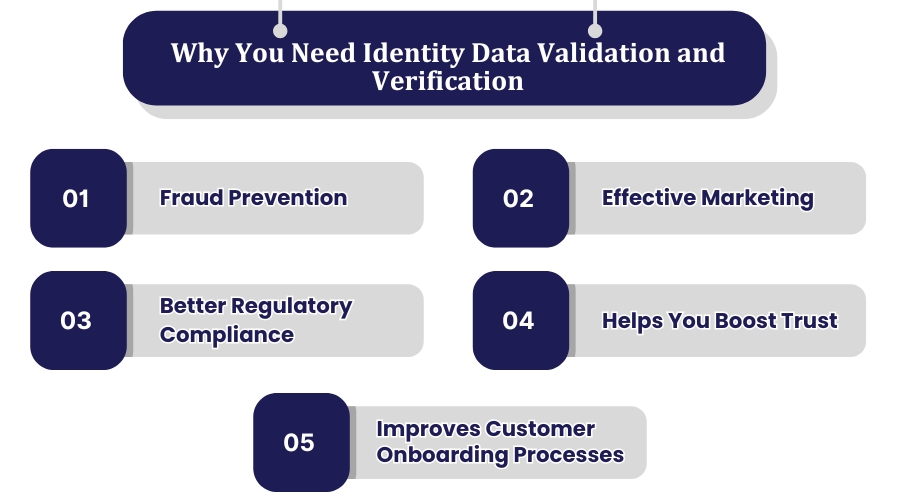
Identity data verification and validation are essential because invalid and incorrect information causes inefficiencies. In some cases, such information will even cause trouble, such as when fraudsters register with your business as genuine customers.
So, whether you're looking at names, emails, phone numbers, or even addresses, it's crucial to ensure you have accurate and authentic information to avoid inconveniences. For businesses that need to research publicly available information about an individual, a people search tool can also help gather relevant details before taking further verification steps. Here are some of the key reasons to implement identity data verification alongside validation:
1. Fraud Prevention
In most cases of fraud activities, fraudsters use stolen information to pose as genuine customers. If they register successfully, they will have access to services that they can use for criminal purposes like money laundering. Identity data checks are the top solution to prevent such occurrences.
A good example of how this works is in the finance industry. Institutions can recognise and prevent fraud if someone is trying to open a new account or access an existing one.
During account opening procedures, the user will have to undergo an identity document check, phone number verification, and real-time facial comparison to ensure they aren't opening an account with someone else's details. On the other hand, institutions can use facial recognition and biometrics to prove that the person trying to access an account is the real owner.
2. Effective Marketing
You need accurate and reliable data to facilitate productive marketing for your business. There simply is no way you will use invalid, unreachable phone numbers in an SMS marketing campaign, for instance, and expect it to yield great results. Valid data, on the other hand, will be highly reliable, thereby giving you a good chance at establishing a robust foundation for effective marketing.
If your business relies heavily on marketing, you can evaluate aspects like data granularity and the differences in performance for specific types of marketing so you know which ones to focus on more. As if that's not enough, identity data validation also makes it possible to ensure your marketing efforts employ personalisation.
3. Better Regulatory Compliance
A majority of industries in different fields of business are subject to regulations that require them to know their customers to curb issues like money laundering, terrorism financing, crimes against children, and other harmful activities. These regulations are typically non-negotiable and so strict that non-compliance can result in licence revocation and similar outcomes.
Identity data validation in combination with verification are great solutions for ensuring compliance with regulations that require you to know who your customers are.
4. Helps You Boost Trust
Businesses are built on trust. If you want to understand that better, try looking at businesses that have fallen from their past glory due to trust issues emanating from rather common issues like data leaks. A damaged reputation is almost always never recoverable, which is why you should avoid getting there.
Identity data verification can contribute to these efforts by assuring your customers that you care about their security, which is why you check every user detail that goes into your systems.
5. Improves Customer Onboarding Processes
A growing number of customers is becoming interested in utilising online channels as long as it's an option. As these customers get used to getting almost every service remotely, business owners have to keep up with the trend by offering digital identity verification solutions. This ensures that your customers receive the services they need with as minimal entry friction as possible.
Automated identity verification eliminates lengthy manual verifications, accelerates data entry, and increases accuracy when processing data. So whether you want to make it easier for customers to create accounts, complete hotel check-ins, or facilitate faster aeroplane onboarding, digital identity data verification will go a long way.
Top Data Validation Techniques
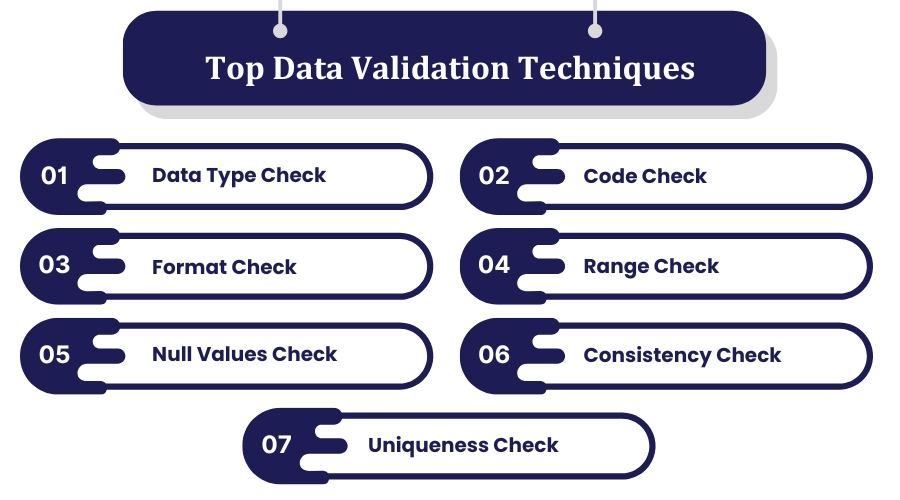
There is a considerable range of validation checks you can choose from in your data accuracy campaigns. The most appropriate will depend on the type of data you want to validate and the unique requirements of your projects. In some cases, you might want to use more than one technique.
Either way, here are the top data validation checks you can choose from:
1. Data Type Check
Since data is available in different types, this check ensures you enter the right data type in a specific field. For instance, it will alert you if you enter text in a field such as "Phone Number", where the data should be in number format. Similarly, it helps ensure that all-text fields like "Customer Name" contain the right data type.
2. Code Check
If you've always had trouble verifying whether country codes conform to ISO standards or that country codes are formatted correctly, a code check will always come in handy. This validation technique is used where there is a need to ensure that the codes used in data are valid and that they match specific standards.
3. Format Check
Format checks are also applicable in identity data validation. This technique ensures that all the data you enter is in the required format. A good example is a check to verify whether a phone number has been filled in with all the parts, as well as whether it includes dashes and parentheses where required.
4. Range Check
This check is what you will need to ensure that the data going into your databases falls within an acceptable range of values. For example, you can set your data validation tools to ensure that customer ages are within the 18-100 years range.
5. Null Values Check
When trying to identify your customers, you should ensure that data isn't missing in the mandatory fields. A good example is a case where a database contains customer information. In such a case, a crucial field like the "Name" or "Phone Number" field should never be blank.
6. Consistency Check
It's paramount to ensure that the information a user provides is consistent across all fields or tables. This is one of the best ways to ensure you are referring to the right individual at all times. A consistency check, for instance, is what you need to ensure that a particular customer ID has the same phone number or ID number across all applicable tables.
If the information varies, you can contact the customer so they can provide the correct data.
7. Uniqueness Check
No two customers or users should have the same details for unique fields. A perfect example in this case would be a situation where two users share an email address, ID number, or phone number. This means there was an error during data entry that should be followed up with the customers to get the correct information.
Grow Your Business With Treste
Most people believe that growing their business is all about delivering excellent services and products, ensuring effective communication, and leveraging powerful marketing techniques. They just don't realise how powerful accurate databases can be in the success or failure of a business. Don't make this mistake. Leverage the powerful and automated data validation, verification, and enrichment tools Trestle offers to ensure that your databases are as accurate and reliable as they can be.