
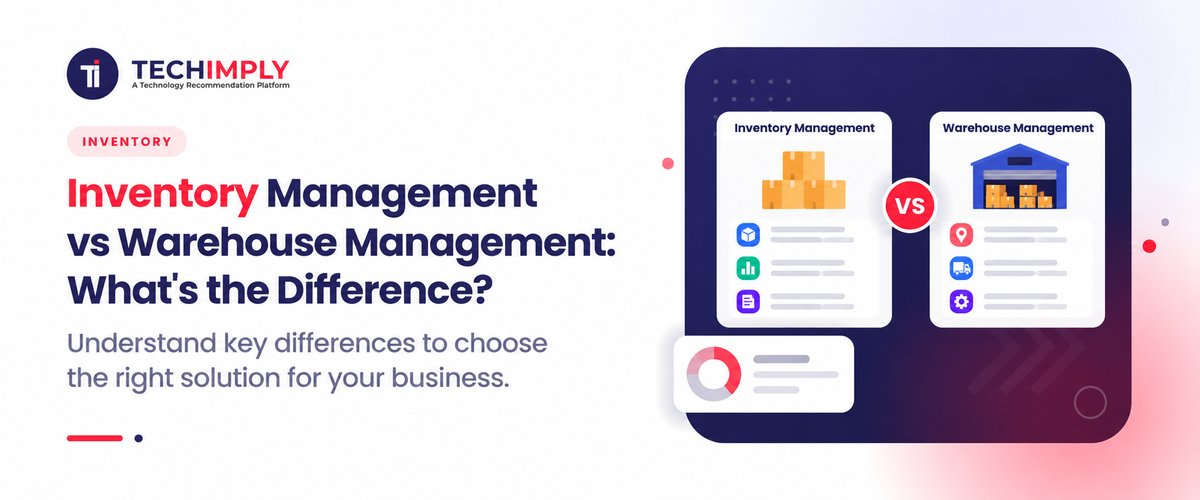
A textile trader in Surat checks his stock register and sees four hundred pieces of a fabric roll marked available. His warehouse supervisor, two floors below, cannot find more than two hundred and fifty on the shelf. Neither of them is lying, and neither number is technically wrong. One is looking at inventory management, the running total of what the business owns. The other is looking at warehouse management, what is physically sitting in that one building right now, correctly located and ready to be picked.
The difference between those two figures is often when company owners understand that the software systems function in different ways. The confusion exists frequently among Indian small-to-medium enterprises and direct-to-consumer brands that purchase software for the first time - this occurs because vendors use both terms interchangeably and do not clarify the distinctions. By searching for inventory management versus warehouse management, a manager indicates that the enterprise faces this specific discrepancy.
What Is Inventory Management?
Inventory management is the method where staff monitor plus regulate the items that a company purchases, stores, sells or uses during manufacturing. The goal is that the business keeps sufficient stock to satisfy customer requests without spending more capital than the budget allows.
An inventory management process can cover:
- Stock quantity and availability
- Purchasing and replenishment
- Inventory transfers
- Stock adjustments
- Inventory valuation
- Product management
- Reorder levels
- Demand planning
- Cycle counting
- Stock reporting
For example, an Indian electronics distributor owns 5 000 components located in Ahmedabad, Mumbai & Pune. With inventory management, the distributor knows the quantity of units present at the sites and determines if the company must buy more stock. The scope is wider than a single building. It is possible for inventory management to provide data across retail outlets, storage buildings, manufacturing plants and digital marketplaces.
What Is Warehouse Management?
Warehouse management is the control of daily activities within a storage building or distribution center. It is focused on how items arrive at the facility, the specific spots where workers place them, the methods workers use to find them but also the steps to select, box and ship orders.
Typical warehouse management activities include:
- Receiving incoming goods
- Checking received quantities
- Assigning storage locations
- Putaway
- Bin and shelf management
- Picking
- Packing
- Shipping
- Stock movement within the facility
- Warehouse labor coordination
- Cycle counting
A Warehouse Management System, often referred to as a WMS, has the ability to digitize and synchronize numerous operations. According to ASCM, warehouse management involves receiving, holding, selecting, boxing, and dispatching goods, whereas a WMS is built to control and improve warehouse processes and storage areas.

Pro-tip
Prior to acquiring either software category, record the specific query that remains unresolved rapidly, such as aggregate stock levels per site or current physical holdings within a single facility. This particular inquiry typically indicates if inventory control or warehouse operations represent the more pressing acquisition need.
Inventory Management vs Warehouse Management: The Core Difference
As the most straightforward approach to distinguish the two, the questions the functions answer can be identified.
- Inventory management's question is: What stock do we have, how much do we require, and when do we re-order?
- While warehouse management's question is: Where does the stock ware and how does it move around the store?
|
Area |
Inventory Management |
Warehouse Management |
|
Main focus |
Stock visibility and control |
Warehouse operations |
|
Scope |
Can cover multiple locations |
Usually focused on a specific facility |
|
Stock levels |
Monitors quantities and availability |
Records physical movements |
|
Replenishment |
Helps determine when to reorder |
May support movement and putaway |
|
Storage |
Tracks inventory location |
Organizes actual storage locations |
|
Picking |
May support order allocation |
Directly manages picking activities |
|
Packing |
Limited or indirect |
Core warehouse activity |
|
Shipping |
May track fulfillment status |
Handles dispatch workflows |
|
Forecasting |
Often supported |
Usually not the primary purpose |
|
Labor management |
Limited |
Can include warehouse workforce tasks |
|
Typical software |
Inventory management software |
Warehouse management system |
The distinction is also reflected in current software guidance. Usually, inventory management tends to deal with stock levels, stock movements, and accuracy, whilst warehouse management involves operational functions as picking, packing, labor management and despatching.
How Inventory Management and Warehouse Management Work Together
These functions should not be treated as competing systems. Imagine an online furniture business receives an order for a dining table.
First, inventory management confirms that the item is available. The order management process then sends the fulfillment requirement to the appropriate location. Warehouse management determines the storage location of goods and directs staff on selecting and boxing items. After the product exits the building, stock counts get revised.
This creates a connected flow:
Purchase → Receive → Store → Track → Order → Pick → Pack → Ship → Update Stock
The two systems depend on accurate information from each other. Warehouse staff need reliable stock and location data, while inventory records need warehouse transactions to remain accurate. Order management overlaps a number of these activities because it relates the order from the point of ordering through to order fulfillment, and links order information to inventory and fulfillment.
How This Fits Into the Bigger Supply Chain Picture
Inventory control and warehouse oversight function as components within the wider supply chain framework, positioned near procurement, transport, and distribution systems. Numerous medium-sized enterprises operating in India ultimately integrate these functions into a unified enterprise resource planning system when existing isolated applications no longer suffice, primarily since financial records, acquisition activities, and storage processes require shared data visibility rather than manual file transfers across internal units. .
This kind of supply chain management consolidation, combining inventory, warehouse, and distribution management data in one place, is worth planning for early, even if a business starts with lighter, separate tools, since migrating stock history into a full ERP software system later is considerably more painful than choosing tools that can talk to each other from day one.
Do You Know?
A warehouse can have the correct total quantity of a product but still have poor operational visibility. Knowing that 500 units exist is different from knowing exactly which rack, bin, or storage area contains each unit and whether those units are available for picking.
Do You Need Inventory Management, Warehouse Management, or Both?
There is no single answer for every business.
Choose inventory management when:
- Your core requirement is to be able to record stock accurately, control purchasing, track availability, and handle stock across one or more sites.
- This is a common requirement for smaller retailers and wholesalers, some distributors, and businesses with relatively simple warehousing processes.
Consider warehouse management when:
- Your warehouse has complex storage arrangements, high order volumes, frequent picking activity, or multiple operational steps that need coordination.
- A WMS becomes particularly useful when manual instructions are creating delays or errors.
Consider both when:
- The business operates with multiple warehouses, high SKU counts, integrated e-commerce channels, complex fulfillment processes, and large-scale distribution management.
- In such cases, inventory management provides the broader stock picture while warehouse management handles detailed execution at the facility level.
Key Benefits of Getting the Distinction Right
Understanding inventory management and warehouse management can improve software decisions and operational planning.
- Better Stock Accuracy: Controls over stock means the accuracy of stock levels is now more transparent and closer checks can be made on any variances.
- Higher Warehouse Productivity: Warehouse management can eliminate wasteful motion by guiding work toward suitable storage and picking points.
- Less Fulfillment Errors: When records of inventory and warehouse transactions are integrated, workers are better guided on the items to pick and ship.
- Improved Purchasing Decisions: Purchasing teams can identify low stock items and plan reordering more effectively with accurate inventory information.
- More Reliable Customer Commitments: To provide accurate delivery estimates, businesses rely on advanced ecommerce tools to track real-time stock levels. Clear inventory visibility ensures companies can make and keep dependable customer promises.
- Easier Scaling: Processes that work with a small number of SKUs can become difficult once a business adds locations, products, sales channels, and order volume. Connected inventory and warehouse processes provide a stronger foundation for growth.
How ERP, Order Management, and Logistics Software Fit In Inventory Management
Inventory and warehouse processes rarely operate in isolation. An ERP software can connect inventory with finance, purchasing, sales, manufacturing, and other business functions. This can be useful when a business require an accounting purchase, or accounting transaction.
Order management deals with all aspects of order from entry through delivery and post sale activities. An order management system as a digital way to manage product lifecycle while connecting processes such as inventory management and fulfillment.
Logistics software has a different emphasis. It may facilitate transportation planning, shipment planning, carrier management, and other logistics activities.
Distribution management takes the picture a step further by managing the flow of products from suppliers and/or facilities to stores, customers, or other destinations.
The result is a connected technology environment rather than one system doing everything:
ERP → Inventory → Warehouse → Order Fulfillment → Logistics → Customer
The exact architecture depends on the business and the software being used. Some modern platforms combine several of these functions, while others integrate specialized systems.
What Should You Look for When Buying Software?
Start with the operational problem instead of the feature list.
For inventory management software, examine:
- Multi-location inventory
- Stock alerts
- Purchase management
- Reorder levels
- Inventory reporting
- Barcode support
- Serial or batch tracking
- E-commerce integrations
- Accounting or ERP integrations
For warehouse management software, examine:
- Receiving and putaway
- Bin and location management
- Barcode or RFID scanning
- Pick-and-pack workflows
- Dispatch management
- Warehouse analytics
- Labor management
- Integration with inventory and order systems
In addition, verify if the software interacts with your current ERP, e-commerce solution, accounting software, or order management software. Advanced software won't bring much value if it causes extra manual tasks between systems.
Conclusion
The simplest distinction is this: inventory management controls the stock picture, while warehouse management controls the physical warehouse operation. Vendors can use inventory management without the production management of a WMS. But once storage, order-picking, packing, and movement require a level of complex organization, the operational layer of a WMS can be the solution missing between simple inventory management and production management.
Related Reads :
- 6 Features to Look For In An Inventory Management Software
- Smart Inventory Management with AI & QR Codes
- Work In Progress (WIP) in Inventory Management: Definition, Examples & Process Guide
- How to Monitor Grocery Inventory Management
- WMS, Automation, and Warehouse Layout: What E-Commerce Sellers Need to Know


.png "How To Hire Java Developers From India (Guide for US Employers)")