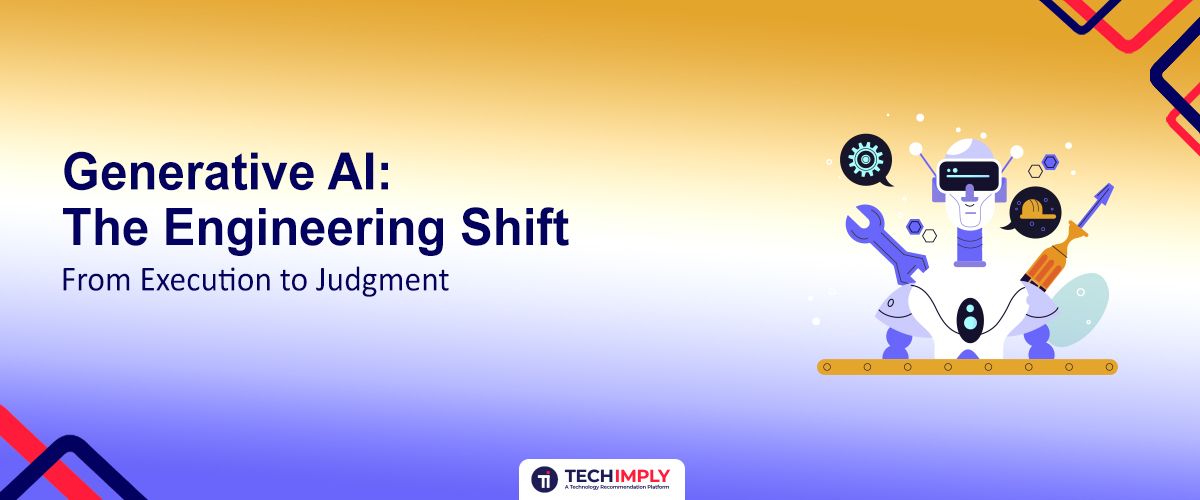
Generative AI will shift jobs from routine task execution to oversight, exception handling, and model tuning. AI-powered business process automation can cut manual steps and speed decisions, but it creates new work: validation, data cleanup, and ethics checks. Expect fewer repetitive tasks, not fewer problems; governance, retraining, and edge-case handling still demand skilled humans.
Automate the Boring, Amplify the Brilliant
AI-powered business process automation uses machine learning and generative models to perform, augment, or orchestrate routine business tasks that were previously manual. It combines traditional workflow tools and RPA with AI capabilities—such as natural language understanding, document extraction, and decision generation—to handle ambiguous, unstructured, or knowledge‑intensive work. For organizations looking to implement these capabilities at scale, partnering with experts in Generative AI development services helps ensure models are properly designed, integrated, and aligned with business goals. Rather than simply eliminating headcount, it shifts human roles toward supervision, exception handling, and higher‑value activities. Proper implementation requires governance, monitoring, and feedback loops so models stay accurate, auditable, and aligned with business rules. When done well, it shortens cycle times, reduces errors, and creates new product and service opportunities.
From Automation Fear to Augmentation Mindset
Early stories sold fear by narrowing change to one outcome: replacement. That made for neat headlines and drove clicks. Leaders pictured machines clearing teams, so they froze hiring instead of redesigning roles. People who started testing models inside real workflows found a different truth. A generative AI system integration excels at patterns and volume, but struggles with judgment and context. Teams that paired models with human skills moved faster while keeping control. Treat the technology as a tool that expands capacity, not a substitute for judgment.
-
Real-World Shift Toward Augmentation Over Replacement
Companies shifted their focus from whether AI would eliminate jobs to how work could be redesigned. Roles are split into three buckets: routine execution moved to models, oversight and exception handling stayed with people, and new roles emerged for data and model stewardship. That produced smaller, faster teams that still needed deep domain knowledge.
-
Examples Of How Teams Are Using AI
Customer support: AI drafts responses and summarizes threads. Humans review tone, correct facts, and manage escalations.
Finance & reporting: Models prefill reports and flag anomalies. Accountants validate numbers and explain variances.
Product & design: AI generates prototypes and options. Designers prune concepts and set direction.
Legal & compliance: Systems extract clauses and identify potential risks. Lawyers make final calls and negotiate trade-offs.
Where Generative AI Is Changing Real Work
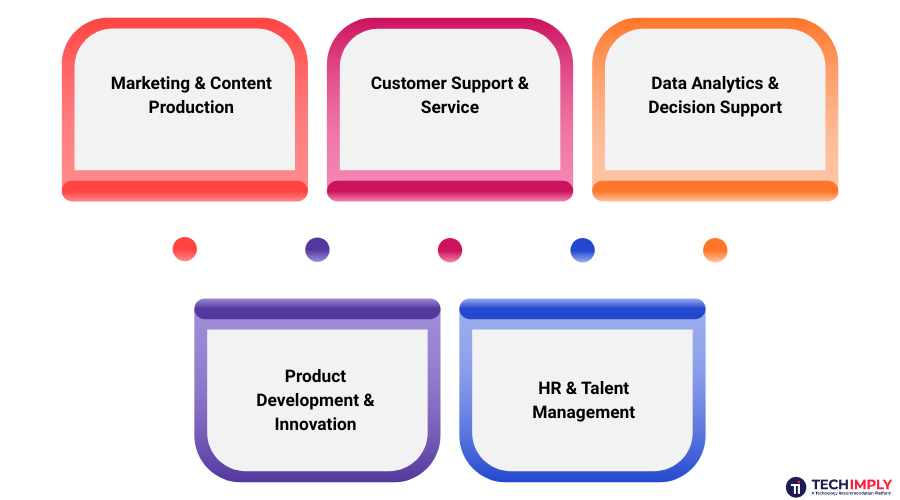
Generative AI accelerates routine tasks and unveils new possibilities. Expect new oversight, training, and error modes.
-
Marketing & Content Production
Generative models produce draft headlines, social posts, long-form articles, and multiple visual concepts in minutes, shrinking the idea-to-publish cycle. Teams use those drafts to run rapid A/B tests and personalize messages for segments at scale. Humans set overall strategy, brand voice, and campaign goals so outputs stay on-message. Editors validate facts, legal compliance, and cultural sensitivity. Copywriters shape tone and nuance that models often miss. Creative leaders combine generated options with original thinking to push for memorable work.
-
Customer Support & Service
AI chatbots and knowledge assistants handle routine queries, provide instant answers, and triage tickets to the correct queue, cutting response times and volume for human agents. These systems summarize long threads, pull relevant policy excerpts, and suggest next-best actions so agents work faster. Humans remain essential for complex, emotional, or judgment-heavy cases where context, empathy, and discretion matter. Support teams spend more time on handling escalations, repairing relationships, and addressing situations. That stuff requires improvisation or cross-team coordination. Continuous training and oversight are required to correct model errors, update knowledge bases, and preserve customer trust.
-
Data Analytics & Decision Support
Generative models turn raw logs into readable reports and highlight unusual patterns in minutes. They build dashboards and surface correlations that would take analysts days to assemble. Analysts shift to testing those leads, probing causality, and ruling out artifacts or bias. Managers treat AI outputs as draft inputs for trade-offs, not as definitive answers. You must invest in lineage, validation, and audit trails to keep decisions defensible and trusted.
-
Product Development & Innovation
Generative tools spin up prototypes, mockups, and sample code far faster than manual starts. Teams use those artifacts to explore more directions without blowing timelines or budgets. Engineers and designers prune low-fit ideas, fix technical debt, and decide which prototypes move forward. Product leads validate concepts with users, assess market fit, and weigh operational costs. Expect faster iteration, but also more governance, integration work, and careful prioritization.
-
HR & Talent Management
AI drafts job descriptions, suggests learning paths, and automates first-pass resume screening to save time. Those automations move volume fast but miss signals about grit, growth potential, and cultural fit. HR teams must probe why the model ranked someone, test for bias, and correct systematic errors. Managers handle edge cases, coach hires, and own outcomes when the model gets it wrong. Budget for audits, appeals, and ongoing calibration—automation lowers workload but increases governance.
The Case—From Manual ETL to AI‑Assisted Data ProductsA mid‑sized fintech replaced slow, hand‑edited reports with AI‑assisted data products. They reduced report delivery time and shifted analysts into validation and product roles. Pain point: Analysts spent most of their week cleaning spreadsheets and hand‑crafting client reports. ETL failures and schema drift forced repeated firefights and ad‑hoc fixes. Slow delivery and delayed decisions resulted in inconsistent, untraceable outputs. Solution: They mapped high‑effort tasks and automated deterministic parts with pipelines. Generative models produced first‑draft narratives, data summaries, and anomaly explanations. Senior analysts moved to review, exception handling, and productizing report templates. Tools:
Result: Report lead time dropped 60 percent; analyst throughput rose 2.5x. Human oversight caught 98% of model mistakes before client delivery. The firm launched two new report products that generated incremental revenue within six months. |
How Jobs Shift When People Work With AI
AI changes how work gets done, not who gets hired. Most roles acquire tools that streamline tasks and require new oversight. Expect more supervision, strategy, and messy trade-offs.
-
Roles Becoming AI-Augmented
AI accelerates routine work for these roles, thereby reducing the time spent on repetitive tasks. People now check outputs for quality, context, and ethical risk. Teams spend time framing problems, not pushing pixels or writing boilerplate code. This shift raises the value of domain knowledge and judgment over rote skill. Be prepared for uneven productivity gains and a persistent need for human validation.
-
AI-Driven Roles Emerge
New roles get models to behave reliably in real work—prompt engineers craft inputs so systems return useful, safe outputs. AI trainers label edge cases and correct model mistakes with real examples. Workflow architects design systems that integrate AI seamlessly into human processes. Ethics officers set boundaries, audit outcomes, and manage legal and reputational risk.
-
Skills Gain Value in the AI Era
-
Critical thinking helps people spot model errors and misleading outputs.
-
Communication translates model results into practical next steps for teams.
-
Domain expertise supplies the context models lack and anchors decisions to reality.
-
Digital literacy prevents misuse and accelerates tool adoption.
-
Decision-making remains central: someone must weigh trade-offs and accept responsibility.
How AI Changes Interaction Models Inside Organizations
Work stops being just about tools and starts being about conversations. That shifts decision points, handoffs, and where responsibility lives.
Conversing with Autonomous Agents
-
People interact with systems that act, recommend, and drive progress.
-
Agents reduce click-work but introduce new trust and verification tasks.
-
Teams must decide who accepts agent output and who double-checks it.
Iterative Co‑creation Workflows
-
Work becomes a loop: humans prompt, models draft, humans refine.
-
This accelerates the drafting and idea generation process, but it also creates versioning and ownership gaps.
-
Define clear handoff rules to prevent edits from becoming responsibility black holes.
AI Embedded Across Core Platforms
-
AI is integrated into CRM, IDEs, HRM, BI, and other systems that teams already use.
-
That lowers friction but exposes critical processes to model errors.
-
Keep audit logs, limit high‑risk automation, and require human sign‑off in sensitive flows.
From Top‑Down Delegation to AI‑Assisted Decisions
-
AI enables more people to act on near-real-time insights without waiting for managers.
-
Faster decisions increase the risk of inconsistency without shared standards.
-
Implement guardrails, metrics, and escalation paths before broad adoption.
Four Practical Steps for Responsible, Profitable AI Adoption
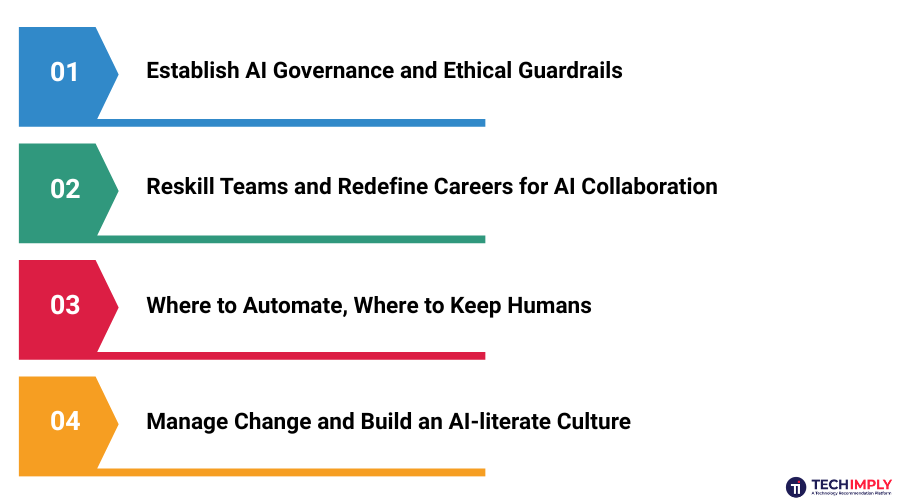
AI projects fail when governance, people, or processes lag behind models. Start with controls, then move on to skills and workflows, rather than the other way around. Do small pilots that prove economic value and make risks visible.
- Establish AI Governance and Ethical Guardrails
Begin by documenting the data you can and cannot use. Create clear policies covering data lineage, access controls, and approved model suppliers. Assign a small oversight team that owns audits, drift detection, and incident response. Require transparency artifacts: model cards, versioned training data, and decision logs for high‑risk flows. With these controls, you limit regulatory exposure and make failures traceable.
-
Reskill Teams and Redefine Careers for AI Collaboration
Inventory the skills your teams lack against target AI workflows. Design-focused training includes model literacy, prompt engineering basics, and data observability practices. Map career paths to guide people from repetitive execution to roles such as supervision, quality control, and domain validation. Run paired work: junior engineers use AI for speed while seniors validate outputs and teach edge cases. That approach preserves institutional knowledge and reduces replacement anxiety.
-
Where to Automate, Where to Keep Humans
Start with a value map that lists process cost, error sensitivity, and automation risk. Automate deterministic, high‑volume tasks first and keep humans in loops for judgment calls. Build pipelines with feature flags and rollback hooks to disable model outputs quickly. Pilot, instrument, and measure business metrics tied to each automation, not just model accuracy. Scale only when latency, error rates, and economic lift are predictable.
-
Manage Change and Build an AI‑literate Culture
Inform people about the changes, the reasons behind them, and what remains unchanged. Involve frontline staff in pilots so you uncover hidden edge cases and reduce pushback. Reward behavior that improves model quality: labeling, feedback, and incident reports. Monitor adoption metrics and sentiment, and adjust training and incentives as needed to address stalled uptake. A pragmatic culture shift reduces fear and keeps teams accountable for outcomes.
Don’t Automate—Invent
Generative AI opens product paths you didn’t have time to explore. Pick experiments that prove value quickly and force trade‑offs.
-
AI as a Source of Product Innovation
Use models to create capabilities that customers can buy, rather than just automating chores. Fuse your domain data with generative outputs to produce differentiated features. Measure success by retention and revenue, not raw reduction in headcount.
-
Speeding Time‑to‑Market and Decision Velocity
Replace long manual steps with model‑assisted drafts, tests, and summaries. Faster iterations reveal honest user feedback and reduce wasted roadmap work. Track lead time, release frequency, and decision latency as your core KPIs.
-
Competitive Moat Through Timely Adoption
Early adopters lock in integrations, expertise, and reusable assets that compound.
Move with small, controlled pilots that limit blast radius and prove ROI.
Focus on repeatable wins that can be scaled, rather than a single big, speculative bet.
Train the Team and Tame the Model
Begin with the constraint that skills and controls lag behind models. Explain the engineering reality: without governance, retraining plans, and process redesign, minor model errors cascade into costly outages. Close with an outcome: set up those systems now, and you get predictable performance and auditable decisions.
Begin with governance and reskilling as linked controls. Create clear policies for data use and model monitoring, and provide focused training for engineers and operators. Those two moves eliminate surprises and enable teams to validate model output under load.
Next, redesign workflows so that automation amplifies human capabilities. Replace repetitive tasks with model-assisted flows, and push judgment and edge‑case handling to experienced staff. That reduces cycle time while keeping responsibility where it matters.
Finally, lock the change in with culture and pilots. Run small, measurable experiments that surface real trade‑offs and reward behaviors that improve model quality. Companies that combine governance, skills, and process redesign gain reliable systems and a genuine competitive edge.