Battle of the brains: OpenAI and DeepSeek are rewriting what “thinking machines” can do. We’re diving into DeepSeek vs OpenAI — two powerful open reasoning models that are shaking things up in the world of generative AI.
OpenAI’s GPT-4 has been the go-to for creative writing, chatting, and general-purpose tasks. But now there’s a new player in town: DeepSeek-R1 — an open-source model built with a strong focus on reasoning and code. And it’s catching serious attention from devs, startups, and AI pros who want smarter, more transparent tools.

Looking for Artificial Intelligence?
Check out Techimply's List of Top Artificial Intelligence (AI) Software in India for your business.
In this blog, we’ll walk through what makes each model tick, compare how they perform in real-world use cases, and help you figure out which one fits your needs. Whether you’re exploring OpenAI competition, checking out DeepSeek pricing, or trying to make sense of the DeepSeek R1 OpenAI O1 comparison — we’ve got you covered.
Key Takeaways
-
DeepSeek-R1 is an open-source model built for reasoning and code generation.
-
OpenAI's GPT-4 is closed-source but excels in general-purpose and creative tasks.
-
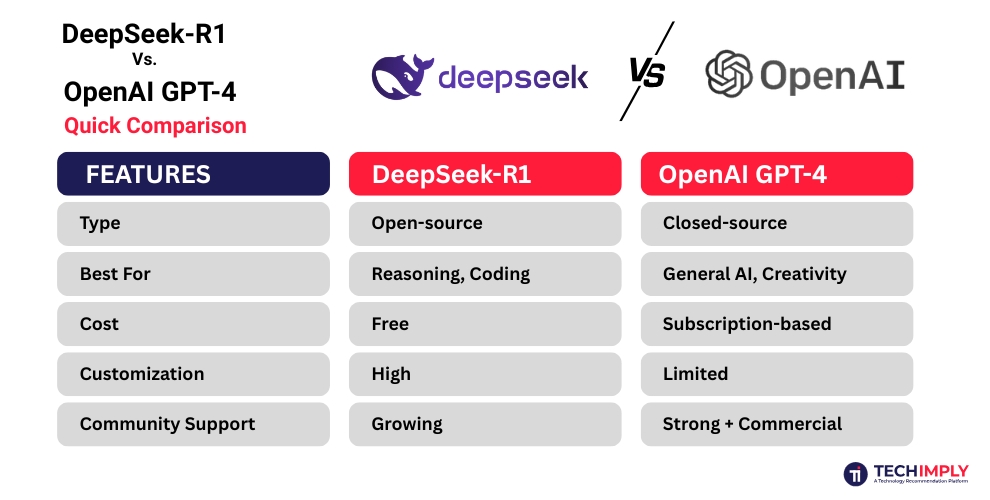
DeepSeek is free and highly customizable; GPT-4 offers polished performance at a price.
-
Your ideal choice depends on your use case: transparency vs. versatility.
What Is DeepSeek-R1?
DeepSeek-R1 is an open-source large language model developed by DeepSeek, designed to handle advanced reasoning and coding tasks. Think of it as a smart, code-savvy alternative in the world of AI models — built for developers, researchers, and tech teams who need more transparency and control.
What makes the DeepSeek AI model stand out is that it’s open-source, which means you can play with it, fine-tune it, and even construct your own tools on top of it. It’s a part of a growing trend where human beings are seeking out effective, open options to mainstream AI solutions, without being locked into one platform. It’s a flexible desire for all of us looking beyond the standard AI tools — especially for those exploring AI development services, where adaptability and control are essential.
And the best part of DeepSeek pricing is super budget-friendly since it’s free to use. That means you get a powerful tool without spending a lot.

Did You Know?
DeepSeek trained its models on a massive mix of code and text datasets — including GitHub, arXiv, and Common Crawl — to better mimic how developers actually think.
What Is OpenAI's GPT-4?
Before DeepSeek entered the scene, GPT-4 was running the show — and it still might be. OpenAI's GPT-4 is a highly capable language model known for its strong understanding and content generation abilities. Compared to in advance models, it is familiar with context more, writes more naturally, or even chooses up on diffused information in communication or content creation.
One of its standout features is being multimodal — meaning GPT-4 can handle both text and image inputs, making it smarter and more versatile in real-world tasks.
With all its capabilities, GPT-4 continues to set the bar in the AI space, though it's now facing growing OpenAI competition from newer, open-source models like DeepSeek. Still, when it comes to all-around performance and polish, GPT-4 remains one of the top players out there.
Editor’s Note:
As AI evolves rapidly, new models like DeepSeek are challenging established players like OpenAI. This comparison is based on the most recent public benchmarks and community feedback as of 2025.
DeepSeek vs OpenAI: A Comparison
When it comes to AI models, DeepSeek and OpenAI each bring their own strengths to the table. Here’s how they stack up against each other.
-
Core Technologies and Architecture
It all starts with how these two models are actually built.
DeepSeek R1: DeepSeek R1 is built on a dense model architecture similar to GPT-3.5 and GPT-4, but it's optimized for efficiency and large-scale training. DeepSeek uses a Mixture of Experts (MoE) strategy, which allows it to activate only a portion of its network for each query — making it faster and less resource-heavy.
OpenAI’s O1: On the other hand, OpenAI’s O1 is based on the evolving GPT architecture. Known for pioneering the transformer model, OpenAI continues to refine its dense, fully-activated networks that prioritize broad generalization and deep contextual understanding.
In the DeepSeek R1 OpenAI O1 comparison, DeepSeek is all about openness and giving you more control, while OpenAI’s GPT-4 is more polished and fine-tuned for broader uses.
-
Key Features and Capabilities
DeepSeek AI model: When it comes to capabilities, DeepSeek AI model emphasizes multilingual support, high-speed response, and lightweight deployment options — making it ideal for businesses needing faster outputs at scale.
OpenAI: OpenAI continues to set the benchmark for creative writing, complex reasoning, and task versatility, from coding to content creation. Its API offers deep integrations across industries, with a strong focus on alignment and ethical use.
Interesting Read:
-
Cost Comparison
DeepSeek: Here’s where DeepSeek pricing wins big. Since DeepSeek-R1 is open-source, it can be used and modified without major costs, making it startup- and dev-friendly. In the growing OpenAI competition, DeepSeek is positioning itself as a cost-effective alternative. Reports suggest DeepSeek’s pricing for API access is significantly lower compared to OpenAI, especially for high-volume use cases.
OpenAI: GPT-4, meanwhile, is part of OpenAI’s commercial offering, which comes with a subscription or API pricing.
-
Data Privacy and Security
Data privacy is a hot topic in AI — and both players are addressing it seriously.
DeepSeek: DeepSeek claims strong encryption standards and emphasizes on-premise deployment options for businesses worried about data security. DeepSeek’s open-source nature gives teams more control over where and how their data is used. You can run it on your own infrastructure for added privacy.
OpenAI: OpenAI also maintains strict data handling policies, especially for enterprise customers, and has enhanced its compliance measures (like SOC 2 certification) to meet global privacy regulations. OpenAI, while secure, handles data through its own systems, which may not be ideal for users with strict data governance needs.
-
Performance
When you talk about real-world performance, it’s where most deepseek vs openai debates heat up.
DeepSeek: DeepSeek R1 shows impressive speed, lower resource consumption, and strong multilingual performance, positioning it as a practical AI workhorse. and it’s steadily improving — becoming a real OpenAI competition contender.
OpenAI: When it comes to performance, it depends on the task. GPT-4 leads in natural language tasks, creative writing, and general AI interaction. OpenAI O1 still leads in nuanced reasoning, emotional intelligence, and handling complex queries that require multiple layers of understanding.
Looking for Artificial Intelligence?
Check out Techimply's List of Top Artificial Intelligence in India for your business.
Industry Applications & Use Cases
Both DeepSeek and OpenAI models are powering a wide range of industry innovations, but their strengths shine differently across sectors.
DeepSeek AI model is gaining traction in research, education, and open-source development thanks to its transparent architecture and flexible integration. Its affordability—highlighted in DeepSeek pricing—makes it ideal for startups, academic institutions, and developers experimenting with custom solutions.
On the other hand, OpenAI models are heavily used in enterprise-grade applications, including customer service automation, content generation, and data analysis—where scalability and plug-and-play efficiency matter most. The DeepSeek R1 vs OpenAI O1 comparison becomes especially relevant in sectors like healthcare and finance, where interpretability and fine-tuning capabilities are key.
Whether you're optimizing internal workflows, building AI-driven products, or exploring next-gen NLP tasks, both platforms offer robust solutions, each with its edge in the ongoing OpenAI competition.
Also Read:
How to Choose the Right Model
When it comes to choosing between DeepSeek and OpenAI, it really depends on your priorities—performance, use case, and budget. If you're focused on open reasoning and transparency, the DeepSeek AI model stands out for its open-source approach and community-first development. On the other hand, OpenAI continues to lead in polished performance and integration options.
For developers comparing DeepSeek R1 vs. OpenAI O1, consider the technical depth you need: DeepSeek may offer more freedom for customization, while OpenAI excels in out-of-the-box reliability. DeepSeek pricing is also more accessible for startups and research use, making it a serious contender in the growing OpenAI competition landscape.
Ultimately, it all comes down to what you need — whether you need fine-tuned control,, ready-to-go features for big projects, or just keeping things budget-friendly.
DeepSeek vs OpenAI – Quick Comparison
Conclusion
So, when it comes to DeepSeek vs OpenAI, it really depends on what you need.
If you're into open-source tools that are great at coding and reasoning, DeepSeek-R1 is worth checking out. But if you need something more polished and versatile for writing, chatting, or creative work, OpenAI’s GPT-4 still leads the game.
With all the buzz around OpenAI competition, curious minds are diving into things like DeepSeek pricing and digging into the DeepSeek R1 OpenAI O1 comparison. Bottom line — it’s a great time to explore what each model can do and pick the one that fits your goals best.