

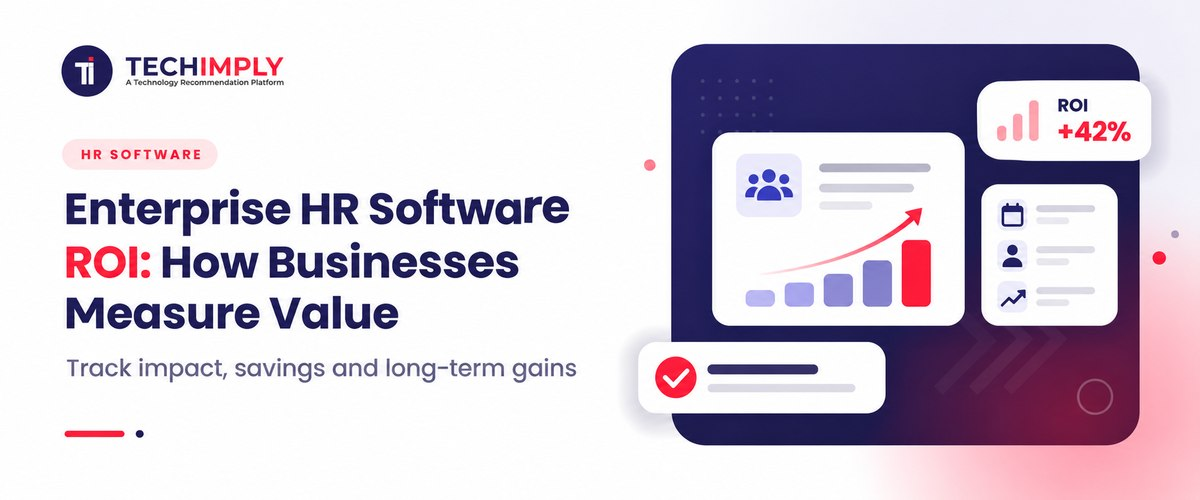
When evaluating enterprise HR software, decision-makers often fall into the trap of analyzing licensing expenses alone. However, choosing a platform for a global workforce requires a much broader lens. To secure executive buy-in, stakeholders must understand enterprise HR software ROI (Return on Investment) and quantify how modern HR technology ROI impacts the bottom line.
Deploying sophisticated HR systems involves significant capital, making it vital to measure true HR software business value. Beyond subscription costs, modern organizations evaluate enterprise HR technology investment through comprehensive metrics covering productivity, automation, cost savings, employee experience, risk mitigation, and strategic HR outcomes. True financial return accounts for both direct cost reductions and long-term operational value.
1. What Is Enterprise HR Software ROI?
At its core, HR software investment ROI measures the financial and operational return generated by a technology platform relative to its total costs. The fundamental formula used by enterprise finance teams is:
HR Software ROI=Total HR Software InvestmentFinancial Benefits−Total HR Software Investment×100
Calculating this accurately requires looking beyond basic expense lines to capture the multidimensional impact of enterprise platforms. Essential components of this calculation include:
- Direct savings: Elimination of legacy system maintenance, reduced paper-based document processing, and lowered compliance fines.
- Productivity gains: Hours recovered by HR personnel, managers, and employees through streamlined digital workflows.
- Reduced administrative workload: Fewer manual data entries and automated routing of approvals.
- Lower hiring and turnover costs: Improved retention driven by structured engagement, career tracking, and continuous performance management.
- Better workforce visibility: Real-time analytics that prevent costly staffing missteps and optimize labor distribution.
- Risk and compliance benefits: Minimized legal liabilities associated with missed payroll taxes, incorrect classifications, or regulatory oversights.
Practical Calculation Example
Imagine an enterprise with 5,000 employees investing $400,000 annually in a unified HR stack (including licensing, implementation amortization, and support). If the platform generates $700,000 in verified annual savings and productivity value, the calculation is:
ROI=$400,000$700,000−$400,000×100=75%
This yields a net return of 75% on the platform investment within its first optimized year of operation.
2. Why Measuring HR Software ROI Matters for Enterprise Businesses
Enterprise buyers need rigorous metrics that go far beyond standard feature comparisons. Securing executive approval for enterprise HR technology investment requires connecting human resources goals directly with financial outcomes.
Justifying Technology Investments to CFOs
Chief Financial Officers rarely approve software expenditures based solely on qualitative promises like "better culture" or "easier workflows." Quantifying HR digital transformation ROI translates employee engagement and operational agility into hard financial metrics, satisfying strict corporate budgeting standards.
Comparing Options and Establishing Baselines
Evaluating competing vendor proposals requires an objective framework. A structured ROI model allows procurement teams to weigh different platform tiers against projected cost reductions. Furthermore, it establishes baseline benchmarks to track performance quarterly, identifying underused functionality and ensuring the organization fully utilizes its software stack.
3. Enterprise HR Software Benefits That Drive ROI
Modern platforms generate value across multiple operational dimensions. Let's examine the primary functional drivers of enterprise HR software benefits.
3.1 HR Automation and Administrative Savings
Manual HR processes are notoriously prone to errors and bottlenecks. HR automation ROI materializes quickly by digitizing complex workflows, such as:
- Payroll and administrative workflows: Automated calculation of taxes, deductions, and cross-border pay structures.
- Employee data management: Centralized record updates that propagate instantly across systems.
- Approvals: Automated routing for time-off requests, expense reports, and job requisitions.
- Reporting: Instantaneous generation of compliance and executive workforce reports without manual data compilation.
3.2 HR Productivity Gains
Administrative burdens often consume hours that HR teams could otherwise spend on strategic initiatives. HR software productivity gains stem from self-service tools that empower staff:
- Employee self-service: Team members update personal data, access pay stubs, and enroll in benefits independently.
- Manager self-service: Leaders approve workflows, view team analytics, and initiate compensation reviews instantly.
- Faster HR processes: Drastically reduced turnaround times for onboarding and internal mobility changes.
3.3 Better Workforce Decision-Making
Centralized workforce data provides leadership with clear visibility into labor trends. Advanced analytics allow executives to spot retention risks, forecast headcount requirements, and model organizational restructures accurately.
3.4 Employee Retention and Experience
Replacing a departing enterprise employee can cost tens of thousands of dollars in lost productivity and recruiting expenses. By delivering responsive service, structured career paths, and clear performance goals, platforms help organizations retain key talent.
4. How to Measure Enterprise HR Software ROI: 8 Key Metrics
Tracking the right indicators is essential to accurately measure HR software ROI. The table below outlines the core metrics required for an enterprise audit.
|
HR Software ROI Metric |
What to Measure |
Example Calculation |
|
Administrative Time Saved |
Hours spent on routine tasks before vs. after automation |
Hours saved per month × average HR hourly cost |
|
HR Cost per Employee |
Total HR operating cost divided by total workforce size |
Comparative ratio: before vs. after implementation |
|
Process Completion Time |
Time required to finish standard workflows (e.g., onboarding) |
Percentage reduction in average cycle days |
|
Self-Service Adoption Rate |
Transactions completed without direct HR intervention |
Completed self-service requests ÷ total requests × 100 |
|
Payroll Error Reduction |
Number and direct cost corrections per pay cycle |
Financial savings from avoided manual correction fees |
|
Employee Turnover Rate |
Attrition percentage before vs. after system rollout |
Avoided replacement and recruitment costs |
|
HR Productivity Ratio |
Number of employees supported per HR FTE |
Change in workforce-to-HR-staff ratio post-launch |
|
Software Utilization Rate |
Percentage of licensed features and workflows actively used |
Active monthly users ÷ total provisioned licenses × 100 |
Balancing these HR software efficiency metrics and HR software performance metrics provides a comprehensive view of operational health.
5. HR Software Cost-Benefit Analysis: What Should You Include?
A credible HR software cost-benefit analysis requires balancing total expenditures against comprehensive operational returns.
Total Costs to Include
- Licensing and subscription: Recurring SaaS fees.
- Implementation: Professional services, consulting, and project management.
- Data migration: Cleansing and transferring legacy records.
- Integrations: Connecting the HR platform with ERP, CRM, and IT directory systems.
- Training and change management: Employee adoption programs and user guides.
- Internal IT resources: Dedicated internal support hours.
Total Benefits to Include
- Labor savings from automated workflows.
- Reduced payroll and compliance error costs.
- Productivity gains across HR, management, and staff.
- Lower recruitment expenses due to improved employee retention.
- Mitigated legal and regulatory risk exposure.
6. Understanding HR Software Total Cost of Ownership (TCO)
When evaluating enterprise HR software pricing, headline subscription rates rarely tell the whole story. Enterprises must analyze a 3 to 5-year HR software total cost of ownership (TCO) model.
TCO=Software Licensing+Implementation+Integration+Training+Maintenance+Internal Support
- Year 1 (High Initial Outlay): Software licensing + custom implementation + data migration + intensive training.
- Years 2–5 (Operational Equilibrium): Ongoing licensing + minor configuration updates + support + periodic administrative training.
Comparing long-term TCO prevents organizations from choosing cheaper software that incurs heavy customization and maintenance expenses later.
7. How HR Automation Creates Measurable Cost Savings
To see how automation drives tangible financial impact, consider this before-and-after model for routine HR transactions:
- Before Automation:
- 5,000 annual manual HR transactions (e.g., address updates, document requests, status changes).
- 20 minutes required per transaction.
- Total time spent: 1,667 hours/year.
- After Automation (Self-Service Portals):
- 5 minutes required per transaction via self-service.
- Total time spent: 417 hours/year.
- Net Time Saved: 1,250 hours/year.
Multiplying 1,250 hours by an average HR administrative cost of 35 per hour yields an immediate annual savings of $43,750 from just one streamlined workflow.
8. Total Rewards and Continuous Performance Management ROI
Advanced platforms connect compensation, benefits, and performance data into a unified ecosystem. Implementing total rewards software for enterprise HR allows organizations to align monetary investments with employee output.
Similarly, deploying enterprise HR software continuous performance management replaces traditional annual reviews with ongoing feedback loops, milestone tracking, and dynamic goal alignment. Organizations measure this ROI by tracking:
- Performance review completion velocity.
- Key result and goal achievement rates.
- Manager time saved during evaluation cycles.
- Internal mobility and promotion tracking.
9. HR Software ROI Calculator: A Practical Calculation Framework
Organizations looking to model potential returns can use this practical framework to build custom spreadsheet tools:
Inputs Required
- Total workforce head count.
- Number of HR Full-Time Equivalents (FTEs).
- Average hourly compensation for HR staff.
- Estimated hours saved per employee or HR FTE annually.
- Current legacy technology operating costs.
- New software licensing and implementation estimates.
- Projected reduction in employee turnover percentage.
Outputs Generated
- Total annual operational savings.
- Net annual benefit after expenses.
- Percentage ROI and payback period (in months).
- Comprehensive 3-year TCO projection.
10. Enterprise HR Software ROI Example
Consider a hypothetical global enterprise with 10,000 employees deploying a unified cloud HR platform:
- Annual Software Investment: $600,000 (amortized implementation + licensing)
- Administrative & Workflow Savings: $350,000
- Productivity Value (Manager/Employee Self-Service): $450,000
- Reduced Turnover Replacement Costs: $400,000
- Compliance & Error Mitigation Savings: $150,000
- Total Measurable Benefit: $1,350,000
Applying the standard formula:
ROI=$600,000$1,350,000−$600,000×100=125%
This yields a 125% net return, demonstrating substantial financial and operational value for the business. (Note: Results vary based on organizational maturity, baseline efficiencies, and adoption rates.)
11. How to Build a Business Case for Enterprise HR Software
- Establish baseline costs: Audit current legacy spending, manual error rates, and administrative labor hours.
- Identify measurable inefficiencies: Pinpoint operational bottlenecks in onboarding, payroll processing, and reporting.
- Estimate software costs: Gather comprehensive vendor quotes covering licensing, implementation, and integration.
- Quantify direct savings: Calculate labor reductions via workflow automation.
- Estimate productivity benefits: Model time saved for managers and employees.
- Define non-financial benefits: Document risk reduction, compliance improvements, and cultural alignment.
- Calculate TCO and ROI: Run multi-year financial projections.
- Establish post-launch KPIs: Define metrics to review quarterly with finance leadership.
12. Common Mistakes When Calculating HR Software ROI
- Looking only at subscription price: Ignoring integration, training, and internal IT support overhead.
- Using unrealistic productivity assumptions: Claiming 100% time recovery on automated tasks without accounting for change management friction.
- Failing to establish a baseline: Moving forward without clear metrics on current process speeds and error rates.
- Counting benefits twice: Overlapping labor savings across overlapping modules (e.g., payroll and core HR).
- Measuring too soon: Evaluating financial returns before the organization has completed adoption and onboarding.