Modern organizations operate in complex, distributed, and fast-moving environments where human capital is the primary driver of competitive advantage. To manage workforces efficiently across multiple regions, legal entities, and regulatory frameworks, organizations rely on sophisticated digital infrastructure. Deploying the right enterprise HR software ensures that global workforces are managed securely, compliantly, and at scale.
How Modern Enterprise HR Platforms Work
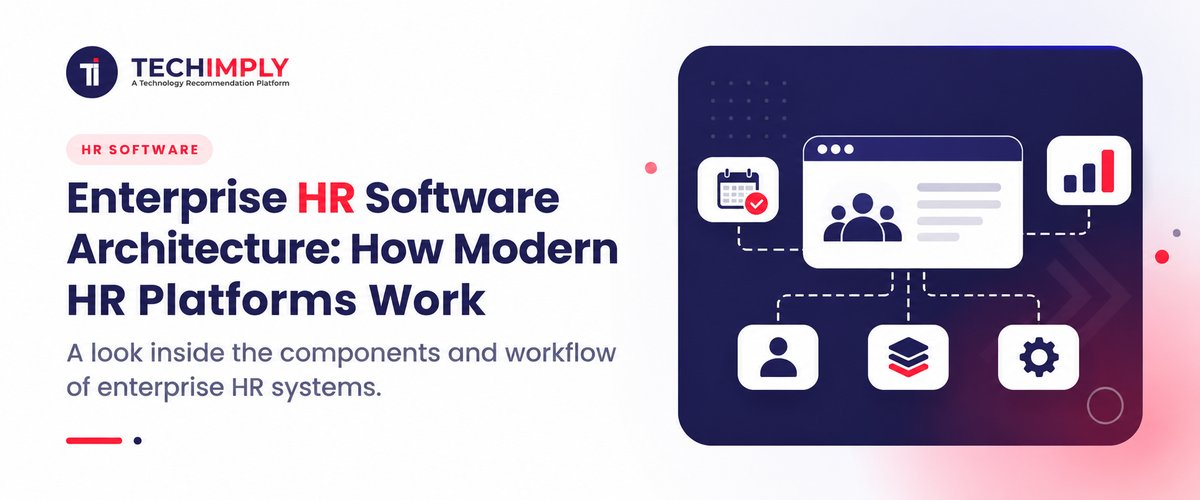
Modern enterprise HR systems function as the operational nervous system for people operations, combining deep data repositories with automated workflows. Underpinning these architectures are multi-tenant cloud models that deliver seamless updates, robust security, and real-time computation across the entire employee lifecycle.
Centralized Employee Data Layer
At the foundation of every robust enterprise HRM platform is a unified, single source of truth for all workforce data. This layer securely maintains comprehensive employee profiles, hierarchical organizational structures, salary benchmarks, benefit configurations, compliance records, and complete employment histories. By consolidating this data, organizations eliminate fragmented spreadsheets and data silos.
HR Application Layer
The application layer houses the functional modules that power day-to-day human resources tasks. This suite typically covers:
- Core HR: Personnel tracking, organizational data, and structural management.
- Payroll: Global and local compensation calculations, tax withholdings, and statutory deductions.
- Benefits: Health insurance, retirement plans, and perks enrollment.
- Recruiting & Onboarding: Sourcing, applicant tracking systems (ATS), and digital new-hire setup.
- Performance & Learning: Goal management, continuous feedback, reviews, and professional development.
- Time, Attendance & Workforce Management: Shift scheduling, time-off requests, and labor tracking.
Workflow & Automation Layer
This middleware layer handles multi-step approvals, employee self-service (ESS) requests, automated onboarding triggers, compliance tracking, and contextual notifications. It removes administrative friction by routing tasks dynamically based on predefined business rules.
Analytics & Reporting Layer
Advanced enterprise HRIS software provides executive dashboards, predictive workforce analytics, operational reporting, and decision-support engines. This transforms raw workforce data into strategic insights regarding turnover risks, labor costs, and talent gaps.
Integration & API Layer
Integration components ensure the platform communicates fluidly with external applications. This layer coordinates APIs, identity providers (IdPs), payroll engines, finance systems, enterprise resource planning (ERP) systems, ATS tools, and benefits platforms. Robust enterprise HR management software relies heavily on this infrastructure to unify enterprise HR software platforms and enterprise HR solutions into a single collaborative ecosystem.
Enterprise HR Software Architecture and ERP Integration
Enterprise HR platforms increasingly position integration with core enterprise infrastructure as a critical architectural capability. Rather than operating in isolation, the HR platform connects natively with broader corporate systems.
- HR Platform & ERP: Synchronizes organizational changes, headcount budgets, and cost-center allocations between human resources and overarching enterprise planning systems.
- Payroll & Finance: Directs compensation data, ledger entries, and tax liabilities directly into corporate financial systems for real-time general ledger (GL) reconciliation.
- Identity & Access Management (IAM): Provisions and de-provisions user accounts automatically using protocols like SAML and SCIM, reinforcing security from day one through day off-boarding.
- Workforce Management & External Apps: Aligns scheduling data with production requirements while hooking into collaboration tools, learning management systems, and specialized local point solutions.
Common integration approaches range from synchronous REST APIs and real-time webhooks to single sign-on (SSO), scheduled data synchronization, integration platforms (iPaaS), and secure batch file transfers for legacy data exchanges.
Enterprise HR Software Features
Evaluating options requires a concise framework covering essential operational pillars:
- Core HR and employee records: Centralized repositories for global personnel data.
- Payroll and compensation: Multi-currency, localized calculation engines.
- Benefits administration: Plan configuration, open enrollment, and carrier feeds.
- Recruiting and applicant tracking: Talent sourcing, pipeline management, and interview scheduling.
- Onboarding: Digital document signing, task automation, and equipment provisioning.
- Performance management: OKRs, KPI tracking, and 360-degree feedback.
- Learning and development: Compliance training catalogs and career pathing.
- Time and attendance: Biometric, web, and mobile punch tracking with rule enforcement.
- Workforce planning: Scenario modeling and headcount forecasting.
- Analytics and reporting: Custom report builders and pre-built executive dashboards.
- Employee self-service: Mobile-friendly portals for personal data, pay slips, and time-off requests.
- Compliance and security: Role-based access controls (RBAC), data encryption, and audit logs.
- Automation: Conditional triggers for repetitive administrative tasks.
- Integrations: Bi-directional data exchange with third-party software.
This breakdown directly addresses enterprise HR software features while addressing complex enterprise HR software requirements.
Enterprise HR Software for Large Companies and Organizations
Deploying technology for large enterprises involves navigating structural complexities that smaller businesses rarely encounter.
- Multi-Country Operations & Legal Entities: Managing separate subsidiaries, tax IDs, and statutory reporting across international boundaries.
- Complex Structures & RBAC: Enforcing granular, role-based access permissions that limit data visibility based on geography, business unit, or management level.
- Localization & Global Payroll: Translating interfaces into native languages, supporting multi-currency transactions, and ensuring adherence to localized labor laws.
- Scalability & Security: Handling high-volume employee data streams under strict enterprise security protocols (such as SOC 2 Type II, ISO 27001, and GDPR) alongside end-to-end auditability.
Organizations prioritizing these capabilities depend heavily on global HR software built specifically as enterprise HR software for large companies and enterprise HR software for large organizations.
Enterprise HR Software Implementation: Timeline, Process, and Challenges
When evaluating human capital management SaaS platforms, buyers frequently ask: "What is the average implementation timeframe for human capital management SaaS platforms?"
While standard implementations for mid-market deployments typically range between 3 to 6 months, enterprise-grade deployments across multinational footprints often span 6 to 12 months (or longer) depending on complexity.
The standard lifecycle follows ten structured phases:
- Requirements discovery: Documenting business processes and technical constraints.
- Vendor selection: Demonstrations, RFPs, and contract negotiations.
- Data preparation and migration: Cleaning, mapping, and testing legacy employee data.
- Configuration: Setting up business logic, approval chains, and UI layouts.
- Integrations: Establishing secure connections with ERP, payroll, and IAM tools.
- Testing: User acceptance testing (UAT) and end-to-end scenario validation.
- Training: Admin certification and end-user enablement.
- Pilot: Controlled rollout to a specific business unit or geography.
- Go-live: Full system launch and legacy system decommission.
- Post-launch optimization: Continuous tuning and feedback integration.
Timelines vary significantly based on employee headcount, operating countries, active modules, data cleanliness, custom configurations, and migration depth.
Enterprise HR Software Pricing and Cost
Navigating enterprise HR software pricing requires looking beyond base subscription fees to understand total ownership costs. Enterprise HR software cost models are driven by several key factors:
- Per-Employee-Per-Month (PEPM) or tiered subscription fees based on headcount.
- Modules purchased (e.g., adding advanced talent intelligence or global payroll accelerators).
- Geographic coverage and multi-entity setup complexity.
- Professional implementation services and consulting hours.
- Custom integration development and ongoing middleware maintenance.
- Data migration scope and historic record conversion.
- Tiered support levels, dedicated customer success, and admin training programs.
TCO Insight: Software subscription costs typically represent only 40% to 50% of the three-year Total Cost of Ownership (TCO). Professional services, change management, custom integrations, and internal resource allocation account for the remainder.
How to Choose Enterprise HR Software
Selecting the right platform requires a rigorous, multi-phase buying framework.
Define Your Enterprise HR Software Requirements
- Business requirements: What operational bottlenecks must the system solve?
- Technical requirements: Cloud availability, uptime SLAs, and architecture preferences.
- Security requirements: Data residency, encryption standards, and compliance certifications.
- Integration requirements: Required bi-directional data sinks and API throughput limits.
- Compliance & Reporting requirements: Statutory reporting rules and custom data visualization needs.
- Global workforce requirements: Multi-currency, multi-entity, and multi-language support.
Evaluate Enterprise HR Software Vendors
Assess prospective enterprise HR software vendors using objective criteria: functional coverage, horizontal scalability, integration resilience, security posture, global depth, user experience ratings, implementation backing, analytics depth, customer support quality, and total cost of ownership. Knowing how to choose enterprise HR software depends on balancing immediate functional needs with long-term strategic agility.
Enterprise HR Software Comparison: What Should You Compare?
Rather than relying on subjective vendor lists, evaluate platforms using a structured comparison framework:
|
Criteria |
Questions to Ask |
|
Core HR |
Can it handle complex, matrixed employee structures and multi-tiered approval chains? |
|
Global HR |
Does it natively support multi-country operations, local compliance, and multiple legal entities? |
|
Integrations |
How smoothly does it connect with enterprise ERP, finance, and specialized payroll systems? |
|
Security |
What granular role-based access controls, encryption, and immutable audit logs exist? |
|
Scalability |
Can the architecture support rapid workforce growth without performance degradation? |
|
Automation |
Which manual HR administration processes can be automated through conditional logic? |
|
Analytics |
What real-time workforce data can be modeled for predictive decision-making? |
|
Implementation |
What professional resources, partner networks, and timeframes are required? |
|
Pricing |
What structural components contribute to long-term total cost of ownership? |
Enterprise HR Software Buying Guide
Use this actionable checklist to guide your procurement journey:
- Define overarching strategic business goals.
- Map existing end-to-end HR workflows and identify process gaps.
- List mandatory system integrations and data dependencies.
- Document regional and industry-specific compliance requirements.
- Estimate short-term and 5-year employee volume growth.
- Shortlist qualified vendors matching technical specifications.
- Request structured, use-case-specific software demos.
- Run sandbox-based evaluations with cross-functional team members.
- Validate implementation partner resources and SOW terms.
- Calculate 3-year and 5-year TCO projections.
- Check peer references operating in your specific industry.
- Build a comprehensive data migration and change management strategy.
Enterprise HR Solutions: What Does the Future Look Like?
The evolution of modern enterprise HR solutions is being shaped by transformative technological advancements. Artificial intelligence is shifting from a novelty to an embedded operational layer, driving AI-assisted HR workflows, automated talent matching, and predictive workforce analytics.
Furthermore, modern enterprise HR software solutions are leaning heavily into API-first architectures and composable HR technology frameworks. This shift enables organizations to plug-and-play specialized modules without sacrificing data integrity, ensuring that global workforce management remains agile, secure, and deeply integrated with overarching enterprise strategy.