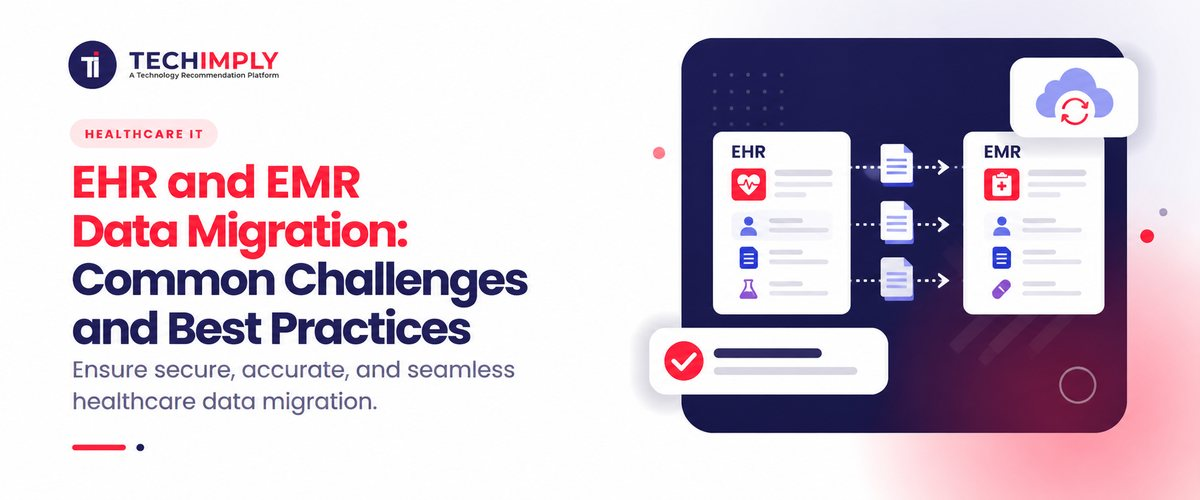
The process of migrating Electronic Health Record (EHR) and Electronic Medical Record (EMR) systems in India is fraught with many challenges, as this highly regulated activity necessitates the organization to gain operational continuity while ensuring the integrity of patient data. With organizations in the healthcare sector striving to enhance their infrastructure to improve interoperability, streamline processes, and adhere to changing government regulations, including HIPAA and the 21st Century Cures Act, they inevitably come across several hurdles associated with the migration. Some of the issues that organizations may face include the incompatibility of the legacy system as well as non-standardized formats of data, incomplete or duplicate patient information, and the critical need to prevent downtime when patients are being treated. It is necessary to adopt some of the best practices in the industry, such as thorough data cleansing before migration, having reliable field mapping protocols, multi-step testing, and being compliant throughout the process for a successful migration.
What is EHR and EMR data migration, and why does it matter for Indian Healthcare Providers?
Data transfer of EHR (electronic health records) and EMR (electronic medical records) is described as the movement of vital information such as patient records, medical histories, billing details, or notes to the new electronic platform. This process in the medical field in India usually occurs when a healthcare practice switches software vendors, merges entities, or upgrades from outdated IT equipment or local storage to state-of-the-art technology. Moreover, the term EHR transfer does not simply mean file moving from one computer to another, but implies converting the data between various formats, re-mapping complicated medical codes such as ICD-10 and CPT, and ensuring that the years of sensitive information of patients are neither lost nor mis-encoded.
For healthcare professionals in India, data migration is crucial not only from the regulatory perspective, but also for the sake of smooth running of operations. As per the federal regulations, it is essential to observe HIPAA and the 21st Century Cures Act. In case of the data being breached or lost, the consequences can be devastating for the providers.
Also, uninterrupted migration affects patient safety and operational continuity. If critical information like the existence of drug allergies, current prescriptions, and previous surgeries is either improperly processed or lost during the migration, healthcare providers are likely to put patients at risk.
Did You Know?
According to research results, hospitals that migrate their medical record systems without thorough data cleaning beforehand tend to have from 20% to 30% duplicate records in the new system. Not only does this lead to increased costs of data processing and other operational troubles, but duplicate medical records are also among leading causes of preventable cases of patients’ misidentification, according to the ECRI Institute.
Why is EHR and EMR Data Migration so important for Modern Medical Practices?
Today's healthcare organizations know migrating their electronic health records (EHR) and electronic medical records (EMR) is not simply about technology upgrades; it revolves around the very core of healthcare business operations and the rapid development of health technology and evolving standards. This process connects the old legacy systems to the new cloud-based technologies; data migration helps organizations integrate their past experiences with future technological innovations. Cloud-based indian solutions enable medical institutions to obtain advanced analytic results, automation tools, and telemedicine equipment so that millions of paper records can become useful in terms of providing quality healthcare to patients while improving clinical outcomes.
In addition to technological effectiveness, the process of data migration is also important to fulfill stringent federal laws like the HITECH Act, HIPAA, and the 21st Century Cures Act. The last one involves strict punishment for information blocking, which obliges medical facilities in India to enable easy patient records access for patients as well as across various systems. In accordance with historical data, such as immunization history, allergy data, and data on previous diagnostic images, it is properly transferred according to standardized forms (the so-called FHIR format). Due to this standardized data management method, medical organizations can freely share medical records with hospitals, laboratories, and specialists while not worrying about violations of privacy and incurring additional costs on compliance checks.
The ultimate benefit associated with a successful migration translates into preserving safety standards for patients and ensuring continuity in clinical care. As a patient enters the examination room, full medical histories must be available for clinicians' critical decisions related to diagnosis, the possibility of drug interactions, and treatment. Failure to migrate data correctly may lead to missing trends in lab results, misplaced documents, and a lack of a proper medication list, which can seriously threaten patients. By following careful data migration, modern practices ensure data integrity for clinicians.
What are the most Common Challenges of EHR and EMR Data Migration?
- Issues with Various Formats of Data and Poor Standardization: Multiple legacy systems tend to use formats that are outdated, proprietary codes, or disordered words while storing patient case management information. It may be said that while converting entries that lack any standardized format into a format recognized by modern EHR systems, mapping problems may arise.
- The Issue of Duplicate and Corrupted Data: A lot of old databases contain either duplicated or corrupted data. The inability to preprocess this data beforehand could lead to the issue of identity matching, which will eventually lead to increasing costs of storage and may create serious threats for the health of patients.
- The Issue of Legal Compliance and Vulnerability of Data: Transfers of the so-called Protected Health Information (PHI) may be accomplished only within the framework of important legal regulations such as HIPAA. Failure to comply with laws may lead to consequences for healthcare providers either when they perform unprotected transfers of data, fail to secure the application programming interface during migration, or improperly control access to the database.
- Scope Realities and Misalignment: It is very expensive or impractical to transfer decades’ worth of databases to a new EHR. Finding out which active records to transfer and which inactive records to archive while staying compliant with legal requirements can be complicated.
- Downtime and Potential Disruption of Clinical Workflow: Healthcare facilities continue to run smoothly all the time. Changing systems can be disruptive for clinical work by making appointment scheduling impossible.
- Data Integrity Loss and Historical Records Loss: Complicated data like lab trends over time, vital signs history, testing images, and medication records can be lost during transfer. This means that doctors may not have reliable information while treating patients.
How do HIPAA and Compliance rules shape EHR and EMR Data Migration?
- HIPAA Security Rule & Technical Safeguards: HIPAA’s Security Rule states that all organizations must implement measures that protect Protected Health Information (PHI) at all times. This means that organizations are required to encrypt health information before it gets transmitted from one location to another using a secure end-to-end encryption technology such as TLS 1.2+. Furthermore, PHI should also be kept encrypted when in storage using encryption technologies such as AES-256.
- Business Associate Agreements (BAAs): HIPAA stipulates that every vendor, cloud service company, or migration consultant who interacts with PHI should not only protect the information, but they should also draft and sign a BAA. This ensures that these third parties use similar security protocols and assume responsibility for data protection during migration processes.
- Privacy Rule & The Minimum Necessary Principle: The HIPAA Privacy Rule prohibits passing live patients' records around randomly. The IT organization is required to limit access to authorized personnel and use only de-identified or masked synthetic data while performing various automated testing processes and sandbox migrations.
- HIPAA Security Rule & Technical Safeguards: Organizations must comply with the Security Rule's demand for strict enforcement of security measures on Protected Health Information (PHI) in transit. This includes using end-to-end encryption technology while transmitting PHI (such as TLS 1.2+) and encryption technology during storage (such as AES-256) on staging servers, databases, and pipelines.
- Business Associate Agreements (BAAs): In accordance with HIPAA regulations, all third-party vendors or consultants in cloud service providers must execute Business Associate Agreements regarding the transmission of PHI. This ensures that these third parties use similar security protocols and assume responsibility for data protection during migration processes.
- Privacy Rule & The Minimum Necessary Principle: The HIPAA Privacy Rule prohibits passing live patients' records around randomly. The IT organization is required to limit access to authorized personnel and use only de-identified or masked synthetic data while performing various testing processes and sandbox migrations.
What Costs should Healthcare Organizations expect during EHR and EMR data Migration?
- Legacy Vendor Extraction & Exit Fees: It is standard practice for the vendors of outgoing electronic health records (EHRs) to impose hefty fees for some services necessary in connection with access to data stored in the proprietary format of the vendor. For example, the vendor may impose a fee amounting to several cents for exporting its databases in a usable form, which may include various formats (e.g., CSV, XML)
- Data Cleaning, Normalization & Custom Field Mapping: It is indeed time-consuming to convert corrupted or logically disarranged legacy data into a format that can be used by the EHR. For that purpose, the hospitals will incur expenses in the form of the cost of special software India solutions and database experts who will lead the process of cleaning the data.
- Interface, Integration & API Build Costs: The establishment of connection points between the new EHR system and other internal systems requires financial analysis investments in connection with interface construction and licensing costs associated with the use of interfaces (such as FHIR or HL7).
- Legacy system upkeep and Dual Licensing: In order to guarantee that data is accessible and a total cross-verification occurs before the previous database is retired, healthcare providers must bear the cost of dual licensing, cloud computing, and technical assistance of both the new and old platforms during the transition stage.
- Factors of Legality and Data Storage Methods: Making sure that patients’ inactive records are stored in compliance with local and federal laws (which often require retention for 6-10 years or more) requires the use of cloud storage exclusively for this purpose or an installation of vendor-neutral archiving systems (VNA) which meet HIPAA requirements for encryption and auditing.
How do you build a Successful EHR and EMR Data Migration Strategy?
- Governance Permits Data: A cross-functional leadership team is composed of IT professionals, Chief Medical Officers, compliance officers, and specialists in Health Information Management (HIM). For future data integration to be performed properly, data retention requirements should be set at the pre-investigation phase by integrating a complete data set regarding active patients for the last 3 to 5 years and keeping all inactive or obsolete data in a vendor-neutral storage facility.
- Conduct Data Validation: Examine the data repositories for errors at source and check that there are no missing data, corrupt files, or duplicated records. The electronic medical information should be converted into an easily readable format, and all duplicated records in the master index should be eliminated.
- Transfer data correctly preserving meaning: The list of attributes of the previous and new information systems should be developed.
- Execution of Risk Testing and Validation: Use sample information to conduct consecutive test runs before implementing full migration processes in a non-production testing environment. Check the accuracy of the data in 3 areas: technical (completeness of data as a count), functional (interrelationships of processes that reflect the medical practices), and medical safety (compliance in terms of dosage, allergies, and lab data).
- Establish HIPAA Protection Measures: Safeguard Protected Health Information (PHI) during the information extraction, storage, movement, and uploading processes. In terms of technology, make sure that it is protected with strict encryption technology (TLS 1.2 during the movement and AES-256 during storage), recommend that the company implement role-based access control, and check whether Business Associate Agreements (BAA) with data migration companies have been signed and maintained.

Pro-tip
Implement a phased approach to a company-wide rollout, beginning with a single department, so that your network of teams can fine-tune mapping for data in advance, making mistakes easy to spot. Additionally, test the old system and the new system at the same time for two weeks, so no patient care is going to be impacted while making sure the new system captures real-life clinical processes accurately. Finally, having an unalterable audit log that meets HIPAA standards created during the processes of extraction and loading would guarantee absolute data integrity.
What are the Best Practices for a smooth EHR and EMR Data Migration?
- Establishing a Multidisciplinary Steering Committee: Organize a cross-functional governance body made up of professionals in the fields of IT, Chief Medical Officers (CMO), Health Information Management (HIM) chiefs, legal compliance staff, and revenue cycle managers. This committee will be tasked with overseeing that migration regulations adhere to clinical, legal, and operational requirements.
- Establish Sufficient Scrutinizing Measures and Archiving Guidelines: It is crucial to start by determining whether the data should be moved to a new system or archived. The most effective approach involves moving active records only (for example, patients who have been treated within the past 3 to 5 years) and archiving cold historical files in simple, cheap read-only archives to meet legal requirements.
- Complete Proper Data Preparation and Pre-cleaning: The legacy database must be carefully examined before migration. For example, the process may involve removing duplicate patient entries as well as correcting incomplete demographic data and unifying manual data entries.
- Adopt a phased testing Strategy and Validation Process: Start the process with preliminary tests in non-productive sandbox environments using anonymized real data. Validate data in terms of technical counts (checksum and record matching), functional UI accuracy, and clinical user acceptance testing (UAT) with practicing physicians.
Conclusion
Successful EHR and EMR data migration is essential for modernizing clinical workflows, complying with HIPAA regulations, and ensuring uninterrupted patient care. As there are many challenges related to this process, such as field mapping, data integrity issues, and compliance with requirements, proper strategy implementation can lead to the successful completion of this process. Those who want to make this process easier can visit Techimply, a unique software comparison platform that allows them to discover, compare, and purchase any software available on the market with the help of the latest technology.

.png "How to Design an Optimal Recruitment Process in 2023")