


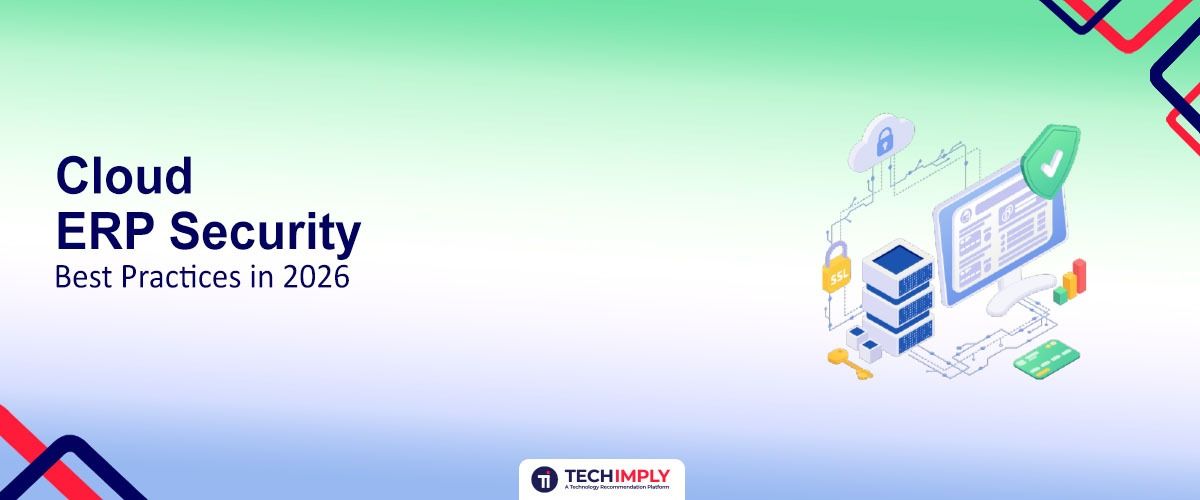
Let’s be real for a minute. Shifting your whole business infrastructure over to the web is honestly a total no-brainer for any growing company these days. Think back to how old corporate offices looked just a short while ago. You had these massive, heavy metal server racks humming in a back closet all day, tangled wires all over the floor, and cooling fans blowing non-stop.

Looking for ERP Software?
Check out Techimply's List of the Best ERP Software in India for your business.
Thank goodness for that! They want better flexibility, and they hate paying massive upfront hardware bills. But the second you throw your internal banking sheets, staff payroll logs, and shipping schedules online, a giant question hits you square in the face. How do you actually keep your private company records safe from modern web thieves? That is the exact reason why locking down your Cloud ERP Security has become a top priority for corporate boards globally. By taking a smart, early approach to ERP Cybersecurity, you get to enjoy the freedom of remote work without leaving your business wide open to web attacks.
What Is Cloud ERP Security?
When we say Cloud ERP Security, we are basically talking about the full mix of tools, daily habits, and staff rules built to protect your online business software from data leaks and unwanted eyes. Your company's central database holds the real lifeblood of your entire business. It handles everything from staff salary sheets and client deals to design blueprints and daily sales tracking. Keeping this setup safe means building a bunch of different protective layers around your records.
It is super important to remember that locking down a web setup is totally different from guarding an old office network. In the past, companies relied on a basic perimeter style, which just meant putting a strong firewall around the physical building. But with a modern Cloud ERP Software, your team members are logging into the system from home offices, coffee shops, and airport lounges all over the globe.
Since those old office walls don't exist anymore, your safety rules have to travel right along with the files. A solid ERP Security plan covers every single corner of your digital setup, from web data pathways to the laptops your staff uses at home. It makes sure your remote workers can check inventory files or sign off on bills smoothly, while instantly blocking any weird login attempts coming from random corners of the web.
Why Cloud ERP Security Matters in 2026
The massive focus on high-level ERP Cybersecurity comes down to real-world business logic and huge shifts in how we work. Over the last couple of years, hybrid work schedules have permanently changed how corporate teams log into work systems. When you have hundreds of employees connecting to your central database using their basic home internet routers, the number of open doors for hackers completely skyrockets.
On top of that, international privacy boards are handing out huge cash penalties for business data leaks. Leaving your customer contact files or supplier tax records unprotected can bring massive legal fines that can easily wipe out a scaling company's yearly profits. Running a safe Cloud ERP Software isn't just a fun project for your IT team anymore. It is a strict legal requirement if you want to keep your business operating without getting hit by regulators.
We also have to look at how smart modern business spying has become. Rivals and rogue groups are always hunting for unpatched spots to swipe factory designs, client lists, and pricing sheets. If your firm relies on weak, outdated safety setups, you are essentially leaving your front gate wide open. Investing in real ERP Security layers guards your secret business recipes and gives your investors total peace of mind.
Top Cloud ERP Security Best Practices
To actually protect your corporate logs from modern web threats, you need a smart defense plan with a lot of variety. Putting the right technical boundaries inside your Cloud ERP Security dashboard ensures that every single login attempt, file transfer, and back-office task stays tracked and verified.
1. Setting Up Multi-Factor Authentication (MFA)
Let’s be real, just using a username and password doesn’t cut it anymore. Passwords are either too easy to guess or end up leaking somewhere on the internet. Make your team use Multi-Factor Authentication. This is not about typing a password. Now they have to prove who they are with a phone, a fingerprint, or a code from an app. Multi-Factor Authentication is a thing. It can be a face scan. It can be a one-time code. Whatever the method is, Multi-Factor Authentication blocks every automated hack before it even starts. If someone gets your password,d they are not getting in without that second check from Multi-Factor Authentication.
2. Locking Down Role-Based Access Control
You need to set up clear permission limits to manage your team members across different departments. Seriously, nobody in your office needs to see every single file, especially master financial ledgers or top-secret executive salary files. When you set up clear permission levels, your warehouse crew only sees inventory sheets, sales reps stick to customer files, and HR only dives into employee folders. Limiting where people can go in the system keeps your data safe. If someone’s account gets hit by a phishing scam, the damage stays contained.
3. Deploying Heavy Data Encryption
To keep your commercial transactions completely private from snooping eyes, you must encrypt all your data both while it travels across the web and while it sits on cloud storage drives. Think of this as scrambling your plain numbers and text into weird code strings. Even if a hacker manages to intercept your weekly bank payout files or supplier contracts during transit, they won't be able to read anything without your unique digital keys. It just looks like complete gibberish to them, which keeps your records totally safe.
4. Staying Up to Date with Regular Security Updates
Your IT team must implement a strict routine for patching backend systems against fresh code defects. Software developers are constantly finding hidden vulnerabilities in their application codes and releasing quick digital patches to fix them. Setting up automatic software patches ensures that your Cloud ERP Software stays completely immune to the latest malware types, preventing hackers from finding an easy backdoor into your business databases. If you ignore these pop-up alerts, you are basically leaving your front door unlocked.
5. Moving to a Zero Trust Network Architecture
The old idea of trusting a user just because they are sitting inside the main office building is completely dead. This strategy means you never trust any user blindly, no matter who they are. Every single digital transaction taking place across the cloud platform requires continuous authentication, authorization, and validation. If a manager tries to look at a sensitive financial ledger from an unfamiliar tablet or a random hotel network, the system instantly halts the request until further security checks clear.
6 . Tracking Everything with SIEM Logs
You can't just set up security tools and walk away; you need a system that watches the network 24/7. Deploying automated tracking tools helps security teams monitor database event logs in real time. SIEM platforms watch over data coming in from all your company’s apps, looking for anything out of the ordinary. Picture a manager up late at night, suddenly downloading thousands of client contact lists. Yeah, that’s the kind of thing they catch. The system immediately alerts admins, giving them a chance to lock things down before any real damage happens.
7. Auditing Outside Vendor APIs
Modern enterprises link their primary cloud storage spaces with external software plugins to speed up logistics, marketing, and client care. But every extra connection is a potential doorway for a hacker. To keep your perimeters safe, your IT professionals must conduct rigorous evaluations of every third-party system entry point. Ensuring your business software integrations run on secure, authenticated tokens prevents external system defects from serving as a bridge for network attackers.
Common Cloud ERP Security Risks
Even when you buy an expensive software package, managing a digital workplace always brings a few common risks that managers have to watch out for constantly. The weakest link in any corporate network is almost always the human side of things. Simple slip-ups, like a worker clicking on a fake email link, writing their network password on a notepad, or opening a weird file on a work computer, can bypass the strongest digital shields in a second.
Another huge threat comes from messy cloud settings during the very first system setup phase. If your internal tech crew or your external setup partners forget to turn on basic database encryption or accidentally leave your cloud storage folders set to public, your private data becomes visible to anyone who knows how to search for it. These setup mistakes happen way more often than you'd think when companies rush their web transition without using a proper checklist.
Finally, you have to watch out for third-party connection traps. Modern businesses love to hook up their central Cloud ERP Security space with external software tools, like customer tracking apps, automated shipping maps, or email marketing platforms. If just one of those small, outside vendors has a weak safety setup, hackers can use that compromised app as a stepping stone to crawl straight into your main business vault.
How to Choose a Secure Cloud ERP Solution
Finding a truly safe software vendor means looking way past pretty marketing websites and asking tough, technical questions about how they handle data protection. You should start your search by checking out the actual physical buildings where the vendor keeps their cloud servers. High-quality brands always host their systems inside world-class data centers managed by massive tech firms like Amazon Web Services, Microsoft Azure, or Google Cloud, which feature 24/7 security guards and biometric locks.
Next, you need to ask for proof of their international compliance badges. A trustworthy software provider should easily show you recent compliance reports like SOC 1, SOC 2, and ISO 27001 audits. These badges prove that outside digital security experts have completely tested the vendor's internal code, data rules, and employee hiring checks to confirm they meet global standards.
Lastly, make sure you understand the vendor's backup and recovery rules. Ask them exactly how often they run automated system saves and how many minutes it takes to get your business back online if a server goes down. A reliable partner will always store copies of your data across different geographic regions. This ensures that an unexpected storm or power cutout in one city won't cause permanent data loss for your business.
Conclusion
Stepping into the future of digital business means taking Cloud ERP Security completely seriously from day one. Migrating your daily operations onto a modern Cloud ERP Software platform provides your business with incredible market speed and financial savings, but those wins only count if your data stays fully protected.
The baseline trends in corporate computing show that total digital connectivity is the new standard. Businesses that ignore basic ERP Security protocols will find themselves dealing with devastating financial losses and stressful legal battles that can easily derail their market momentum. Take a close look at your company's digital access points today, train your team to spot modern online scams, and build a multi-layered protection strategy that keeps your business running safely for decades to come.


.jpg "What will Be the Next Decade's Progress in the World of Applications?")


