


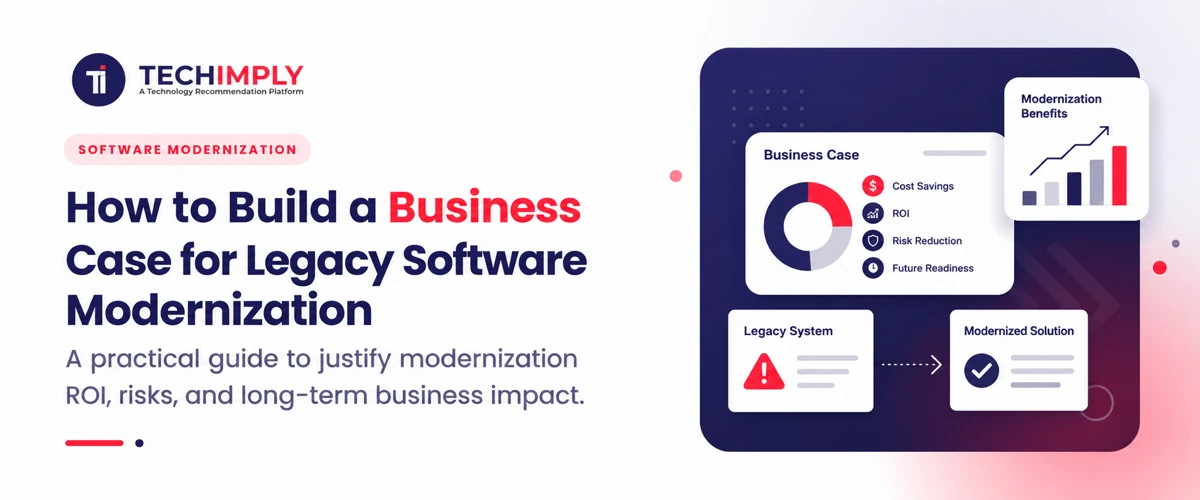
ModLogix operates in the specialized field of legacy software modernization, where technical improvements must be connected to clear business outcomes. An aging application may be expensive to maintain, difficult to secure, or unable to support new products, but these limitations do not automatically justify a complete rebuild.
Decision-makers need evidence showing why change is necessary, which modernization approach is appropriate, what it will cost, and how the organization will manage operational risk.
A well-structured business case turns technical concerns into measurable priorities that business and technology leaders can evaluate together.
Define the Current Business Problem
The business case should begin with the consequences of leaving the system unchanged.
Technical debt is important, but the term may not explain why investment is required. The proposal should describe how the application affects costs, employees, customers, security, and future development.
Common warning signs include:
- increasing maintenance effort
- frequent defects or outages
- dependence on unsupported technologies
- difficulty finding developers with relevant skills
- slow delivery of new functionality
- limited integration options
- inadequate security controls
- poor application performance
- inaccessible or inconsistent data
- reliance on manual workarounds.
Each problem should be supported by evidence where possible. Incident records, maintenance hours, delayed projects, customer complaints, security assessments, and infrastructure costs can demonstrate the operational effect of the legacy system.
Calculate the Cost of Doing Nothing
Organizations often compare modernization costs only with the current annual technology budget. This can make continued maintenance appear less expensive because the wider consequences are excluded.
The cost of doing nothing may include:
- developer time spent on emergency fixes
- infrastructure and software licences
- prolonged outages
- security remediation
- manual data entry
- delayed product launches
- lost sales opportunities
- employee training on obsolete systems
- dependence on a small number of specialists.
Opportunity cost is particularly important. A system may continue operating but prevent the organization from integrating a new service, entering a market, or responding quickly to regulatory requirements.
Not every cost can be calculated precisely. Assumptions should be documented and presented as estimates rather than facts.
Identify the Required Business Capabilities
The project should not be framed solely as replacing old technology with new technology. It should explain which business capabilities the organization needs.
Examples may include:
- faster introduction of new features;
- secure remote access
- real-time data exchange
- improved reporting
- integration through APIs
- higher transaction capacity
- shorter recovery time
- support for mobile users
- stronger access controls
- reduced manual processing.
These capabilities provide a foundation for comparing modernization options. They also help prevent the project from expanding into changes that offer limited business value.
The target should be a system that supports the organization’s future needs, not simply a newer version of the current application.
Assess the Existing System
A credible business case requires a technical and operational assessment.
The assessment should examine:
- source code and architecture
- databases and data quality
- internal and external integrations
- infrastructure
- third-party dependencies
- security vulnerabilities
- application performance
- deployment and testing practices
- documentation
- business-critical workflows.
Employees who use and maintain the application should participate. Code can show how a feature works, but users may understand why it exists and what would happen if it changed.
The assessment should identify which components remain valuable, which create the greatest risk, and which can be retired.
Compare Modernization Strategies
Modernization does not always require rebuilding the entire application. The business case should compare realistic alternatives.
Rehosting moves the application to new infrastructure with minimal code changes. It can address hardware or hosting risks but generally preserves the existing architecture.
Replatforming introduces limited changes so the application can use a newer platform, database, or managed service.
Refactoring improves the internal code while retaining the application’s external behaviour.
Rearchitecting changes the system’s structure to improve scalability, maintainability, integration, or deployment.
Rebuilding creates a new version of the application, while replacement moves the organization to an existing commercial product.
Retirement removes functionality that no longer provides sufficient value.
A programme may combine several strategies. Stable components can remain in place while restrictive modules are refactored, rebuilt, or replaced.
Estimate Costs Transparently
Modernization estimates should include more than development work.
Potential cost categories include:
- system assessment;
- architecture and planning
- software development
- data preparation and migration
- infrastructure and cloud services
- third-party licences
- security testing
- quality assurance
- employee training
- parallel operation
- documentation
- post-deployment support.
Legacy environments often contain undocumented dependencies, making precise early estimates difficult. The business case should therefore include assumptions, ranges, and contingency rather than presenting an uncertain number as fixed.
A paid discovery phase or technical pilot can improve the reliability of later estimates.
Quantify the Expected Benefits
Benefits should be linked to measures that the organization can track before and after modernization.
Possible indicators include:
- maintenance hours
- incident frequency
- application availability
- infrastructure costs
- deployment frequency
- time required to deliver a feature
- system response time
- manual processing effort
- security findings
- employee or customer completion rates.
Financial benefits may include reduced support costs, lower infrastructure spending, or additional revenue enabled by new capabilities.
Benefits should not be overstated. Some improvements may take time to appear, and modernization may initially increase operating costs while old and new environments run together.
The business case should distinguish direct savings, avoided future costs, and potential revenue opportunities.
Address Operational Risk
Decision-makers need to understand how the project will protect critical business operations.
A large one-time replacement may create more risk than an incremental approach. Organizations can divide modernization into smaller stages, beginning with the components that offer high value and manageable complexity.
Risk controls may include:
- characterization and regression testing;
- phased data migration
- user acceptance testing
- parallel operation
- performance testing
- security reviews
- production monitoring
- backups
- rollback procedures
- defined decision points.
The project plan should also identify dependencies on employees, external providers, licences, and legacy technologies.
A transparent description of risk strengthens the business case. Claiming that modernization can occur without uncertainty is unlikely to be credible.
Protect Business Logic and Data
Legacy applications often contain important rules that are missing from formal documentation. These may include calculations, validation, reporting logic, permissions, and unusual exception handling.
Characterization testing can record how the current system behaves before changes begin. Business stakeholders should then verify which behaviours must remain and which can be removed.
Data migration requires similar care. Older databases may contain duplicated records, missing values, inconsistent formats, and poorly documented relationships.
The migration plan should define what data will move, what can be archived, how quality issues will be resolved, and how the final result will be validated.
A technically modern application will not create reliable outcomes if its underlying data is inaccurate.
Create a Phased Roadmap
The business case should propose a realistic sequence rather than treating modernization as a single release.
An initial phase may focus on assessment and risk reduction. Later stages can address integrations, high-maintenance modules, data, infrastructure, and user-facing functionality.
Each phase should have:
- defined deliverables
- expected business value
- estimated cost
- technical dependencies
- acceptance criteria
- risk controls
- responsible owners.
A phased roadmap allows the organization to learn from early work and adjust later investment. It can also begin producing value before the entire programme is complete.
Establish Ownership and Governance
Modernization requires cooperation between technology teams, business leaders, users, security specialists, and external providers.
The programme should assign responsibility for architecture, scope, data, security, testing, and business outcomes.
A governance process should explain how priorities, risks, budget changes, and scope decisions will be reviewed. Without clear ownership, the project may become a technical initiative disconnected from operational needs.
Knowledge transfer should also be included. Internal teams need sufficient documentation and training to operate the modernized environment after implementation.
Present a Decision, Not Just a Problem
A strong business case should end with a clear recommendation.
It should summarize:
- why change is necessary
- what happens if the organization delays
- which approach is recommended
- why alternatives were rejected
- what the project is expected to cost
- what benefits it should produce
- how risk will be controlled
- which decision is required now
Decision-makers should be able to understand both the value and uncertainty of the proposal.
Conclusion
A legacy modernization business case connects technical limitations with their financial, operational, and strategic consequences.
It should compare the cost of change with the cost of continued maintenance, define the capabilities the organization needs, and evaluate several modernization options rather than assuming a complete rebuild.
With reliable assessment, measurable outcomes, transparent assumptions, and a phased roadmap, organizations can make modernization decisions based on evidence and move forward with greater confidence.

.jpg "Protecting Your Systems: The Importance of Vulnerability Scanning")
.png "5 Essential Actions That Should Be Considered When Creating Healthcare Software")


