For freelancers in India, choosing billing and invoicing software can lead to many changes. This software can help them comply with the tax laws of the country. Moreover, this software can simplify their payment receipts from overseas clients. The best option for freelancers in India is an application that suits their specific needs and fits the Indian fiscal environment in terms of tax compliance, i.e., specially designed to handle GST (including automatic operation with SAC codes, calculating IGST/CGST in every Indian state, etc.). Besides, the software should also be able to integrate with Indian payment gateways so that payment collection is as easy as possible.
What is Billing and Invoicing Software, and how does it work?
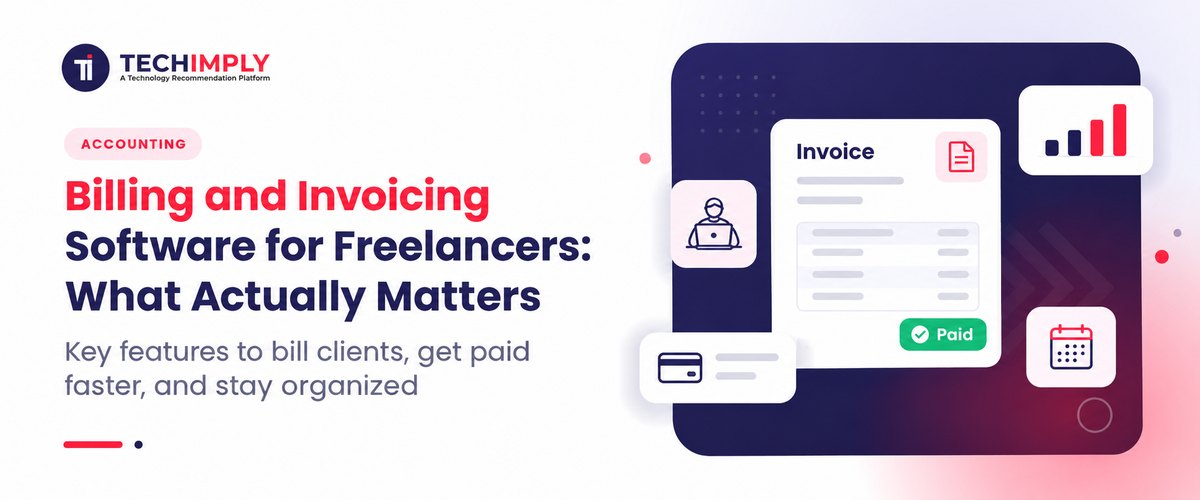
Online tools for invoices and payments assist both businesses and their clients, like freelancers, in executing payments easily without too much effort. You no longer have to open a word processor just to write each invoice by hand. The invoice software allows you to generate a new invoice almost instantly because it comes with various pre-made templates. A variety of programs can be used for tracking the hours worked by employees, listing the billable hours, calculating any applicable taxes, including GST billing, and applying discounts where necessary. As soon as you finish creating the invoice, you can send it as soon as you want via email or any other messenger. The client receives a payment link through which he can pay.
The software works in the background as a system managing the steps associated with payments. The moment money is collected, it will mark the invoice as paid and make the necessary changes in the accounting process. In case an invoice hasn’t been paid, it will independently send reminders, thus saving time and effort usually spent on various communications concerning unpaid bills. Some software also provides an option to send recurring invoices for ongoing projects. It is also possible to attach notes to invoices for expense purposes, change currency, and create reports.
Did you know?
Modern invoices take less than a third of the time to process payment compared to manual processing of payments because they embed instant 'Pay Now' buttons and QR codes in the client's e-invoice. Traditional invoices in paper form or simple emailed PDF format function much more slowly, as they often take anywhere between 21 and 30 days before they are settled in full. On the flip side, e-invoices with direct links for payment get settled within a few hours after receipt,pt usually from 24 to 48 hours.
Why does Billing and Invoicing Software matter so much for Freelancers in India?
Freelancers in India rely on using billing and invoicing software for more than just convenience; such platforms allow avoiding tax compliance problems as well as bottlenecks with cash flow. Working in the Indian economic environment means dealing with specific rules of GST and SAC numbers that should be tagged correctly, as well as calculating other essential parameters of the tax like IGST, CGST, and SGST. Manual invoicing often results in problems with compliance as a result of making errors in tax calculations and having missing invoice number information. Automated systems help with ensuring that invoices meet the requirements.
In addition to compliance, these tools speed up the payment process of freelancers. The process of requesting overdue payments from clients can be a challenging one. Fortunately, the practice can be streamlined through automation by using specialized software that can send gentle reminders via email or WhatsApp on autopilot. By using payment processors such as UPI, Razorpay, or credit card transactions, clients can pay their dues in a couple of clicks with instant acknowledgement. For freelancers, this also means less waiting. They do not have to wait for weeks just to receive money.
Working with clients outside India can be tricky. You may run into currency conversion issues and export paperwork. The good part is that Indian invoicing tools can handle cross-border payments by creating invoices in the client’s currency. They also use live exchange rate calculations and connect with payment gateways.
What Features should Indian Freelancers look for First?
1. Automated GST compliance and SAC mapping
No manual interference is needed to apply place-of-supply rules, i.e., CGST + SGST (9% + 9%) in case of clients based in your state, or IGST for out-of-state clients at 18%. Also, the software has to store your GSTIN and, using that, automatically prefill the mandatory SAC (Services Accounting Code) numbers specific to your domain. For example, if you are into software development, the SAC will be 998314; for design, SAC 998381. The report lead generation should be simple for GSTR-1 filing.
2. Native Indian payment gateway with UPI integration.
The platform should work with local payment gateways like Razorpay, Cashfree, and Paytm. It should also generate UPI QR codes on the invoice itself. With this, Indian customers can pay right away. They can use Google Pay, PhonePe, or Paytm to complete the transaction.
Multi-currency invoicing and export support, along with handling of LUT.
In case you are invoicing clients outside India, the software should maintain the ability to generate invoices in global currencies (USD, EUR, GBP) with the help of real-time exchange-rate calculators. It must also permit LUT for zero-rating GST invoicing for services
3. Integration with International Money Transfer Companies
Working with tools means that the process of collecting money from abroad will be made easier. The software that automatically links wire transfers with unpaid export invoices allows for better tracking of the payments and minimizes the stress involved in the process of obtaining FIRC/FIRAs (Foreign Inward Remittance Certificate).
4. Automatic Notifications via Email and WhatsApp
It is always a hard job to hunt for overdue payments manually. Opt for the software that provides bespoke reminders about the payments via email and WhatsApp, the most important communication tool for business in India, where clients will be offered to pay directly via the application.
5. Time-Tracking and Billing According to Projects
If you pay per hour or project, you should make sure that you find a platform that allows tracking time with the help of built-in timers or project management logs. The given function helps to transform the time and expenses into a formal invoice.
6. Mobile Application (Android and iOS)
Currently, in the mobile business world, it is impossible to be without a high-quality app. A great mobile design will enable you to create and edit.
How Important is GST-Ready Invoicing for your Business?
Invoicing that adheres to the GST guidelines is very important for all businesses and freelancers in India who have crossed the ₹20 lakh yearly revenue limit (threshold of ₹10 lakh for special category states). The following are the many reasons why ensuring that invoicing software is GST-compliant is very useful:
1. Removal of Tax Calculation Errors
GST invoicing requires one to differentiate between intra-state sales and inter-state sales. GST-compliant software can automatically calculate these tax rates, which helps businesses avoid the incorrect collection of taxes from the customers.
2. Compliance with the Law
As per Indian taxation laws, a GST-compliant invoice has to have certain things. In fact, the GST law requires the presence of your GSTIN (Goods and Services Tax Identification Number), a serial number of the invoices, the client’s GSTIN, and the HSN code (six-digit code identifying goods and services). The invoicing software ensures that you correctly include all required sections and information in your invoices so that you do not run into any problems during GST audits.
3. It grants zero-rated tax benefits for exports:
Services provided to clients abroad are deemed “zero-rated supply” based on the issued Letter of Undertaking (LUT). The export invoices, following the LUT policy, will not include GST charges to foreign customers, and the accounting is completely error-free.
4. It protects the companies from input tax credit (ITC) loss:
Corporate clients require tax-effective invoices to be able to utilize Input Tax Credit (ITC). If the invoice is in the wrong format or does not have the GSTIN number, the client is unable to obtain their tax offset, which affects the payments and may spoil business relationships.
5. It makes submission of GSTR-1 and GSTR-3B much easier:
The obligations to file quarterly or monthly GST returns include providing detailed information on all issued invoices of B2B and export nature. GST-ready invoicing tools allow preparing the ready-to-upload data (or integrating with the GST portal), saving precious time and money.
6. It avoids substantial fines and interest penalties:
Issues arising from failures to issue compliant tax documents or delayed submissions involve heavy penalties and automatic fines of ₹50 for each day of delay, in addition to the interest for overdue tax.
7. Prepares Your Business for Scale (e-Invoicing Readiness):
Companies with significant revenues are required to create Invoice Reference Numbers (IRN) and QR codes signed by the authorities through the government portal (e-Invoicing). GST-compliant software helps ensure your systems are ready to deal with lower e-invoicing numbers as your income scales.
Which Payment Options and Gateways work Best for Indian Clients?
1. Unified Payments Interface (UPI):
UPI, being a low-cost mode of payment, is by far the most preferred method of payment in India, as it gives customers the option of scanning dynamic UPI QR codes to be used in invoices to make payments directly through Google Pay, PhonePe, Paytm, or BHIM. Payments are processed instantly, while the success rate of payment transactions is way better than bank transfers.
2. Cashfree Payments:
Cashfree has excellent features for invoice billing, instant settlements, and low fees for transactions. Companies have access to over 100 types of payment systems like Buy Now Pay Later and cardless EMIs, alerting them in connection with their revenues through integration with other platforms.
3. Paytm Payment Gateway/Paytm for Business:
Paytm is well known in India. It enables independent workers to send payment links via SMS, email, or WhatsApp. Clients have the choice to pay with their Paytm Wallet, UPI, Postpaid, or NetBanking, ensuring a hassle-free experience free from unnecessary delays in setup, thus facilitating quick onboarding. Instamojo fits well for solo creators, small shops, and freelancers. People can make payment links right away. There is no need to build difficult API setups.
4. Direct bank transfers (NEFT/RTGS/IMPS):
Direct bank transfers are still used for high-amount B2B contracts and retainers, as processing fees take a high percentage of the bill. Using modern invoicing software allows you to save the bank’s IFSC code, account number, and Virtual Payment Address VPA in the footer of an invoice.
How much Should you Actually Pay for the Right Tool?
The cost of billing and invoicing software varies according to the volume or size of your business and how extensive your accounting requirements are, i.e., how much international business you engage in. Here are some options you can consider:
- Forever Free Tier (₹0/month): For sole freelancers sending out regular invoices, it is possible to find free independent applications that do not charge any subscription fees. The features offered in these free tiers are pretty straightforward, and they allow you the luxury of such services as GST calculation, SAC mapping, branding options, multi-currency transactions, as well as sending invoices via emails or messaging apps, all free of any hidden fees.
- Entry-Level Paid Software (₹300-₹700/month): Those freelancers who need more advanced features, such as project expense control, inventory management, basic bank reconciliation, or collaboration with other users, will have to look for options in the paid tier, which usually costs around ₹300 to ₹700.
- Transaction Fee-Based Model (Pay-As-You-Go): If you would like to avoid monthly fees for the SaaS service, you can always make use of payment gateway applications, which make it possible to create and send invoices for free while charging an insignificant commission for the bill through an embedded link or dynamic UPI code.
- Cross-border payments (extra fee: 0.5% to 2% on FX): When you receive money from another country in USD, EUR, or GBP, you usually do not get the full amount. A provider often adds a fee. Sometimes the fee is a flat charge. In other cases, they add a spread of roughly 0.5% to 2% over the mid-market rate. With that setup, the cost can end up lower than what large banks charge for SWIFT wire transfers. In many situations, you could save about 4% to 5%.
- Accounting tools (₹1,000 to ₹2,500+ each month): If your freelance work is more similar to running a small business rather than a typical freelancer, this will lead to an increase in fees. You will need more features than simple bookkeeping. You may also want more advanced reporting. Different tools for tax preparation may also be used. Sometimes you need payroll as well. If more than one staff member requires access, there will be higher needs as well. For such a complex system, various paid providers charge between ₹1,000 and ₹2,500 and more.
- A simple way to decide: If you are starting in the market and working as a freelancer, you should use free invoicing applications for now. There is also the option of payment links based on the usage of the product. Move to paid SaaS solutions only in case you earn more money, build a larger team, or your tax requirements become more complex.
Conclusion
Selecting billing and invoicing software is about saving you time and speeding up the payment process. The software would operate through prescribed Indian Tax rules. A good software package would take care of the entire workflow; it shall eliminate many slow manual processes and shall cut down on the whole back-and-forth associated with invoices being delayed in their payment. Review included options of all platforms comparison, their precise pricing, and choose the one working for you best. Techimply, a trusted marketplace of software that you can compare and buy based on your needs.