
A Bill of Materials (BOM) is a comprehensive, structured list of all the raw materials, components, subassemblies, parts, and precise quantities required to manufacture or assemble a finished product. Acting as the ultimate product blueprint, a BOM drives manufacturing, purchasing, inventory management, cost calculation, and production planning.
Without an accurate BOM, modern supply chains would grind to a halt. It bridges the gap between design engineering and physical execution, ensuring that every screw, circuit board, and sheet of metal is accounted for before production begins.
What Is a Bill of Materials (BOM)?
At its core, a bill of materials answers a foundational question for any business building a physical item: What goes into making this product?
Bill of Materials Definition
A proper BOM is far more than a simple shopping list; it is a meticulously organized relational document. It details:
- Components: Individual parts that make up a larger assembly.
- Raw Materials: Unprocessed substances or base materials (such as steel sheets, resin, or lumber) needed to build components.
- Subassemblies: Intermediate groupings of parts that are assembled separately before being integrated into the final product (e.g., a car engine's cylinder head).Quantities: The exact number of units required for each item
- per finished product.
- Part Numbers: Unique alphanumeric identifiers assigned to each component for rapid tracking.
- Specifications: Engineering notes, dimensions, grades, or tolerances.
- Units of Measure: How each item is measured (e.g., each, kilograms, linear meters, liters).
- Component Relationships: The hierarchical parent-child structure showing how parts fit together.
What Does a BOM Include?
The following table outlines the essential elements typically captured in a standard manufacturing BOM:
|
BOM Element |
What It Contains |
Example |
|
Part Number |
Unique identifier for tracking and purchasing |
PN-CHAIR-BASE-01 |
|
Component Name |
Clear description of the item |
Office Chair Star Base |
|
Quantity |
Amount required per assembly |
1 |
|
Unit of Measure |
Measurement standard |
Each (EA) |
|
Description / Specs |
Technical details, dimensions, or materials |
Heavy-duty nylon, black matte finish |
|
Revision |
Current version number of the design |
Rev B |
|
Supplier / Source |
Vendor name or manufacturing source |
Acme Plastics Inc. |
How Does a Bill of Materials Work?
The lifecycle of a BOM follows a logical journey from initial concept to the final customer delivery:
- Product Design: Engineers design the product in Computer-Aided Design (CAD) software and establish the initial BOM structure.
- BOM Creation: The engineering team formalizes the component list, adding part numbers, specifications, and hierarchical levels.
- Component Sourcing: Procurement teams review the BOM requirements to source raw materials and negotiate with suppliers.
- Production Planning: Operations managers use the BOM to schedule assembly lines, allocate labor, and map out work orders.
- Manufacturing & Assembly: Production floors follow the BOM structure step-by-step to build subassemblies and the final product.
- Quality Control: Inspectors verify that finished goods match the precise BOM specifications.
- Finished Product Delivery: Completed items are shipped to inventory, distribution centers, or end customers.
Why Is a BOM Important?
A well-maintained BOM acts as the single source of truth across an entire enterprise. It directly influences:
- Accurate Production: Prevents assembly errors by providing clear build instructions.
- Purchasing Efficiency: Ensures procurement buys the exact quantities needed without costly overstocking or emergency shortages.
- Inventory Planning: Helps warehouse managers optimize stock levels and track component turnover.
- Cost Calculation: Enables accurate calculation of total Material Requirements Planning (MRP) and unit production costs.
- Production Scheduling: Coordinates workflows so parts arrive precisely when needed (just-in-time manufacturing).
- Quality Control & Traceability: Allows companies to trace defective parts back to specific supplier batches if a recall occurs.
What Is BOM in Manufacturing?
In manufacturing, the BOM tells production teams exactly what components are required, how many are needed, and how they fit into the finished product. Without this master document, assembly lines would lack coordination, leading to missing parts, idle workers, and delayed shipments.
How BOMs Are Used in Manufacturing
Manufacturing teams rely on BOM data for multiple operational functions:
- Product Planning: Translating engineering drawings into actionable shop-floor instructions.
- Material Procurement: Generating purchase orders based on production forecasts.
- Inventory Management: Stocking appropriate buffer levels of raw materials.
- Production Scheduling: Aligning subassembly timelines with final assembly milestones.
- Quality Control: Verifying component compliance against strict engineering standards.
- Costing Analysis: Tracking material variance and identifying cost-saving alternatives.
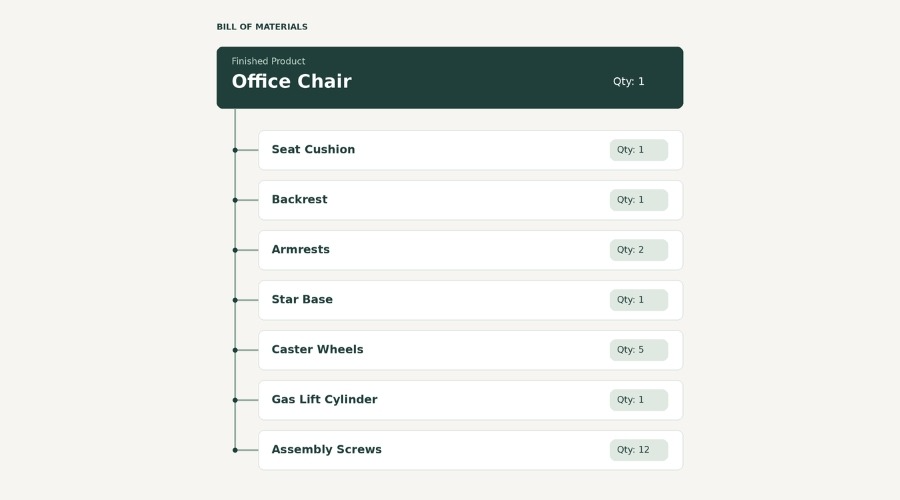
Real-World Manufacturing Example: Office Chair
To visualize how components roll up into a finished product, consider a standard office chair:
What Is BOM in Production?
While engineering focuses on how a product is designed, production focuses on how a product is built. A production BOM bridges these two worlds. Production teams use BOMs to determine material requirements, component quantities, assembly sequences, and labor allocations needed to execute active work orders.
BOM vs. Production Order
|
Feature |
Bill of Materials (BOM) |
Production Order |
|
Primary Purpose |
Defines what materials and parts are required. |
Authorizes what will be produced and when. |
|
Scope |
Product-focused and structural. |
Specific production job or batch-focused. |
|
Lifespan |
Relatively permanent, updated upon engineering changes. |
Temporary, created for a specific manufacturing run. |
Types of Bill of Materials
Different departments within an organization require different views of product data. Consequently, several distinct types of bills of materials exist to serve specific functions.
1. Engineering BOM (EBOM)
Created by the design and engineering teams during the product development phase, the EBOM focuses on the product's functional design. It reflects how the product is conceived conceptually and typically mirrors CAD drawings.
2. Manufacturing BOM (MBOM)
The MBOM translates the engineering design into a practical blueprint for the factory floor. It includes all the parts, raw materials, subassemblies, and packaging materials required to build, test, and ship the complete product.
3. Single-Level BOM
A flat, simple list that shows only the immediate components and assemblies required to build a product, without breaking down subassemblies into their constituent parts. It is ideal for straightforward products with minimal manufacturing complexity.
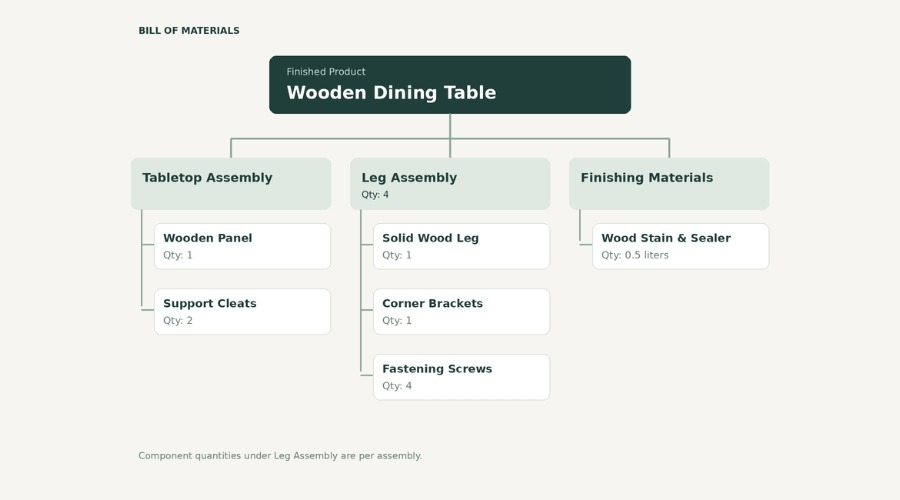
4. Multilevel BOM (Hierarchical BOM)
A comprehensive document that shows the finished product, its subassemblies, and all underlying components and raw materials in a nested parent-child hierarchy.
5. Configurable BOM (CBOM)
Used heavily by companies offering customizable products (such as automobiles or specialized machinery), a CBOM adapts dynamically based on customer selections, factoring in specific modules, colors, and optional features.
6. Service BOM
Designed specifically for field service technicians and customer support teams, this BOM lists replacement parts, maintenance kits, and repair instructions needed to service or repair a product post-sale.
Bill of Materials Example: Wooden Table
Examining a practical multi-level example highlights how parent-child relationships function in a real-world scenario.
- Level 0: Wooden Table (Qty: 1)
- Level 1: Tabletop (Qty: 1)
- Level 1: Table Legs (Qty: 4)
- Level 1: Support Brackets (Qty: 4)
- Level 1: Assembly Screws (Qty: 16)
- Level 1: Wood Finish / Stain (Qty: 1 Liter)
What Is BOM Management?
BOM management is the systematic process of creating, organizing, updating, controlling, and maintaining bill of materials information throughout the entire product lifecycle from initial conception through manufacturing, maintenance, and eventual obsolescence.
Key BOM Management Activities
- Creating initial product structures and parts lists.
- Managing versions and revisions as designs evolve.
- Implementing strict Engineering Change Orders (ECOs) and approval workflows.
- Tracking component obsolescence and identifying alternative suppliers.
- Synchronizing data seamlessly across ERP, PLM, and CRM systems.
Why BOM Management Matters
Poor BOM management can lead to catastrophic operational failures, including production delays, incorrect purchasing, inventory stockouts, unexpected cost overruns, assembly errors, and the accidental use of outdated components. Modern organizations utilize advanced BOM management software and Enterprise Resource Planning (ERP) systems to maintain data integrity across global supply chains. Businesses looking to connect BOM management with other enterprise systems can work with a software development company to build custom integrations that streamline data exchange, improve operational visibility, and support more efficient production planning.
What Is BOM in Business?
In a broader commercial context, a bill of materials is not restricted to the factory floor. Across the business ecosystem, BOM data connects product information with procurement, finance, operations, sales, and supply chain management.
Businesses rely on accurate BOMs to calculate total cost of goods sold (COGS), forecast cash flow requirements, evaluate supplier performance, streamline quoting processes for sales teams, and maintain regulatory compliance.
What Is BOM in Project Management?
In project management, a Bill of Materials typically represents the materials, equipment, software licenses, or hardware resources required to complete a specific project deliverable.
It is crucial to distinguish a BOM from a Work Breakdown Structure (WBS):
- BOM: Product-oriented; defines the physical materials, components, and assemblies.
- WBS: Project-oriented; defines the tasks, phases, deliverables, and project work streams required to complete a project.
Real Estate, Marketing, and Other Contextual Meanings
Because acronyms vary across industries, "BOM" can occasionally appear in non-manufacturing contexts:
- Real Estate: In some regional real estate markets, BOM stands for Back On Market, indicating that a previously pending property sale has fallen through and the home is available again.
- Marketing: In marketing organizations, BOM data can inform product configuration, pricing structures, and product information management (PIM) catalogs during major product launches.
(Note: While these alternate definitions exist, in product development, supply chain, engineering, and manufacturing, BOM universally refers to a Bill of Materials.)
BOM vs. Other Product Documents
To avoid confusion, it helps to understand how a BOM differs from related manufacturing and supply chain terminology:
- BOM vs. Bill of Quantity (BOQ): A BOM details components and raw materials for manufacturing a product, whereas a BOQ outlines the specific quantities of materials and labor required for a construction or engineering project.
- BOM vs. SKU: A BOM represents the structured recipe and component makeup of an item, whereas a Stock Keeping Unit (SKU) is a unique internal code used by inventory systems to track a single finished item in stock.
- BOM vs. Routing: A BOM defines what raw materials and parts are needed to build a product, whereas a routing document defines how and where (through what workstations and processes) the product is built.
Benefits of Using a Bill of Materials
Implementing a robust, well-maintained BOM delivers substantial operational advantages:
- Improves Production Accuracy: Eliminates guesswork on the factory floor.
- Reduces Material Waste: Prevents over-ordering and minimizes scrap rates.
- Optimizes Inventory Planning: Aligns stock levels with actual manufacturing demand.
- Supports Accurate Costing: Provides clear visibility into true product COGS.
- Simplifies Procurement: Streamlines supplier negotiations and purchase order generation.
- Enhances Quality Control: Makes it easier to track defects and execute targeted recalls.
- Streamlines Engineering Changes: Facilitates smooth transitions when product designs are updated.
How to Create a Bill of Materials
Building an effective BOM requires a systematic, step-by-step approach:
- Define the Finished Product: Clearly identify the final item you are building.
- Identify All Components: List every part, subassembly, and raw material required.
- Determine Exact Quantities: Specify how many units of each item go into the assembly.
- Assign Unique Part Numbers: Implement a standardized part-numbering system.
- Specify Units of Measure: Indicate whether items are measured by count, weight, or length.
- Organize into Hierarchy Levels: Structure items from top-level assemblies down to raw materials.
- Add Specifications and Suppliers: Include technical notes, material grades, and approved vendors.
- Establish Revision Control: Assign a version number to track future design changes.
- Integrate with Systems: Upload the finished BOM into your ERP, PLM, or inventory management software.
Best Practices for BOM Management
- Maintain a single, centralized source of truth for all product data.
- Use standardized, consistent part-numbering conventions across departments.
- Strictly control revision history and implement formal approval workflows for changes.
- Regularly audit existing BOMs to catch and remove duplicate or obsolete components.
- Ensure engineering (EBOM) and manufacturing (MBOM) teams stay synchronized when designs change.
Conclusion
A Bill of Materials is much more than a basic parts list. It serves as the foundational data backbone for product development, procurement, inventory management, production, and quality assurance. By maintaining accurate, well-managed BOM structures, organizations can eliminate costly errors, streamline supply chain operations, and accelerate time-to-market.
Would you like assistance setting up a standardized BOM template or integrating your product structures with your current inventory workflow?