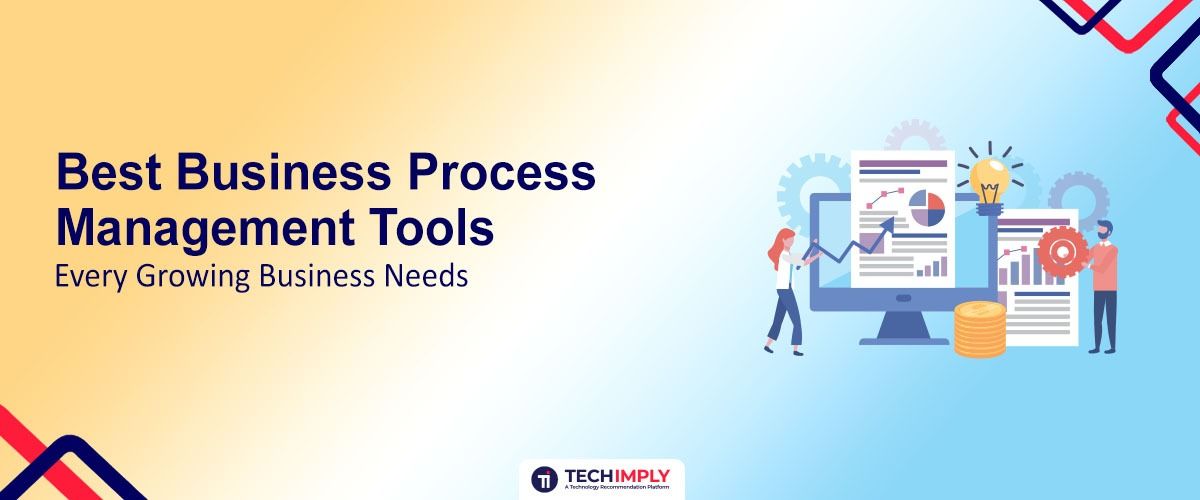
Business process management technologies make things easier for expanding firms by automating workflows, making them more efficient, and cutting down on mistakes. These systems enable teams to plan, carry out, and improve procedures like onboarding, approvals, and reporting, which lets businesses grow without causing problems. They use AI to provide features and integrations that help them adapt to changing demands, which lowers costs and increases productivity in competitive marketplaces.
Key Features of a Modern Business Process Management
Tools for modern business process management (BPM) provide rising Indian enterprises with automation and scalability, which aligns with the fast use of digital technology in industries such as manufacturing, information technology, and banking and financial analysis services. These business process management systems include artificial intelligence to create more intelligent processes, which in turn enable compliance with local legislation such as the Goods and Services Tax (GST) and labor laws.
-
A Visual Modeling of the Process
By utilizing BPMN standards, business process design tools make it possible to create interfaces that are based on drag-and-drop functionality for mapping workflows such as employee onboarding or invoice approvals. This makes design accessible to non-technical users in Indian small and medium-sized enterprises (SMEs).
-
Having the Capability to Automate
Through the use of robotic process automation (RPA) and artificial intelligence (AI), business process management (BPM) automation solutions handle repetitive operations, therefore minimizing the number of mistakes that are caused by human intervention in processes such as payroll or procurement. Efficiency gains of 30–50% are achieved by Indian companies.
-
Data Analysis in Real Time
Advanced dashboards monitor key performance indicators (KPIs) such as cycle time and bottlenecks, and they offer instances of qualitative data analysis, ranging from payments to vendors to customer assistance. Operations are optimized in real time through the use of data-driven insights.
-
Effortless integration
ERP (such as Tally and SAP), customer relationship management (CRM), and Indian payment gateways are all connected to business process management systems, which eliminates silos. The hybrid work paradigms that are common in India are suitable for cloud adoption.
-
Compliance and Access Predicated on Roles
Ensuring audit trails and service level agreements (SLAs) are essential for industries that are subject to regulation. Mobile access enables remote teams to work in a variety of geographic locations.
-
Intelligence-driven optimization
For the purpose of predictive analytics and simulation of changes before implementation, business process management technology makes use of machine learning. Low-code platforms are favored as the Indian business process management market increases at a compound annual growth rate of more than 10%.
Understanding Business Process Management (BPM) and How They Work
Business Process Management (BPM) is a systematic approach to identifying, designing, executing, employee monitoring, and optimizing business processes to enhance efficiency and align operations with strategic goals. In the Indian market, BPM has evolved from traditional outsourcing to advanced digital solutions, with India holding about 36% of the global BPM market share, driven by IT prowess and sectors like finance, healthcare, and customer service.
Tools like Snoh Flow and bpmEdge automate workflows using AI, no-code builders, and audit trails, making them ideal for Indian enterprises facing regulatory compliance.
BPM works through a lifecycle: design (modeling processes visually), execution (automating via BPMS software), monitoring (real-time analytics for bottlenecks), and optimization (continuous improvement using data). Indian companies such as ICICI Bank and State Bank of India have applied BPM via core banking systems, slashing processing times and boosting customer satisfaction through centralized data and tech integration.
Popular tools like PRIME BPM and cloud platforms support this with features for process mapping, Lean/Six Sigma methodologies, and ERP/CRM integration tailored for India's diverse industries. In India, BPM adoption is surging, with the market projected to reach USD 1.95 billion by 2034 at a 10.87% CAGR, fueled by cloud tools and GenAI for decision intelligence. Examples include Mahindra & Mahindra's manufacturing reengineering for productivity amid union challenges, and ONGC's SAP standardization across 500 locations. High-search terms like "BPM tools" (1k searches) reflect demand for automation solutions addressing workflow inefficiencies in growing sectors like retail and BFSI.
Top 10 Best Business Process Management Tools for Smarter Workflow Solutions [Features, price, pros, cons]
BPM tools are utilized to streamline workflows by automating design, execution, monitoring, and optimization cycles. Some of the best options available include Bizagi, which offers low-code modeling, custom pricing, and steep learning; Appian, which is an AI-driven enterprise automation solution with a high cost; Monday.com, which is user-friendly for small and medium-sized businesses (SMBs) and has limited complexity; Zoho Creator, which offers drag-and-drop applications and is ecosystem-tied; Pipefy, which is a no-code task, free tier, and basic for large firms; TIBCO, which focuses on AI analytics and is a custom/enterprise-heavy; Kissflow, which offers agile forms; Nintex, which focuses on SharePoint and is flexible but expensive; Microsoft Power Automate, which is integrated with Microsoft; and Camunda, which is an open-source engine and requires development.
1. Appian
Established in 1999, this low-code automation company is situated in the United States and serves businesses all around the world, including Indian BFSI companies. Allows for the processing of difficult cases using RPA and AI process mining. Takes the lead in terms of scalability for regulated industries. We are reliable for initiatives involving quick digital transformation.
-
Features: The following features are included: drag-and-drop design, AI process mining, case management, and connection with RPA.
-
Price: Custom enterprise pricing (starts ~$75/user/mo).
-
Pros: Rapid deployment, strong security
-
Cons: Steep learning curve for complex apps.
2. Kissflow
No-code business process management (BPM) pioneer with origins in Chennai, utilized by more than 10,000 Indian small and medium-sized enterprises (SMEs) since 2012. Provides processes that are optimized for mobile devices and connections with Tally. Offers a drag-and-drop interface that is easy to use for non-technical people. Provides the most affordably priced options for hybrid Indian teams.
-
Features: Visual builder, 100+ templates, ERP integrations (Tally/SAP), analytics.
-
Price: $10/user/mo (billed annually).
-
Pros: Intuitive for non-tech users, affordable
-
Cons: Limited advanced RPA.
3. Monday.com
Adapted for use by Indian marketing and information technology teams, work OS (2012) was established in Tel Aviv. Boards that are highly flexible for visual process tracking. Gantt charts, automations, and more than 200 integrations are all supported. Beyond project management, it evolves into collaborative business process management.
-
Features: Custom automations, dashboards, Gantt views, API/Zapier support.
-
Price: $9/user/mo (Basic).
-
Pros: Highly visual, collaborative
-
Cons: Overkill for simple processes.
4. Creatio
Since 2009, a no-code CRM/BPM system headquartered in Ukraine has been moving into the Indian sales operations market. Studio for omnichannel applications and artificial intelligence forecasts. Marketplace speeds up the development of industry templates. Integrated customer relationship management (CRM) with workflows.
-
Price: $25/user/mo.
-
Pros: End-to-end CRM-BPM
-
Cons: Customization needs training.
5. ProcessMaker
A business process management (BPM) platform from the United States that was developed in the early 2000s and is preferred by the Indian finance and human resources departments. The versatility of BPMN programming alongside PHP and JS. Custom reporting and mobile forms are examples. Free tier and enterprise upgrades are brought into balance.
-
Features: BPMN 2.0, scripting (PHP/JS), mobile forms, reporting.
-
Price: Free OSS; Enterprise ~$1,500/mo.
-
Pros: Flexible coding
-
Cons: Setup requires devs.
6. Bonita BPM
Since 2006, French open-source business process management has been utilized in hybrid cloud environments in India. The utilization of the connectors ecosystem for studio modeling. Apps and simulations that are alive are supported. Designed with developers in mind for bespoke additions.
-
Features: Studio for modeling, connectors, living apps, and simulation.
-
Price: Free community; Enterprise custom (~$10k/year).
-
Pros: Developer-friendly
-
Cons: UI is less modern.
7. Process Street
Using checklist automation software from San Francisco (2013), Indian operations are able to scale. With conditional logic, recurring templates are available. Utilizes Slack and Teams for auditing purposes. Simplifies standard operating procedures for teams that are scattered.
-
Features: Templates, conditional logic, Slack/MS Teams integration, and audits.
-
Price: $25/user/mo (Pro).
-
Pros: Simple onboarding
-
Cons: Not for complex branching.
8. Cflow
Specializing on GST for small and medium-sized businesses, this no-code business process management provider has been established in Chennai since 2010. OCR and mobile approvals are supported using drag-and-drop. The flow of procurement and human resources for India compliance. local option that is more cost-effective.
-
Features: Drag-drop designer, mobile approvals, OCR, analytics.
Price: $7/user/mo. -
Pros: India-specific (Tally/UPI), cost-effective
-
Cons: Scaling limits.
9. iGrafx
Indian manufacturing relies heavily on the United States' pioneering work in process intelligence (1991). AI-driven modeling of BPMN and RDF with insights. Simulation for the Lean Six Sigma methodology. A package of analytics designed for enterprise use.
-
Features: BPMN/RDF modeling, simulation, RPA orchestration, AI insights.
-
Price: Custom (~$50/user/mo)
-
Pros: Advanced analytics
-
Cons: High cost for SMEs.
10. Newgen Software Technologies
Delhi-headquartered AI-BPM leader (1992), NSE-listed with 800+ Indian clients. Low-code orchestration and GenAI rules. Dominates govt/BFSI with compliance focus. Scales from legacy to cloud-native.
-
Features: Low-code orchestration, GenAI rules, mobile BPM, process simulation.
-
Price: Custom enterprise (competitive for India).
-
Pros: Scalable, compliant (GST/DPDP)
-
Cons: Enterprise-focused setup.
Which BPM Tool Suits your Business Size and Needs?
BPM works via a simple lifecycle: design (visual BPMN maps), execution (RPA automation), monitoring (real-time dashboards spotting bottlenecks), and optimization (data-driven tweaks). Indian examples include ICICI Bank's core systems slashing loan times and Mahindra's reengineering, boosting factory output. Business process management solutions (140 searches) like Kissflow and Cflow integrate seamlessly with Tally/SAP, driving the market's 10.87% CAGR toward $1.95B by 2034.
Business Process Management (BPM) tools are game-changers for Indian businesses, streamlining workflows in high-growth sectors like BFSI, manufacturing, and retail. With "bpm tools" topping 1k monthly searches, these solutions automate repetitive tasks, cut errors by 40%, and ensure GST/labor law compliance using no-code builders and AI. Popular for business process design tools (110 searches), they enable drag-and-drop modeling for onboarding or approvals, helping SMEs scale without chaos.
For growing firms, BPM automation tools (110 searches) and business process management workflow platforms deliver 30-50% efficiency gains. From PRIME BPM's Lean tools to Snoh Flow's cloud audits, they tackle real pain points like vendor delays. Dive into business process management examples (260 searches) from ONGC's SAP rollout, choose tech that fits your scale for smarter, compliant operations in India's dynamic economy.
Conclusion
The 10 best Business Process Management (BPM) tools every growing business needs for affordable no-code workflows, Microsoft Power Automate for seamless integrations, and India-favorites like Snoh Flow, Quixy, and PRIME BPM empower smarter, efficient operations amid rising demands. For Indian enterprises facing compliance and rapid scaling, these cloud-native solutions cut costs by 30-50% while boosting agility in BFSI, manufacturing, and retail. Techimpluy, our company, provides tailored BPM services with custom implementations, GenAI-driven optimizations, and 24/7 support to transform your workflows. Partner with us for proven ROI in the dynamic Indian market.


.jpg "How Many LinkedIn Connection Requests May I Send Each Day?")