The digital business landscape is shifting rapidly. Walk into almost any modern corporate office today, and you will find team leads actively setting up a specialized AI Agent Platform to manage client ticket pipelines, automate inventory logging, or handle routine compliance screening. Recent market indicators reveal a massive transition; for instance, IBM’s AI Adoption Insights highlight that organizations are rapidly moving from basic experimentation to agentic workflows that make decisions and coordinate tasks with minimal human intervention.

Looking for AI Agent Platform?
Check out Techimply's List of the Best AI Agent Platform in India for your business.
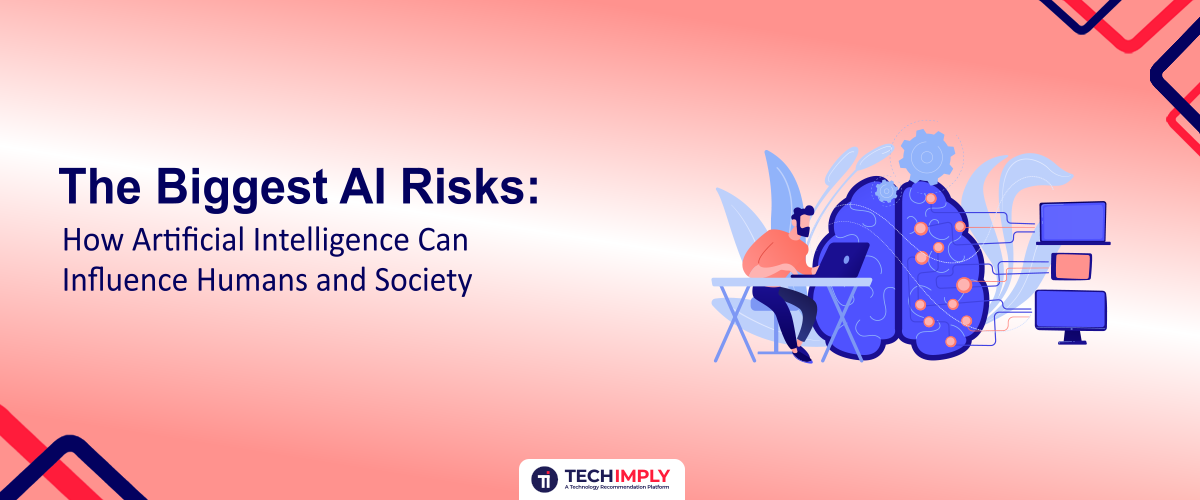
While this efficiency boost is great for a boardroom presentation, the accompanying data quirks demand our immediate focus. Uncontrolled tech scaling is creating a heavy, lasting AI Impact on Society, changing how local communities find sustainable work, guard their data rights, and verify truth online. Knowing how these complex models behave under pressure isn't just a tech department problem anymore; it is a core survival issue for executive boards, local legal teams, and everyday consumers. This guide cuts through the marketing hype to break down the primary vulnerabilities we face based on recent global studies.
What Are AI Risks?
Before a company can fix a broken automated workflow or lock down a vulnerable corporate database, leadership must clearly identify what the threat vector looks like. Real dangers stem from bad coding, unverified model training pools, and a total lack of human oversight.
In practical business terms, AI Risks refer to the broad spectrum of operational liabilities, severe data breaches, and ethical issues that crop up when an enterprise runs unmonitored or poorly trained machine learning models. According to the 2026 International AI Safety Report, backed by over 30 countries and global tech experts, general-purpose systems present unique, emerging risks due to accidental malfunctions, data contamination, and systemic blind spots that can compromise millions of user records in seconds.
The explanation for why these Artificial Intelligence Risks are skyrocketing can be attributed to corporate rush. Corporations are hurriedly deploying software that has been trained on its own from big Internet datasets rather than writing traditional programs coded by humans. As the deep learning algorithms train themselves based on millions of variables not mapped yet, even their own developers cannot determine how the algorithm will respond to some unusual life situation. These are particular challenges that arise in connection with AI.
How AI Is Influencing Humans and Society
Even without realizing it, automated programs are already silently filtering out the news that we get, the goods that we buy, and the views that we develop. The subtle AI Impact on Humans is very quiet, so much so that an ordinary individual will find it hard to believe that their own decision-making and life processes are already being altered by constant code.
Consider how these algorithms touch our lives every single day:
- Healthcare systems: Local clinics run automated diagnostics to scan medical imaging and forecast patient readmission timelines. However, should the foundational models be based on restricted data sets, such systems will not work when examining people belonging to diverse demographics, thus reiterating the need for continual AI Risks Audit.
- Modern education: Software-based teaching programs adjust the pace of learning based on an individual student's abilities. Although the concept is helpful, it tends to eliminate human connection from a growing child’s life, making a further digital divide between those who cannot afford a fast Internet connection.
- Corporate banking: Credit scoring systems quickly determine your ability to take out a loan by examining other data sets using telemetry. However, the issue lies in the fact that such a system might easily perpetuate financial bias through its baseline data sets.
- Everyday Shopping: Online shopping sites have begun to employ machine learning algorithms to make recommendations of products even before you search for anything. This is because such hyper-profiling uses human psychology to induce impulse buying.
- Social media platforms: Online feeds are engineered for one specific thing: maximizing your screen time. To keep users hooked, recommendation engines frequently boost sensationalist, angry, or divisive posts, warping public perception and trashing collective mental health- a clear example of a negative AI Influence on Humans.
- Smart AI assistants: Voice-activated home hubs and office software manage our morning routines, draft quick work notes, and organize digital calendars. This convenience creates a non-stop loop of data harvesting, turning private spaces into sources of commercial telemetry that increase global AI Privacy Risks.
Biggest AI Risks
To protect an enterprise today, you have to look past corporate sales pitches and understand the actual technical failure points of modern automated software stacks.
1. AI Bias
Algorithms are not capable of having an independent moral compass or a feeling for fairness in and of themselves. Rather, algorithms are just a mathematical reflection of the data that goes into them. Should your historic training data be chock-full of the outdated human biases, imbalanced demographics, or cultural blindness of its time, the algorithm will reflect and amplify this very AI bias on an industrial scale.
In the Stanford AI Index Report, multiple instances have been pointed out wherein automated resume selectors have deliberately discriminated against women because the historic corporate records used in the training had been made at a time when the labor market consisted almost entirely of men. Similar problems are seen in police-prediction software and risk prediction algorithms.
2. Privacy Risks
To build a highly capable foundation model, technology firms need an unimaginable amount of text, images, and media code. They get it by aggressively scraping public discussion forums, personal blogs, and private creative portfolios without asking for explicit user consent, creating a non-stop wave of AI Privacy Risks.
A recent survey by the Pew Research Center showed that the vast majority of consumers feel they have zero control over how their data is gathered and utilized by automated systems, which amplifies Artificial Intelligence Risks. The data, once collected, is then used to create a comprehensive tracking system that can track everything about you, including your geographical position, past purchase history, and even your private chat conversations.
3. Cybersecurity Threats
Malicious actors are turning to automation to scale their operations, heavily driving up everyday AI Security Risks. The Check Point Software Cyber Security Report reveals that up to 90% of organizations have encountered risky or malicious prompts, highlighting a massive spike in automated system attacks.
Furthermore, IBM’s X-Force Threat Intelligence Index reports that threat actors are executing highly automated cyberattack campaigns that do in minutes what used to take human hackers days to complete. Generative language tools also let attackers draft hyper-realistic, personalized phishing scams entirely free of traditional spelling or grammatical red flags, making it incredibly easy to trick smart corporate employees into clicking malicious links, introducing a stressful layer of new AI Challenges.
4. AI Hallucinations, Misinformation & Deepfakes
Large language models are designed such that they predict a statistically sound sequence of words, rather than validating world truths. Due to the mathematics behind it, large language models suffer from "hallucinations" in which they fabricate non-existent statistics, make up historical facts, and even quote entirely made-up laws.
When this technical flaw combines with generative video media, it compromises our shared informational reality. Automated content mills produce thousands of search-optimized, completely fabricated news articles every hour, polluting search engines. Meanwhile, data from the European Parliamentary Research Service states that roughly 49% of surveyed organizations experienced deepfake-related incidents, showing how synthetic media attacks are scaling up deception-based fraud and threatening the broader AI Impact on Society.
5. Job Displacement
Algorithmic systems are rapidly moving beyond routine manual factory labor and stepping directly into white-collar cognitive spaces, completely scrambling corporate structures and rewriting the Future of AI in the office. A pioneering study by McKinsey & Company suggests that approximately 30 percent of the hours spent on current jobs within the global economy could be automated. This means that administrative assistants, data entry operators, and young paralegals would be under an immediate threat of job replacement.
In parallel, the ongoing transformation of the labor market requires a significant number of people to adapt to newly emerging job positions such as model validation analysts, prompt writers, and AI Ethics officers.
6. AI Ethics, Transparency & Accountability
Deep neural networks operate across millions of unmapped mathematical connections, creating what computer scientists call the "Black Box" problem. When an algorithm makes a catastrophic error- such as an incorrect automated credit denial or a flawed medical risk assessment- determining legal blame between the software developers, the data vendors, and the corporate operators becomes an absolute nightmare.
In the absence of clear visibility into how these automated brains really function, consumers, company lawyers, and government regulators rightly lack faith in automated conclusions. Responsible innovation entails developing a system that is auditable, yet due to the emphasis on speed-to-market that reigns in the tech industry, these important audits are often neglected, creating significant challenges for AI.
Responsible AI: Best Practices
As stated in a recent market report from Gartner, companies that manage their technology stacks through compliance see 50% fewer data breaches. To embrace automation without placing your business at risk from catastrophic mistakes, your organization must adopt a responsible AI framework.
- Create an efficient governance team: Create an internal governance group to review all new algorithms prior to their implementation.
- Adhere to ethical guidelines: Define fundamental company values that place priority on being transparent, fair, and safe to adhere to all aspects of AI Ethics.
- Perform regular bias tests: Cleanse and audit your existing datasets to ensure your software doesn’t adopt discriminatory demographics without you realizing it.
- Engage in data minimization: Place strict limitations on your data collection; only collect the information you immediately need to maintain minimum AI Privacy Risks.
- Maintain human veto power: Never operate a critical system in autonomous fashion. Maintain qualified human experts in control, allowing human staff to easily override automated outcomes.
- Set up real-time monitoring: Deploy automated auditing software to continuously track live system performance, catching data drift, security anomalies, or hallucinations early before they reach your clients.
Future of AI
The long-term trajectory of global digital transformation depends completely on our collective willingness to balance technical innovation with deep moral responsibility. Next-generation development is moving fast away from simple text generation and stepping into integrated, multi-modal systems that can analyze live video, speech rhythms, and complex code setups simultaneously.
According to Gartner’s technology projections, over one-third of all enterprise software applications are expected to integrate autonomous agentic components. This rapid rise of independent digital workers capable of planning their own tasks and using external software tools makes deploying a highly secure AI Agent Platform essential for corporate survival.
Successful companies will be those that do not choose full automation. They will adopt collaboration between software, which performs all data processing, and humans, who concentrate on strategy and ethics. Modern companies have an opportunity to ensure their incredible development while keeping society safe from any unexpected risks associated with AI by adhering to Responsible AI principles.
Conclusion
The emergence of automation technologies brings a lot of opportunities in the innovation of business worldwide, but there are serious issues that come along with them. As outlined throughout the guide, the following are some of the risks that businesses need to be aware of.