Picture this: A trader sits in a dimly lit room, surrounded not by the familiar chaos of trading floors but by screens displaying complex algorithms and real-time data streams. In milliseconds, her AI-powered system analyzes more market data than a team of analysts could process in weeks. This isn't a scene from a sci-fi movie – it's the reality of modern trading, where artificial intelligence has transformed the art of market speculation into a science of precision and probability.
The Traditional Trading Landscape
Before artificial intelligence became mainstream, traders relied primarily on traditional methods that shaped market analysis for generations. Qualitative research and quantitative methods have always been integral to financial markets, widely deployed in trading through technical indicators and statistical models. Portfolio managers actively incorporate fundamental & price data and qualitative research to create well-balanced portfolios, and some of the industry's giants still rely on established models like factor investing. These traditional approaches included:
-
Manual chart analysis and pattern recognition involved hours of poring over price charts, drawing trendlines, and identifying familiar patterns like double tops or Fibonacci retracements. Over time, traders began using rule-based algorithms to automate pattern identification and apply algorithmic trading strategies based on these patterns. Technical indicators like moving averages and MACD also played a significant role in shaping market analysis.
-
Fundamental analysis required meticulous examination of company reports, financial statements, and industry trends.
-
Personal experience and intuition, developed over years of market observation, guided crucial trading decisions.
While these methods served well for decades, they had clear limitations: human bias in pattern recognition, emotional decision-making during market volatility, and the inability to process vast amounts of data quickly. These patterns, inferences, and rules were purely derived by humans, and constrained by their cognitive limits. The introduction of machine learning brought algorithms capable of learning from vast amounts of multidimensional data, identifying hidden complex patterns, and generating signals based on them. Their sheer speed, scalability, and ability to adapt to changing market conditions made them evolutionary in nature.
The AI Revolution in Trading
Artificial intelligence in trading has transformed these traditional approaches into sophisticated, data-driven strategies. Modern AI-powered trading systems can:
-
Analyze millions of data points simultaneously across multiple markets and asset classes
-
Identify complex patterns that human traders might miss, including subtle inter-market correlations
-
Execute trades at unprecedented speeds, often in microseconds
-
Adapt to changing market conditions in real-time through dynamic strategy adjustment
This transformation hasn't just improved existing processes – it's created entirely new possibilities. Modern AI systems can:
-
Process alternative data sources like satellite imagery of retail parking lots to predict company earnings
-
Analyze voice patterns in earnings calls to detect management confidence levels
-
Monitor global news in multiple languages simultaneously to predict market impacts
Key Components of AI Trading Systems
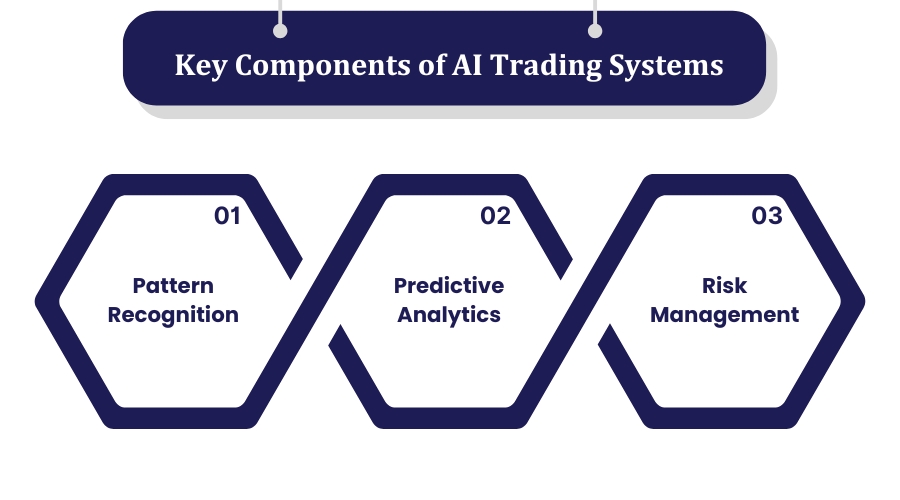
Pattern Recognition
A significant breakthrough in AI-driven trading lies in its ability to identify market patterns by analyzing historical data, technical indicators, and market sentiment simultaneously. These patterns, often too subtle for human observation, can provide valuable trading signals. Consider a practical example: While a human trader might identify a basic head-and-shoulders pattern over hours of chart analysis, an artificial intelligence software can simultaneously evaluate thousands of potential patterns provided we design the AI system in that manner across multiple timeframes and assets. For instance, an AI might detect that when a specific pattern occurs in tech stocks, there's often a delayed reaction in related semiconductor stocks, creating actionable trading opportunities.
Predictive Analytics
Machine learning algorithms can forecast market movements by:
-
Analyzing historical price data using sophisticated time-series analysis
-
Processing news and social media sentiment through natural language processing
-
Evaluating market correlations across multiple asset classes
-
Considering macroeconomic indicators and their historical impact
Real-world application: During the early stages of major market events, AI systems can aggregate data from social media, news sources, and market indicators to predict potential market reactions. For example, an AI system might detect unusual options activity combined with specific keyword patterns in financial news, triggering early warning signals for significant market moves.
Risk Management
AI algorithms excel at simulating thousands of risk scenarios, optimizing position sizing based on market volatility, and managing portfolio exposure across multiple assets and strategies. By monitoring real-time market conditions, risk management software can identify and mitigate potential risks with remarkable efficiency.
-
Optimizing position sizing based on market volatility and portfolio exposure
-
Managing portfolio exposure across multiple assets and strategies
-
Monitoring real-time market conditions for potential risks
Practical Implementation Approaches
Rules-Based Systems
These systems operate on predefined rules and are ideal for:
-
Using AI predictions and probabilities to establish clear rules for generating signals
-
Triggering actions based on increased market volatility, automatic hedging, or positioning based on the strength of signals
-
Filtering markets to decide when to trade or not trade
-
Improvising current strategies with AI models to enhance decision-making and efficiency
-
Systematic risk management with clear boundaries
Machine Learning Systems
These evolutionary systems monitor, learn, and self-adapt in real time:
-
Learn from historical data through supervised and unsupervised learning
-
Adapt to changing market conditions using reinforcement learning
-
Identify complex patterns through AI algorithms
-
Generate dynamic trading signals based on real-time market conditions
Getting Started with AI Trading
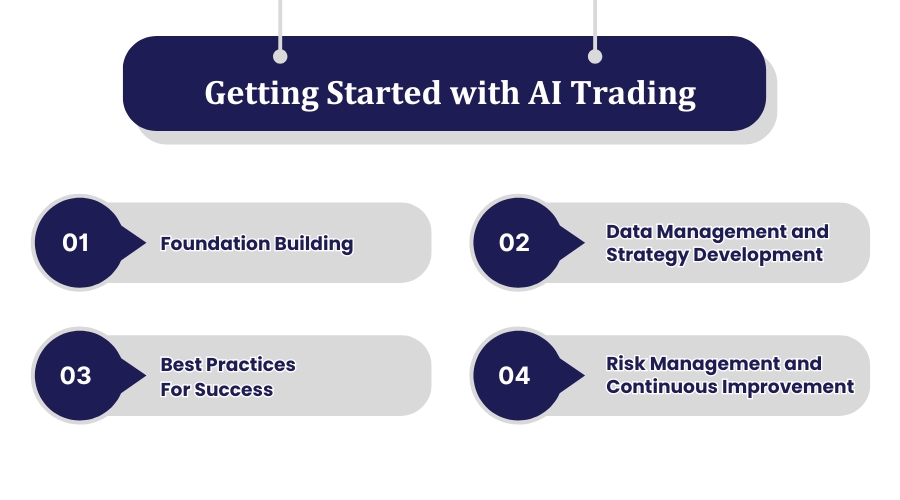
Foundation Building
-
Learn Python programming with a focus on data analysis libraries
-
Understand basic statistical concepts including probability and regression
-
Study market mechanics and microstructure
-
Grasp machine learning fundamentals, particularly supervised learning algorithms
-
Ensure computing resources meet minimum specifications for effective AI trading
-
Choose appropriate data storage solutions: Cloud vs. local storage
-
Maintain network requirements for minimal latency and implement redundancy planning
Data Management and Strategy Development
-
Collect clean, reliable market data from verified sources
-
Prepare data through proper normalization and create robust testing environments
-
Implement validation methods to prevent overfitting
-
Start with simple strategies like basic pattern recognition on a single asset
-
Add sentiment analysis using NLP and incorporate multiple data sources
-
Develop adaptive learning systems that evolve with market conditions
Best Practices for Success
-
Begin with one market or asset class for focus and use basic AI models to understand system behavior
-
Prioritize data quality and test systems thoroughly before deployment
-
Integrate systems with API connectivity for seamless execution and real-time data feed management
-
Optimize order execution to minimize slippage and monitor performance through detailed metrics
Risk Management and Continuous Improvement
-
Implement strict position sizing and stop-loss mechanisms with multiple confirmation levels
-
Maintain manual override capabilities for unexpected events
-
Regularly retrain models and analyze performance across different market conditions
-
Refine strategies based on empirical results and optimize systems for efficiency
Looking Ahead
The future of artificial intelligence in trading looks promising, with developments in:
-
Deep learning applications for market prediction
-
Natural language processing for news analysis
-
Real-time market analysis using edge computing
-
Adaptive trading systems with reinforcement learning
Emerging Trends
-
Quantum computing applications in trading
-
Edge computing for reduced latency
-
Blockchain integration for settlement
-
Federated learning for collaborative AI models
Conclusion
While the barriers to entry for AI trading have never been lower, the complexity of modern markets demands a sophisticated approach. Success requires a delicate balance between technological capability and traditional market wisdom. As markets continue to evolve, those who can effectively combine AI tools with sound trading principles will be best positioned to capitalize on future opportunities.
Remember that implementing AI in your trading requires patience, dedication, and a systematic approach. Start small, focus on fundamentals, and gradually build more sophisticated systems as your understanding grows. The future of trading belongs to those who can harness the power of AI while maintaining the discipline and risk awareness that have always been hallmarks of successful trading.