In India, AI software prices vary from basic subscriptions of about ₹1,500 to ₹3,500 per month to tailor-made enterprise solutions: a simple proof of concept or conversion typically costs between ₹3,00,000 and ₹15,00,000, an enterprise solution between ₹15,00,000 and ₹40,00,000, while a fully-fledged enterprise software with multi-agent orchestrations costs ₹40,00,000 to ₹1,00,00,000 or more. In addition, one must also consider annual recurring expenses like cloud hosting and API compute tokens that add up to about 20% to 30% of the initial build cost.
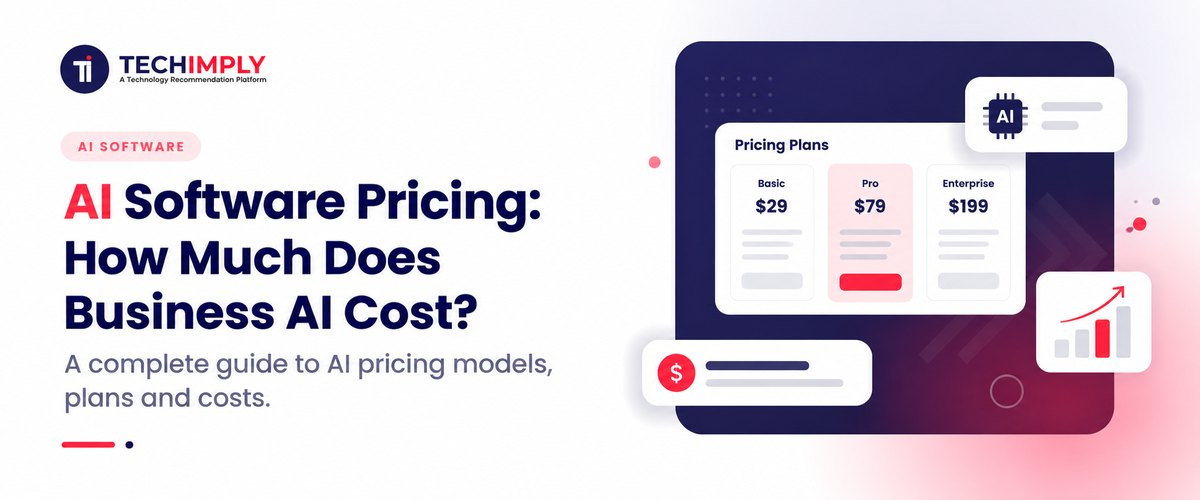
AI Software Pricing: How Much Does Business AI Cost?
Pricing of AI software in the Indian enterprise sector is at one end of the spectrum, with standard per-user software licenses offering solutions at the other end - custom-built infrastructure. Productivity suites and standard AI workspace licenses start at ₹1,500 to ₹3,500 per user monthly. In contrast, basic proof-of-concept and conversational assistant projects cost ₹3 lakh to ₹15 lakh, specialized workflow solutions cost between ₹15 lakh and ₹40 lakh, and end-to-end enterprise solutions with multi-agent orchestration and deep core system integration start at ₹40 lakh.
After the initial investment, total cost of ownership varies according to data readiness, integration complexity, and cloud operations requirements. Processing unstructured data and integrating previously existing systems costs anywhere between 25% and 40% of the total budget. Moreover, running AI application development means incurring regular expenses such as cloud GPU hosting, real-time API tokens, and model support costs, which amount to another 20% to 30% annually.
Did You Know?
India stands out as one of the fastest-growing countries in terms of enterprise artificial intelligence, with local adoption reaching nearly 60% and over 40% of Indian businesses making large use of AI in operations and product development. However, despite high rates, almost 46% of companies remain in the growth phase due to the fact that anywhere between 25% and 40% of their initial project budgets will always go to data cleaning and infrastructure setup before any model enters production and goes live.
What is AI Software Pricing?
AI software pricing in India provides a total framework for all the costs of implementing AI that clients have to incur. There is no uniformly applicable price structure in the market today; the pricing will vary depending on the technology adopted, from standard software, charged by users, to fully bespoke AI solutions designed for specific enterprise tasks.
The price of AI software solutions in India starts at ready-to-use tools at about ₹1,500 to ₹3,500 a month per user. As companies move to custom-built systems, they must be ready to invest more money: the development of a custom internal assistant or a proof of concept costs around ₹3 lakhs to ₹15 lakhs, custom automation costs ₹15 lakhs to ₹40 lakhs, while enterprise-level multi-agency platforms with thorough integration cost at least ₹40 lakhs and may go far beyond ₹1 crore.
Apart from the development of the software and the procurement of licenses for AI technology in India, the recurrent costs involved in using the technologies and maintaining the necessary infrastructure play a crucial role in the pricing of AI services. Operational expense management, including GP hosting in the cloud, real-time computation API tokens, and pipelines, is generally added within the range of 20 to 30% to the costs of the initial build every year, while data preparation as well as data cleaning takes up to 40% of implementation costs before the implementation goes live.
What is Business AI?
Business AI denotes the use of AI technologies like machine learning, NLP, predictive analysis, and automated decision-making in business processes so that the activities can become more efficient and cost-effective. Unlike general types of AI that are aimed at interacting with consumers or working on creative tasks, business AI is specifically developed for solving business-related tasks and working with proprietary information and systems like enterprise resource planning systems, customer relationship management systems, and human resource management systems.
Within the Indian marketplace, the business application of artificial intelligence has progressed from just simple customer service chatbots to being an integrated, organization-wide core commander for its significant actions in business. Several firms in India use business AI to automate many tedious, regular activities such as automatic document extraction for GST billing, prediction of supply chain, tailor-made localised marketing, and real-time fraud detection activities.
What are the Types of AI Pricing Models?
1. Per User Pricing
This is a fixed fee payable by customers per user of the software. While this is customary for olden days, this is the method often used for simpler applications of artificial intelligence.
2. Token-based Pricing
In this type of pricing, charges are applied on the basis of the amount of data handled by the AI model, which is measured in terms of tokens. This is appropriate mainly for schemes of developing APIs and basic models.
3. Pricing Based on Each Task
The practice of pricing based on specific tasks done by the machine is called “per-activity pricing.” Instead of being calculated on the basis of the number of tokens processed, this approach looks at business processes carried out by this technology. In this manner, it converts technical measurements of work performed into terms easy for a buyer.
4. Pricing Based on Outcomes
Pricing is determined in accordance with the achieved results, rather than the activities performed by the technology. In this model, fees are counted only in the cases when predetermined performance indicators are reached by the machine, e.g., a service ticket has been solved, a sales lead obtained, or a transaction processed.
5. Pricing for Dedicated Hardware
Organizations that need AI applications from the machine pay for the dedicated processing power (for example, by reserving cloud GPUs or private instance servers). This principle works on the principle of providing the buyer with fixed prices for the dedicated machine.
6. Hybrid Pricing Model
In the hybrid pricing model, companies use different methods of establishing prices. For instance, fixed fees might be combined with fees based on the use of services provided by the technology.
How much does AI Software Cost for Businesses in India?
- SaaS Subscriptions (Standard AI): Standard tools and AI software licenses are priced between ₹270 and ₹3,500 per person each month, according to whether the use is standard or involves enterprise applications.
- Proof of Concept (PoC) & Basic Bots: The cost of building simple internal search systems, Retrieval-Augmented Generation (RAG) solutions, or customer support bots may be estimated at ₹3 lakh to ₹15 lakh.
- Customization of AI: The price of developing specific solutions such as tailor-made domain models or functioning automation features is between ₹15 lakh and ₹40 lakh, based on the difficulty level and the amount of data.
- Enterprise Platforms: The total price for a comprehensive system integrated with the main company’s software starts at ₹40 lakh and may reach over ₹1 crore.
- Data Cleaning & Development: The operational expenses related to preparing, cleaning, and sorting unstructured company data usually take about 25% to 40% of the initial costs.
- Recurring Operation Expenses: The costs of cloud computing services, model maintenance, and operational services need to be considered as well, and they account for about 20%-30% of the initial model development costs.
What Factors Affect AI Software Pricing?
1. Model Complexity and Scale
Cost is determined by the architecture utilized. Pre-built models and simple language models built on an API are cheaper to use, while customizing models or creating a new deep learning model requires significant time and computing resources.
2. Data Amount and Preparation
AI works with good data. The price increases when more effort is put into the collection, cleaning, tagging, structuring, and securing intellectual property before a model can start using it correctly.
3. Deployment Model and Hosting
The price is determined by where AI is utilized. Cloud-based software charges for the server and its usage or API, while having the software installed at the location requires vast initial investments into specialized hardware with reliable and safe infrastructure.
4. System Integration and Customization
Effortlessly integrating artificial intelligence into legacy platforms such as ERP, CRM, or HR software entails the use of custom APIs, middleware, and thorough testing of workflows, which increases the total number of hours spent on development.
5. Usage Metrics and Scaling Needs
Price models usually take into account actual consumption, meaning the total number of seats, routine API calls, tokens used, or concurrent requests. Depending on the scale of operations, the computing expenses can grow.
6. Continuous Maintenance and Retraining
Purchasing the AI solution is not one-off. The company incurs ongoing costs for periodic retraining of the model to avoid the drift of data, as well as costs related to security updates, compliance, and routine maintenance.

Pro-tip
Helpful Recommendations: One way for organizations to reach optimal ROI when purchasing AI software while preventing overspending is to first audit and clean internal databases because data preparation often consumes between 25% and 40% of initial budgets for projects. Companies can reduce financial risks when they perform small proof of concept designs (PoC) to test accuracy before full use, negotiate flat-rate AI software with caps on computing costs that are enforceable, and ensure vendors will strictly observe privacy requirements against using proprietary data for the development of AI models. In conclusion, users should seek tools that offer ready API connectors to minimize legacy data integration costs and include additional funding possibilities (20%–30% of the original budget) to pay for GPUs, API tokens, and model modifications due to data changes.
Which AI tools offer the Best Value for US Businesses?
- Overall-purpose general assistants (ChatGPT team / Claude team): Costing $20–30 per user per month for usage, overall-purpose foundational LLMs offer the best immediate ROI of all solutions. They perform multiple tasks by enabling drafting, data analysis, code execution, customer support scripts, and bespoke internal GPTs.
- Ecosystem-related collaborators (Microsoft 365 Copilot / Google Workspace Gemini): Costing $20–30 per user per month, these provide great value to businesses that work within the Microsoft or Google ecosystem. Their native integration avoids data toggling and allows for instant AI summarization and drafting in emails, spreadsheets, slides, and calendars.
- Platforms for Automation of Workflow (Zapier AI / Make): From around $20 to $30 per month, automation technologies without the need for programming serve as a tool for connecting software systems. By automating simple administrative jobs performed by several applications, these platforms give a significant return.
- AI Meeting and Knowledge Assistants (Fireflies.ai / Otter.ai): With a price of $8 to $18 per user per month, these intelligent meeting tools greatly speed up the work of sales and operations teams. They transcribe phone calls, highlight important things to do, and send summaries to CRM.
- Incorporated Sales and Marketing AI (HubSpot Breeze / Canva AI): From $10 to $20 a month, these features use artificial intelligence within already existing software used by businesses like CRM or design programs, which do not require costly setup.
- Industry-specific Autonomous Agents (Custom API Deployments): From $50 to $500 and up, implementing and utilizing focused AI agents through developer APIs (custom customer service, automated document generation) is highly beneficial for the company and replaces many hours of routine work.
Conclusion
When figuring out the costs of artificial intelligence applications in India, you must balance the money spent on setting things up and the ongoing costs of using a system. While subscription licenses usually require a smaller investment, special enterprise solutions may require more spending to set up the data in the software, pay for the APIs used in the future, and integrate with the systems. Therefore, in order to choose wisely, businesses must assess the vendors based on features, scalability, and pricing. Techimply is a business software review platform that allows users to evaluate different software solutions, ask for demos, and find the right software for businesses.