


Nowadays, staying competitive in the market, a well-defined Retail Planning Process is indispensable feature for saving time and upscaling. Without a specific retail strategy, firms could mess up stock, work inefficiently, and lose potential gains.

Looking for Retail Software?
Check out Techimply's top Retailing Software solutions for your business.
The flexibility of Strategic Retail Planning is useful for companies to set up their objectives, make operations more efficient, and to achieve customer happiness at the same time. In this brief discussion, we aim to explain the value of strategic retail planning, its main aspects, and the six steps aiming at a smooth retail management process in order to enhance the productivity level of your company.
Did you know? 80% of retailers who implement a structured retail planning process see significant improvements in operational efficiency and sales performance!
What Is The Retail Planning Process?
The Retail Planning Process is an approach used by retailers to make sure their business objectives fit with the market trends, become more efficient, and improve the consumer experience. The technique consists of conducting a situation analysis, identifying the probable demand, maintaining stock, and formulating a retail strategy which when implemented will enable the firm to compete with others.
A strategic retail planning process that is done well guarantees the right product availability at the right place and at the right time, thus resulting in improved business efficiency and more profits. It is indispensable in the retail management process due to the fact that it provides a possibility for businesses to reallocate resources and focus on different consumer needs as well as new sales of a product, which is a major driving force.
Retailing software has been able to help businesses drive change in the retail process, inventory management automation, and data for decision making that will lead to better performance. To be precise, an effective Retail Planning Process is the cornerstone of a company that is in line with the customers' needs.
Interesting Read- The Evolution and Impact of Retailing Software in Modern Business
Importance of Strategic Planning in Retailing
Strategic planning in retail is the backbone of successful businesses, The retail process should be balanced in all the possible dimensions toward achieving the long-term goals. In the absence of a clearly laid out operational plan in retail, retailers face the issue of inefficiencies, are likely to stock out of products, and will ultimately miss sales opportunities due to a weak sales strategy.
A strong retail strategy helps retailers:
-
Optimize inventory to meet customer demand
-
Improve operational efficiency and reduce costs
-
Stay competitive in a rapidly changing market
-
Enhance customer satisfaction through better service
With evolving consumer behaviour and the rise of retailing software, retailers must adopt a strategic retail planning process and improve internal processes to remain agile and profitable.

Pro-tip
If you want to be a step ahead of competitors and optimize customer loyalty, your retail strategy should change on a regular basis in line with market trends.
6 Steps of Strategic Retail Planning Process
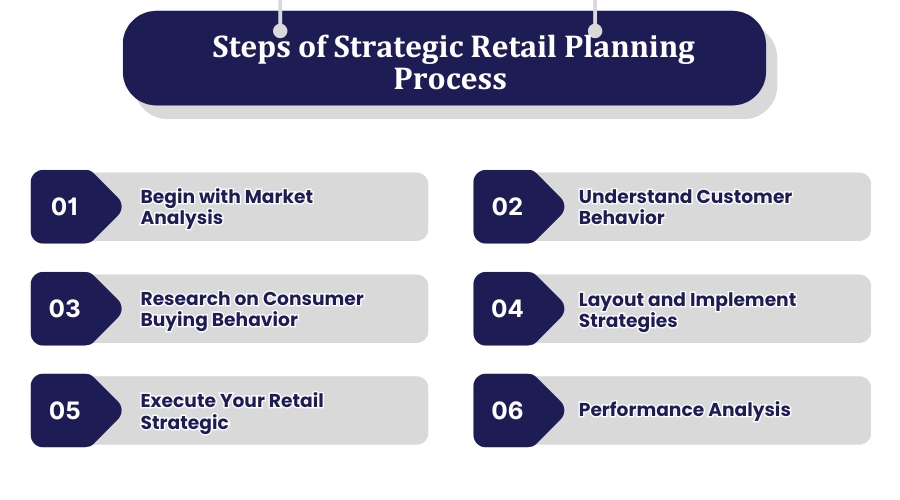
A well-structured strategic retail planning process helps businesses to be competitive, fulfill customer needs, and grow their companies. Seeking for such a roadmap to establishing a successful retail strategy, here it is everything you need to consider and remember.
-
Begin With Market Analysis
The first step in the retail planning process is understanding the market landscape. Analyze industry trends, competitor strategies, and economic factors that impact consumer demand. A thorough market analysis helps identify opportunities and potential challenges.
-
Understand Customer Behavior
First and foremost is integrating customer needs into the retail strategy. Decide who your target audience is, their desires, and shopping habits. Knowledge of elements that attract your customers leads to more comprehensive product, pricing, and marketing choices.
-
Research on Consumer Buying Behavior
By examining consumer purchasing behavior, the retailer can make informed business decisions and even predict fashion trends. Regulation of the retail management process is much influenced by such outstanding aspects as purchasing motivations, seasonal trends, and product preferences.
With the help of data integration tools, retailers are able to get the desired feedback from sales, acquire customer feedback, and apply market intelligence to create healthier strategies and make wiser decisions.
-
Layout and Implement Strategies
Once insights are gathered, develop a clear strategic retail planning process that covers pricing, promotions, inventory management, and store layout. Using Retail Software and Private Branch Exchange (PBX) systems can streamline operations and enhance decision-making.
-
Execute Your Retail Strategic
Clearly, picking the right plan is essential for implementation. Make sure each part of your retail process is consistent—your logistics, as well as your marketing—to your strategy. To operate your business successfully, make sure regular communication and good team collaboration are prevalent.
-
Performance Analysis
Data analysis is a new way to develop innovative strategies and achieve higher operational efficiency over time. Continuous assessment plays a crucial role in determining the proficiency of retail management through the monitoring of KPIs like sales, customer retention, and inventory turnover.
Key Components of Retail Planning
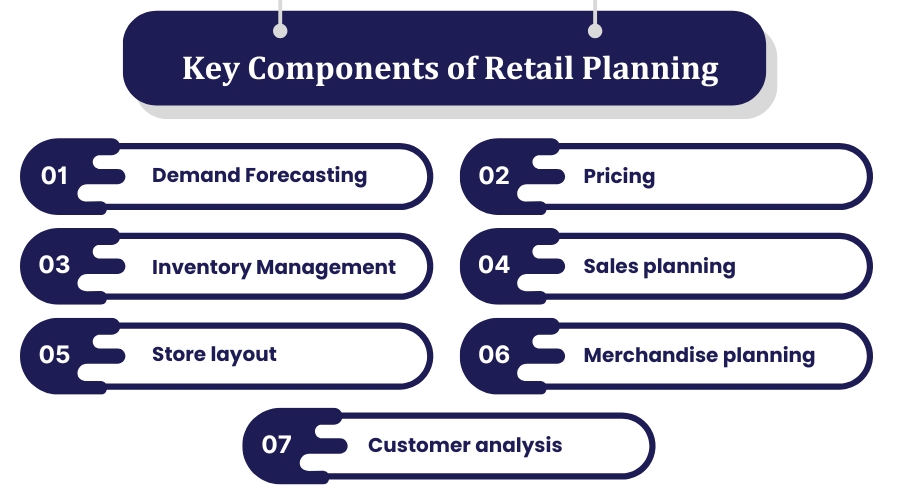
A well-organized retail planning process guarantees profitability, efficiency, and customer satisfaction. These are the necessary components that form a strong retail strategy.
-
Demand Forecasting
Better demand forecasting allows retailers to see the sales trends coming, so they can prevent overstocking and shorten stock. To make safe inventory choices and not suffer such things as stockout or overstock, businesses can analyze the market behavior, the previous sales, and the seasonal trends.
-
Pricing
For a business to survive, its pricing policy should not only be profitability-centered but also be customer-friendly. The probe of the cost-cutting, promos, and discounts is contingent upon their adaption to the current marketing demand, and at the same time, managing to make the company a good profit.
-
Inventory Management
Smart control of inventory can be described as the method to avoid overstocking and stockouts, ensuring that the appropriate products are found at the right time. Retail software used to streamline the process of tracking inventory, replenishing, and optimizing stocks can be done. Retailers looking to improve inventory control and meet customer expectations can benefit from advanced order management systems. With centralized inventory, real-time syncing across locations, and efficient fulfillment capabilities, you can streamline orders with Planet, a powerful OMS designed for omnichannel retail.
-
Sales planning
A thriving process of retail is achieved with the help of working down possible sales and revenue goals, understanding the market conditions, and marinating or increasing the marketing efforts. The content based on analytical data provides a solid chance for the growth of a business and customer loyalty.
-
Store layout
A well-structured store layout is the right way to go if one wants to create a friendly and a desirable environment for shopping. Strategic product placement, along with the ease of navigation and an appealing atmosphere, tends to capture the interest of the customers and, as a result, has a direct impact on sales.
-
Merchandise planning
Merchandise planning requires the selection of the most appropriate group of products to meet customer demand, seasonality, and trends. It ensures that retail distributors supply the necessary and profitable inventory to attain the highest possible sales.
-
Customer analysis
For businesses in retail trade, customer demographics, preferences, and behaviors are very important in the strategic planning in retailing of their company. Personalized marketing, loyalty programs, and individually recommended products contribute to customer loyalty and, hence, satisfaction and retention, respectively.
Editor's Note
Strategic retail planning is now not just for large businesses—small and medium enterprises can also benefit by adopting structured planning processes and the right technology. The main thing is to remain flexible and data-driven.
Conclusion
A strong retail planning process is vital for operational efficiency and long-term success. Retailers are able to ensure inventory optimization, customer service improvements, and long-term competitiveness by going through each of these strategic steps.
Retailing needs to undergo proactive strategic planning as consumption demands are changing. The difference between utilizing Retail Software and traditional methods or not is whether your retail process is maintained for sustained growth and efficiency.
Ready to level up your retail strategy? Start implementing these steps today!




.jpg "How To Build A Custom AI Software Development?")


