
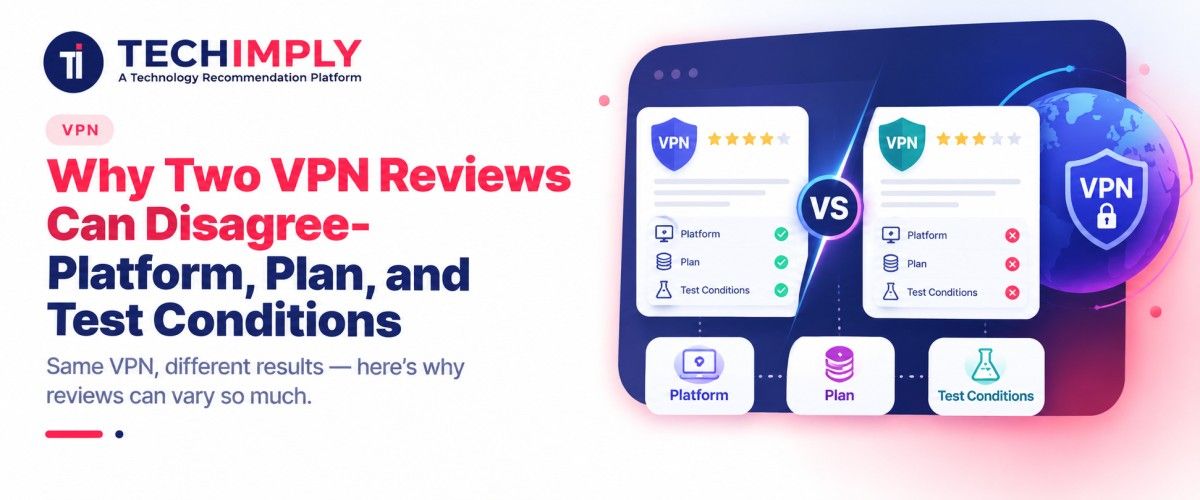
One reviewer finds a useful setting in a VPN app. Another cannot find it at all. Before choosing which review to trust, check whether they used the same app, platform, and plan. Both accounts may describe what the reviewers saw under different conditions.
A brand name and a score leave out much of that context. To decide whether a review helps with your purchase, connect the result to the device you use and the task you need to complete. Start with what was tested, then consider the verdict.
Check which app each reviewer used
A desktop client, mobile app, and browser extension can share a brand while offering different controls and covering different traffic. An Android screenshot tells you about that app. It does not confirm that the same setting exists in the browser extension.
Check the plan as well. A paid account may include settings or choices that a free account lacks. Note the app version and review date, since software and plan details can change between reviews.
If you need a VPN for PC, check the Windows documentation for the feature you care about. A mobile review can suggest a question to investigate, but it cannot settle what is available on your computer. Use current documentation as a starting point and keep the date attached to screenshots from older releases.
Before comparing scores, collect these details:
|
Detail |
What it helps establish |
|
Platform and application |
Whether the reviews concern the same type of client |
|
Version and review date |
Whether a later change could explain a difference |
|
Free, trial, or paid plan |
Which controls were available to the reviewer |
|
Connection and chosen location |
Whether the network conditions were comparable |
|
Task and measurement |
What the result actually describes |
Leave an unknown detail blank in your notes. Assuming that a reviewer used your plan or device can make the comparison look more relevant than the evidence allows.
Find out what “fast” means in the test
A large file downloading quickly tells you about throughput: how much data arrives over time. A short wait for a response concerns latency. How an app recovers when its connection drops is a different part of the experience again.
Which result matters most depends on the task. Someone transferring large files may focus on throughput; someone using an interactive service may notice latency more. One measurement cannot show how the app will handle everything you want to do.
Consider two hypothetical reviews of the same service. One reviewer chooses a nearby location on a quiet home connection. The other chooses a distant location while other devices share the network. Different results would need investigation before either reviewer could attribute the difference entirely to the VPN app.
Look for the starting connection speed or other relevant baseline, measured without the added connection layer where that test is permitted. Check whether the reviewer repeated the task and explained the method. A number without those details gives you little basis for comparison, however impressive it looks.
Treat website-access results with similar care. A successful attempt shows that the site was available under those test conditions at that time. It does not support a promise that access will always remain available.
Test the detail that could change your decision
You do not need to recreate a whole review. Pick the unanswered question that matters to your setup. Does the control you need exist on your device? Is your intended application included in the route? How does reconnection behave during the task you normally perform?
AVPN free trial can help you check that question if the offer includes the relevant app and features. Read the current terms for the channel through which you enroll, including when the trial ends and how billing works. The availability of a trial does not establish how the test will turn out.
Write down what you expect to observe before starting. “Can I find and configure this control on this version?” gives you a result you can assess. “Does the app feel good?” is much harder to use. If a connection fails, record the task, time, and settings before making changes.
Keep the conclusion limited to what you checked. A test on your device can help you choose an app; it does not become an independent audit or establish how every other device will behave.
Read the verdict with its conditions attached
The most useful review may be the one that tests your task and explains its limits clearly. Read its conclusion alongside the platform, plan, date, and method that produced it.
When two reviews disagree, look for the condition that differs or the detail neither reports. That gives you a specific question to resolve before buying, rather than a pair of scores to choose between.