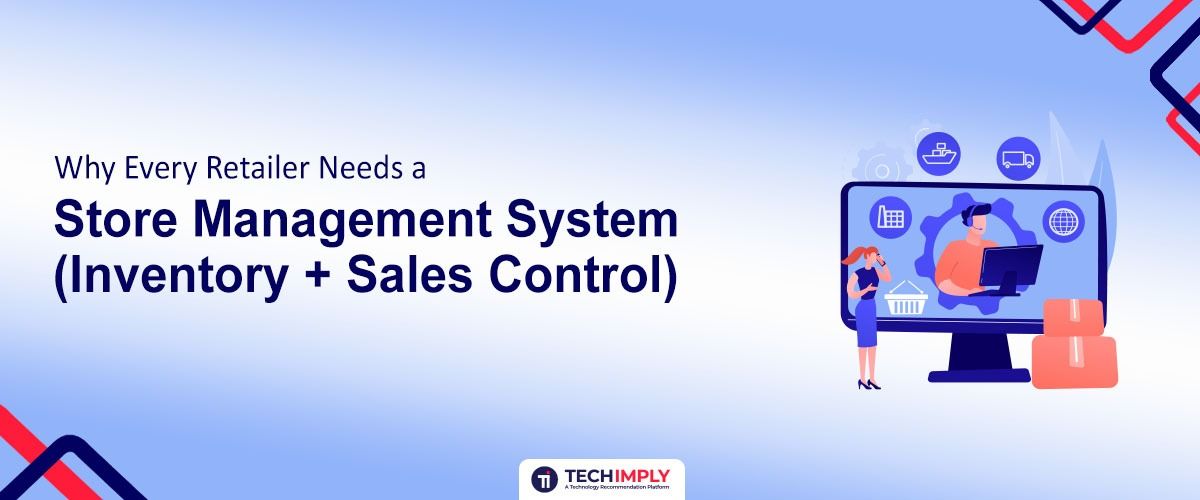
Retail business is a constant tug of war between customer demand and the physical inventory on your shelves. We define store management as managing day-to-day operations, making sure products are available in your store, and accounting every sale accurately. But, even a small store could soon drown in paper work and stock in nosense if there is no centralized store management system. A digital solution keeps you organized so you can focus on growing rather than counting boxes in a backroom.

A dedicated store management system keeps your data accurate and staff productive. And it connects your physical stock with the financial side of your business, enabling you to see where you're at professionally. Most owners begin with spreadsheets, but a dedicated retail inventory management system provides the automation you need to scale. An automated platform minimizes the possibility of human error, which means that your sales and stock levels will always be in perfect sync.
Reasons Why Your Retail Business Needs Inventory Management Software
-
Increase Productivity
Manual stock takes are hugely time-consuming and error-prone, which can impede your day to day operations. Where tracking can be manual, in-store companies will update their inventory levels as evidence of stock has to be physically retraced; however, a retail billing management system helps automate the process with sales occurring online updated immediately in line with your order status. As a result, your team is able to spend less time performing tedious admin work, and more time interacting with customers on the shop floor.
-
Reduce Costs
Efficient tracking is the most assured means of avoiding both overstocking and understocking (the double whammy). If you analyze your stock flow, you will realize that placing small orders frequently will increase inventory cost will lead to a higher inventory cost due to the repeated shipping fees and missing out on volume discounts. A Retail Inventory System can do both of this while saving your business thousands of ₹.
-
Increased Customer Experience
Nothing will make a shopper loyal quicker than heading out for an item they want but is sold off. A store inventory management system enables you to create proactive low-stock alerts to warn you before a shelf goes bare. Its consistency guarantees availability of your best-sellers at all times, which directly fosters long-term confidence and customer satisfaction.
-
Improved Data Security
Traditional physical ledgers and minimal spreadsheets are quite susceptible to compromise, and therefore relatively easy for individuals to modify without the right authority. Most modern retail inventory management tools are equipped with cloud managed platform features such as data encryption and user-specific access rights. This will keep your sensitive financial records and inventory maintenance logs away from prying eyes.
-
Improved Coordination
Multiple outlets necessitate a degree of coordination that only automated systems can obtain. This allows managers in various locations to gain visibility into real-time stock levels across the entire inventory network, thus giving rise to a unified retail inventory management system. This kind of coordination avoids misplaced stock and make sure that your pricing & promotions are the same across all branches.
-
Add new selling channels
As essential as it is to broaden your presence on different platforms such as Instagram or Amazon in the provisioning process, you additionally make your inventory onerous.. By integrating inventory software retail, your physical store stock will exist with stores online without the need for manual updates. This synchronization saves the company a nightmare scenario called "overselling" where a customer buys the last item from web at the precise moment when the last unit is getting out of store by another customer.
-
Automate Inventory Management
However, getting true business growth is impossible without letting go of the manual repetitive work. Utilizing a retail inventory system allows you to automate complex tasks such as when to reorder and competitive reports. When it comes to running a retail store, automation generates much better results because the software takes care of the data while you focus on your top-level business strategy.
Do You Know?
Shrinkage, which encompasses both administrative errors and vendor fraud in addition to shoplifting, costs retailers in India between 2% and 5% of annual turnover. A retail stock management system can eliminate this by providing complete visibility.
Why Is It Important To Discuss Retail Inventory Management?
Good retail inventory management forms the backbone of profitability. It's not enough to know what you have, it's about understanding the velocity of that asset. Retail inventory management is critical because, when done right, it ensures that your capital is not "locked" in items that are slowly losing their momentum preventing you from taking risks on new trends. A clean inventory maintenance process keeps your cash flow in the green and warehouse shelf space tidy.
5 Types of Retail Inventory
To effectively manage your retail stock management system, data should identify items by their position in your business cycle first. With proper classification, you will be able to track value in a much more precise manner and also ensure that your inventory maintenance schedules are targeted at the right goods. By breaking it down into these five categories, your processes in ordering will be simplified and allows for a clearer process in organizing your retail inventory management.
1. Raw Materials
These are the materials or ingredients to produce a final product, for example fabric and its buttons in custom tailor shop. Since a lack of raw materials can put your whole production chain to a standstill, it is essential that you have a strict monitoring system in place for the inventory levels of these goods. Managing these supplies effectively lets your artistic process flow from start to finish absolutely unobstructed by the lack of essential ingredients.
2. Work-in-Progress (WIP) Items
WIP items are goods that have been partially manufactured or assembled but unable to be ready for the shelf yet. All of these are "stuck" value in your retail inventory management software as you have money tied up on them, but they are unable to contribute towards revenue yet. Managing labor and parts expenses accurately requires tracking these carefully so you can spot delays in your workflow.
3. Finished Goods
These are the end, already completed products that are in your warehouse or on your shelves ready for a customer to take away. This is the most important class in your store inventory, because these goods embody your profit potential on a nearest basis. As a retailer, finding the right amount of finished goods without running out and losing sales is the goal of every stock management system.
4. Maintenance, Repair and Operations (MRO) Goods
MRO goods refers to all the necessary supplies that you need for running your business on a day-to-day basis e.g. cleaning chemicals, light bulbs or office stationary. These arenot for sale, yet are mandatory expenses that you need to get accounted on your inventory software retail or else they will shut down operations. Maintaining your store is essential for cleanliness, functionality and looks professional at all times when it comes to MRO stores.
5. Packaging Materials
This category ranges from cardboard boxes and bubble wrap to the branded bags your customers walk out of the shop with. There will be no safe and professional sale of your products even if these are the best in their class, unless you have the packaging tracked through your retail inventory system. Ignoring those items leads to unanticipated costs, particularly given the importance of good packing in protecting goods being shipped and increasing an improving your unboxing experience.
Inventory Accounting Methods for Retail
Selecting an effective retail inventory management vessel profoundly influences the funds stability of your business, including tax obligations and accuracy in reporting profit margins. And, each of these methods provide you a way to value those products bottlenecking on your shelves and therefore ultimately what your cost of goods sold (COGS) is. You can better manage your cash flow and develop accurate records of the cost of inventory maintenance by choosing the method best suited for you business model.
-
Retail Inventory
Method This method offers an immediate estimate of your ending inventory value based on the ratio of the cost of goods against their retail price. This is especially helpful for high volume retailers who have a large quantity of SKUs and would like an easier way to anticipate value without needing to perform a physical count every single unit. This method, however, does make life a lot easier with managing a retail store, although it is also not as precise if your mark-ups differ significantly between product categories.
-
FIFO (First-In, First-Out)
If your inventory is perishable and any older item must be sold first, the FIFO method assumes that items purchased first are sold to customers first. It is frequently associated with a greater net income during inflationary periods since it sells the cost of the earliest purchased items first. This is the preferred method for most users of a retail inventory management system as it gives an extremely accurate view of realistic stock rotation and market value at any given time.
-
LIFO (Last-In, First-Out)
In LIFO, it assumes that the last purchased goods are sold first. This is unlikely to be used in normal retail, as most shop-owners would not want older stock to gather dust but it can deliver tax advantages for certain industries when prices are rising. With regards to your retail inventory system, employing LIFO would cause your profit to appear lower on paper, which might limit how much tax you pay today, although international accounting standards tend to discourage its use.
-
Specific Identification
This is an extremely accurate method which allows you to track each and every sole individual item in the shop using a serial number or an RFID tag. It is the ideal solution for retail users who sell high ticket luxury items, cars, or custom jewelry: every unit has a unique cost. This helps your retail stock management system to accurately reflect the actual profit gained on a certain sale not averages or assumptions.
-
Weighted Average cost
Last but not the least, this method gives a flat cost to your inventory by adding up all costs incurred to acquire similar goods over a period of time and dividing it over the number of units. When handling huge numbers of the same thing like hardware or stationery, it is a perfect compromise between retail responsiveness and inventory management. It is designed to smooth out price fluctuations in your ₹ (Indian Rupee) expenditures, giving you a stable and predictable view of profit margins over time.
Retail Inventory Audit Methods
Physical audits are a must even when practically managing store inventory. For a Full Physical Count, you close the store and count everything. Then again, Cycle Counting is counting a small amount of inventory on a daily basis in which we can cover the whole stock on a monthly basis. Lastly, Spot Checking is used on higher ticket items to ensure that inventory maintenance is handled properly by employees.
What to consider before buying the best Inventory Management Software?
Choosing appropriate retail inventory management software is a vital choice that affects the scalability and operational efficiency of your store on a day-to-day basis. There are a lot of choices, and yes, the victory of yours is the one that fits with your actual operations and long-term objectives! Through assessment, not only do you assure the system is technically compatible and vendors are reliable, but also make sure you reap high ROI on your investments in terms of time and money on a retail stock management system.
-
Define Your Goals
Are you looking for complete retail stock management system features or just minimal sales tracking? Do you face stockouts frequently, or is your core issue the lack of visibility across locations? Thus, recognizing these particular pain points will help you prioritize software that are relevant to the most critical need when running a retail store successfully.
-
Compare Alternatives
The only way to do this well is to have a short list and compare the core capabilities of each retail inventory management software. Search for a number of the must-have contemporary options, such as barcode/QR scanning, automatic reordering and multi-store support. Analyzing how systems work with complex tasks (like tracking product variants [size/color]) will lead you to the best retail inventory system for your niche.
-
Request for a demo
Never Buy Software Blindly A beautiful website doesn't always equate to a great user experience you should request a demo. Ask for a live view to test whether the interface is easy enough for your staffers to learn quickly without extensive instruction. An easy-to-use store inventory management solution minimizes human mistake and makes it sure that this tool is being used by your team during busy hours.
-
Check the integration & customization
Verify the integration & customization Your selected inventory software retail should be a good team player meaning it talks well with whatever existing tech stack you currently use. It must support widely used Indian accounting software (Tally, Zoho) along with your local payment gateways and GST billing modules. You do not have to move data manually between systems, so that keeps your inventory maintenance records accurate and up-to-date with this connectivity.
-
Assess the customer service & support
Measure the Customer Service & Support In the Retail world where every holiday, or a busy Saturday can cost you ₹ Crores of losses with a system crashing. Ensure 24/7 technical support is available through various channels like live chat, phone or email. Vendor support is as important to the software itself, ensuring that any technical hiccups are addressed before they adversely affect your customer experience.
Conclusion
A store management system is not a luxury anymore; it becomes essential for surviving in the business world. You defend your margins, and you present a professional front for your customers by mastering managing a retail store with digital tools. In short, if your sole focus is retail inventory management or indeed improving the flow of daily sales then the proper software will give you that clear picture. So start small, audit often and grow the retail business.