

The landscape of commerce has fundamentally shifted, driven by global supply chain volatility and the demanding nature of omnichannel retail. In this environment, effective stock management is no longer a clerical function but a strategic necessity. For businesses aiming to achieve profitability and resilience in 2025, mastering the art of managing stock maintenance is paramount.

Looking for Inventory and Stock Management Software?
Check out Techimply's List of the Best Inventory and Stock Management Software. for your business.
The increased complexity means that relying on manual processes or outdated spreadsheets is a fast track to failure. It represents the crucial balance between meeting customer demand instantly and minimizing the capital tied up in stored goods. Modern stock management requires sophisticated tools and methodologies to leverage real-time data, optimize warehousing, and integrate with suppliers.
What Is Stock Management?
Stock management can be defined as ordering, storing, tracking, and controlling the inventory of a company, such as raw materials and finished goods, with the aim of achieving maximum profitability and minimizing costs associated with stock. In its essence, to define stock management would be to say that it is a process of creating equilibrium between supply and demand. It involves:
-
Procurement: This involves determining what to purchase, when to purchase it, and the amount to purchase.
-
Storage and Organization: Effective storage of stock to reduce damage and get maximum speed in retrieval.
-
Tracking: Being aware of the precise number, whereabouts, and condition of all things at all times.
-
Optimization: This is the work at the core of stock maintenance that uses the available data to predict the requirements in the future and establish the optimal stock levels.
A detailed stock management system will make sure that a business has the correct quantity of inventory in the correct location at the right moment, which will remove overstocking, which is costly, and a stockout, which is equally costly.

Do You Know?
Theft is not the greatest contributor to inventory inaccuracy, which dramatically disrupts the concept of good stock management, but human error during receiving, picking, or cycle-counting is. The technology of modern stock management systems, such as barcode scanners and RFID, is created with the purpose of preventing this problem.
What Is a Stock Management System?
A stock management system (SMS) is the software, technology, and set of procedures used to automate, record, and control all aspects of a company’s inventory. It acts as the central intelligence hub for all goods that flow through the business. Often integrated with ERP (Enterprise Resource Planning) or accounting software, a stock management system offers features like
-
Real-time Tracking: Utilizing barcodes, QR codes, or RFID tags for instantaneous updates on stock movement and location.
-
Automated Reordering: Setting defined reorder points that automatically generate purchase orders when stock levels hit a minimum.
-
Reporting and Analytics: Providing dashboards and detailed reports on stock turnover, carrying costs, and demand forecasts.
For instance, the management of stock is often too complex for spreadsheets. A dedicated system eliminates manual errors, provides accurate data, and supports advanced strategies like Just-in-Time (JIT) fulfillment. Answering the GSC query, What is stock management system? It is the digital solution that transforms manual inventory control into a streamlined, data-driven operation.
Why Is a Stock Management System So Critical for Every Business?
In 2025, the volatility of global supply chains, coupled with soaring customer expectations for fast delivery, makes the importance of effective stock management paramount. The stock analysis software market size was valued at USD 145.6 Million in 2024 and is projected to reach USD 450.68 Million by 2032, growing at a CAGR of 15.17% during the forecast period 2026–2032.
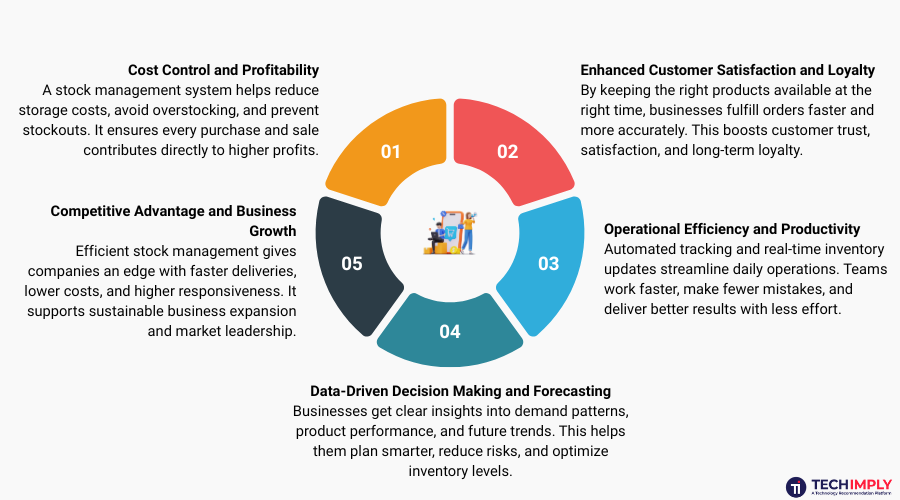
1. Cost Control and Profitability
Effective stock management directly shields your bottom line.
-
Minimizing Holding Costs: Overstocking ties up valuable working capital in inventory and racks up expenses for warehousing, insurance, and utilities. Precise stock maintenance reduces these carrying costs.
-
Preventing Overstocking: Avoiding excess stock protects against obsolescence and devaluation, particularly important in sectors with short product lifecycles.
-
Avoiding Stockouts: Running out of product (stockouts) results in lost sales, lost customers, and often high costs associated with emergency expedited shipping. Good stock management prevents this costly scenario.
-
Reduced Waste: Tracking expiry dates (essential for perishable items) and identifying slow-moving stock helps minimize write-offs due to spoilage or obsolescence.
2. Enhanced Customer Satisfaction and Loyalty
Customer service is inextricably linked to product availability.
-
Product Availability: A reliable stock management system ensures that advertised products are actually in stock, fulfilling the customer promise.
-
Faster Order Fulfillment: Organized warehouses, guided by a sophisticated stock management system, enable staff to locate and pick items faster, resulting in quick order fulfillment and better service.
-
Improved Brand Reputation: Consistent product availability and fast, accurate shipping build consumer trust and loyalty.
-
Reduced Lead Times: By accurately forecasting demand and communicating effectively with suppliers, lead times are optimized, further improving the customer experience.
3. Operational Efficiency and Productivity
A centralized stock management system streamlines the entire fulfillment chain.
-
Streamlined Operations: Automation handles repetitive tasks like reordering and data entry, freeing up human resources.
-
Better Resource Utilization: Knowing exactly where every item is located optimizes warehouse layout and reduces the time employees spend searching for stock.
-
Improved Warehouse Management: The system facilitates efficient receiving, put-away, picking, and packing processes.
-
Reduced Operational Costs: Efficiency gained through automation and better organization leads to lower labor costs and less time spent correcting errors.
4. Data-Driven Decision Making and Forecasting
The data generated by managing stock is its greatest asset for future strategy.
-
Accurate Demand Forecasting: Advanced systems use AI and machine learning to analyze historical sales, seasonality, and external factors, allowing for highly accurate predictions of future demand.
-
Informed Decision-Making: Data on stock turnover rate and profitability per SKU allows managers to make smart choices about product focus and pricing.
-
Optimized Inventory Levels: The system dynamically suggests optimal reorder points and quantities to maintain ideal levels, balancing the cost of holding vs. the risk of stockouts.
5. Competitive Advantage and Business Growth
Ultimately, superior stock management translates into market dominance.
-
Enhanced Market Responsiveness: Businesses can quickly adapt to sudden market shifts, such as supplier disruptions or unexpected demand spikes, thanks to real-time data.
-
Increased Scalability: A robust stock management system can easily handle the increasing volume and complexity that comes with business expansion or multichannel growth without a proportional increase in costs.
-
Stronger Supplier Relationships: Sharing accurate demand forecasts and consistent data builds trust, often leading to better pricing and more flexible terms, which is part of effective stock maintenance.
Pro-tip
In case you wish to enhance your inventory control and accuracy immediately, use Cycle Counting instead of yearly physical reports. This is based on the counting of your inventories (daily) involving a small and high-value portion of your inventory (by way of ABC Analysis) so as to identify inconsistencies at the initial stages and to keep yourself informed that your data on the stock management system remains accurate in real time.
What Are the Different Types of Stock Management and Why Should You Care?
The stock management is enacted in a number of systems, controls, and strategies. These approaches are understood to enable a business to adopt the right strategy that fits its needs.
1. Inventory Accounting Systems
-
Perpetual Inventory System: Continuously updates inventory records in real-time as purchases, sales, and transfers occur. This is the foundation of any modern stock management system.
-
Periodic Inventory System: Inventory is manually counted and valued at specific, fixed intervals (e.g., end of month or quarter). This is less accurate and unsuitable for high-volume businesses.
2. Inventory Control Systems
-
ABC Analysis: Categorizes inventory into three classes: 'A' items (high value, low volume, require tight control), 'B' items (moderate value/volume), and 'C' items (low value, high volume, require simpler control). This helps prioritize management of stock.
-
Minimum-Maximum Inventory Control System: Sets predefined minimum (reorder point) and maximum stock levels for each item. When stock hits the minimum, an order is placed to bring it back up to the maximum level.
-
First-In, First-Out (FIFO): Assumes the oldest inventory items are sold or used first. This is ideal for perishable goods or products subject to technological obsolescence.
-
Last-In, First-Out (LIFO): Assumes the newest items are sold first. While less common in physical flow, it is sometimes used for accounting purposes (though restricted in some regions).
-
Batch Tracking: Assigning a unique batch number to a group of products. Essential for quality control, recalls, and tracking expiration dates.
-
Safety Stock: The extra quantity of stock kept on hand to mitigate the risk of stockouts due to variations in demand or unexpected delays in the supply chain (lead time).
3. Inventory Management Methods/Techniques
-
Just-in-Time (JIT) Management: A method that minimizes inventory and increases efficiency by only receiving goods as they are needed in the production process or for fulfillment. It requires extremely tight control and coordination.
-
Materials Requirement Planning (MRP): A planning system for manufacturing that manages raw material procurement and production scheduling based on forecast goods demand.
-
Economic Order Quantity (EOQ): A formula that calculates the optimal number of units to order to minimize the total cost of ordering and holding inventory.
-
Days Sales of Inventory (DSI): A financial metric that indicates the average number of days it takes for a company to convert its inventory into sales. A lower DSI is generally better.
-
Demand Forecasting: Predicting future customer demand using historical sales data and market trends, typically leveraging AI in modern stock management services.
-
Vendor-Managed Inventory (VMI): The supplier (vendor) is responsible for maintaining the inventory levels at the customer's location.
How Does Perpetual vs. Periodic Stock Management Impact Your Business Growth?
The decision of the Perpetual and Periodic inventory system has a fundamental impact on your capacity to scale and optimize the management of stock.
|
Feature |
Perpetual Inventory System |
Periodic Inventory System |
|
Updates |
Real-time, continuous |
At fixed intervals (e.g., monthly, annually) |
|
Accuracy |
High; discrepancies found immediately |
Low; errors build up between counts |
|
Decision-Making |
Data-driven, instant alerts (reorder points) |
Delayed, reliance on physical counts |
|
Technology |
Requires a stock management system |
Can use manual methods (spreadsheets, paper) |
|
Growth Impact |
Scalable; essential for high volume and e-commerce |
Not scalable; fine for micro-businesses only |
For any business aiming for growth in 2025, the Perpetual Inventory System is non-negotiable. Its continuous, real-time data stream, facilitated by a modern stock management system, allows for highly accurate, automated reordering and reporting. This ensures high customer satisfaction and efficient stock maintenance, which directly supports expansion into new channels or product lines. The Periodic system lacks the precision needed to prevent stockouts or overstocking, making growth risky and costly.
Conclusion
The future of business success in 2025 lies in a flexible, smart supply chain. The driver of such agility is stock management. When businesses embrace the real meaning of stock management, not the sum total of numbers but the data, automation, and other innovative approaches, they will be able to overcome ambiguous situations on a global scale and secure the ability to address the requirements of customers in a very exact manner. The next critical move towards the realization of the two-pronged objectives of minimizing the cost and maximizing the sales is investing in a robust stock management system that will transform the inventory into a strategic resource to be utilized in the process of sustainable expansion.