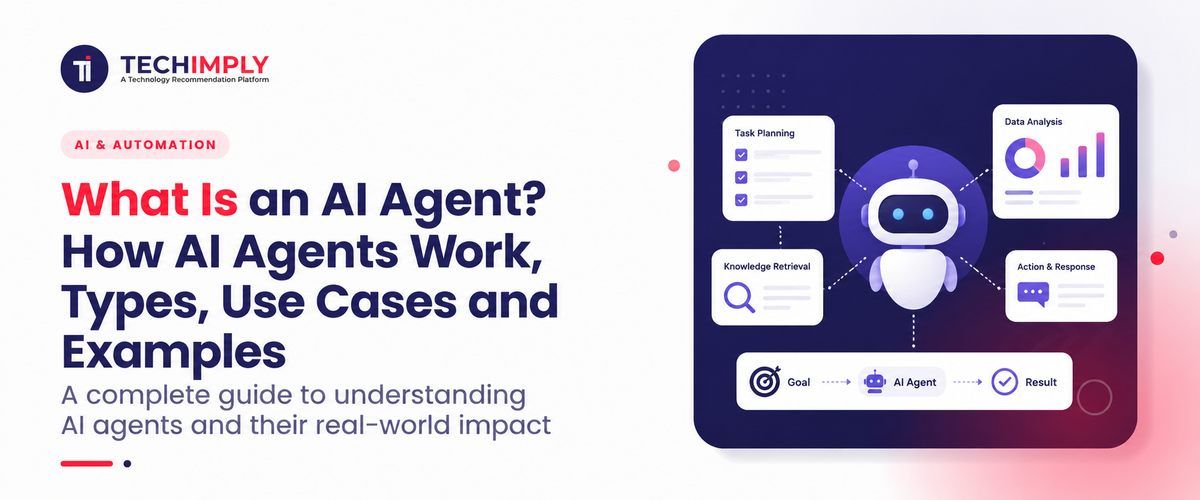
An AI agent is best understood as software that can carry a piece of work forward, not merely answer a prompt. Give it a defined outcome, such as sorting support requests or preparing a sales report, and it can review the available information, choose a next step, call an approved tool, and check what happened. The difference becomes clear when circumstances change. A fixed automation repeats the rule written for it, while an AI agent can interpret context and select from several permitted actions. A chatbot may be the interface, but the agent is the part that plans and acts.

Looking for AI Agent Software?
Check out Techimply's List of the Best AI Agent Software in India for your business.
In a responsible setup, people still approve refunds, payments, hiring decisions, and other sensitive actions. Success means completing a defined task accurately with a reviewable record. Companies considering an AI agent platform should therefore look beyond automation features and evaluate permissions, monitoring, integrations, and human approval controls. The sections below examine how AI agents work, the main types of AI agents and practical AI agent use cases for Indian organizations.
What Is an AI Agent in Simple Terms?
Suppose an employee in Ahmedabad needs a refundable Delhi flight within ₹12,000. An AI agent can check an approved source, exclude unsuitable timings, compare baggage and cancellation rules, and prepare the strongest option for approval.
The agent has not “understood travel” in the human sense. It has converted a goal into smaller decisions and used trusted tools to complete them. The payment remains with the employee or travel desk because purchasing is the higher-risk step.
This ability to plan and act is also what separates an agent from broader artificial intelligence software that may simply analyse data, generate content, make predictions or answer questions without independently carrying a workflow forward.
An AI agent usually has five abilities:
- It receives a goal rather than only a narrow command.
- It gathers information from its environment or connected data sources.
- It reasons about possible next steps and creates a plan.
- It uses tools, such as search, software applications or databases, to act.
- It checks the result and decides whether more work is needed.
Not every product marketed as an “agent” includes all five abilities. Judge a system by what it can access, decide and do, not only by its label.
How AI Agents Work
Most production systems reveal how AI agents work through a simple loop: observe the current state, choose an allowed action, inspect the result and continue only when necessary. Products implement the loop differently, but the operating logic is broadly similar.
1. The agent receives a goal
Every useful run begins with a concrete outcome. An employee may request a weekly pipeline summary, or a new support ticket may trigger the agent automatically. The goal should state both the desired result and the point at which human approval is required.
A clear goal improves performance. “Handle customer support” is too broad. “Classify Hindi and English tickets, use the approved knowledge base and send only low-risk answers automatically” gives the AI agent a useful boundary.
2. It collects context
The AI agent gathers the information needed to understand the task. This may include the user’s request, previous messages, company policies, database records, application status and live information from approved tools.
Context is important because the same request can require different actions. A customer asking for a refund may qualify under one policy but not another. The agent needs the correct order information and policy version before it can recommend a response.
3. It reasons and creates a plan
For a competitor report, the AI agent might confirm the companies, collect public evidence, separate facts from claims, compare equivalent features and prepare a conclusion.
Some systems sketch the whole route before acting; others choose one step, review the result and then decide what follows. Either approach should be constrained by the original goal, current evidence and the organisation’s operating rules.
4. It uses tools to take action
With the right permissions, an agent can search an approved knowledge base, read an invoice, calculate a figure, update a CRM field or prepare a ticket. Each tool should expose only the access required.
Consider scheduling. A text model can recommend setting up a meeting. An authorised AI agent can check the relevant calendars, identify two workable slots and draft the invitation. It should not invite external participants without permission simply because a calendar is connected.
5. It reviews the outcome
After taking an action, the AI agent examines the result. Did the search return enough information? Did the software accept the update? Does the answer satisfy the original goal? If not, it may try another step, request missing information or send the task to a person.
This cycle—observe, plan, act and review—is the simplest explanation of how AI agents work. More capable systems can repeat it, so stronger controls are needed as autonomy grows.
AI Agent vs Chatbot vs Traditional Automation
These technologies overlap, but they are not identical.
A chatbot is primarily a conversation layer. It answers questions and may remember part of the exchange, but it can remain valuable even when it has no authority to change another system.
Modern conversational AI Platforms can go further by connecting chat interfaces with knowledge bases, business applications and AI agents. However, having a conversational interface alone does not automatically make a system an autonomous agent.
Traditional automation follows predefined logic. A rule such as “send a welcome email when a user creates an account” is reliable and easy to test. However, it normally cannot handle an unexpected situation unless a developer has already written a rule for it.
An AI agent is more flexible. It can interpret an objective, select from several actions and adapt to new information. That flexibility makes agents suitable for less predictable work, but it also makes their behavior harder to control than a fixed rule.
A generative AI Tool, for example, may create an email, article, image or summary when a user asks for it. An AI agent can potentially take the process further by gathering information, deciding what needs to happen next, using authorised tools and reviewing the result.
The best business systems often combine all three. A chatbot provides the interface, automation handles predictable steps and an agent manages decisions that require context.
Main Types of AI Agents
There are several ways to classify the types of AI agents. The following practical categories explain the differences without requiring a technical background.
Simple reflex agents
A simple reflex agent reacts to the current situation using direct rules. If a message contains a known request, it chooses a matching action. It does not rely heavily on memory or long-term planning.
These agents are fast and suitable for predictable tasks. Their weakness is that they struggle when the correct decision depends on earlier events or missing context.
Model-based agents
A model-based AI agent keeps an internal representation of the situation. It may remember what has already happened, track the current state of a task and use that information when choosing the next step.
For example, a model-based service agent can record that a customer has already reset the router and checked the cable. The next response can move to a useful diagnostic instead of sending the customer around the same loop.
Goal-based agents
A goal-based agent considers the outcome before choosing an action. If the objective is to restore service quickly, it may compare a remote fix, a configuration change and an engineer visit, then select the permitted option most likely to work.
A route-planning system is a familiar example. It can examine several paths and choose one based on the destination, traffic and user preferences.
Utility-based agents
Sometimes several options can achieve the same goal. A utility-based agent evaluates which option offers the best overall result based on criteria such as cost, speed, risk or customer satisfaction.
An ecommerce agent illustrates the point. A damaged order might qualify for a replacement, refund or store credit. The right recommendation depends on the published policy, stock position, delivery time, cost and what the customer actually requested.
Learning agents
A learning agent uses measured outcomes to improve later decisions. Useful feedback includes whether a support answer solved the issue, whether a recommendation was accepted and where a workflow repeatedly stalled. Vague signals such as clicks alone can reward the wrong behaviour.
Learning must be controlled carefully. An organization should know what feedback is being used, how performance is measured and whether changes could introduce bias or unsafe behavior.
Multi-agent systems
A multi-agent system uses several specialized agents that cooperate. One may gather information, another may analyze it and a third may review the output. This structure can make complex workflows easier to manage, although coordination adds cost and complexity.
These types of AI agents are not always separate product categories. A single solution can combine memory, goals, utility scoring and learning.
Common AI Agent Use Cases
The strongest AI agent use cases have a clear objective, repeat frequently, use accessible data, and allow results to be checked. Common examples include the following.
Customer support
AI agents for customer service can classify requests from email, web chat or WhatsApp, retrieve account details, search an approved knowledge base and draft answers in English or an Indian language. Sensitive cases can be handed to a human with a summary.
Sales and lead management
Sales agents can research Indian companies, enrich lead records, score opportunities, draft personalised follow-ups and remind representatives about next steps. Human review remains important for claims, ₹ pricing and customer communication.
Marketing operations
Marketing teams can use an AI agent to organize campaign data, prepare content briefs, create variations, monitor performance and highlight unusual results. The agent should not publish factual or brand-sensitive content without an appropriate review process.
For organisations managing several connected marketing tasks, AI workflow automation can help agents move information between applications, trigger approved actions and reduce repetitive handoffs while keeping important decisions under human supervision.
IT service management
An agent can diagnose common incidents, collect system information, recommend solutions and perform approved recovery steps. It can also create a clear record of actions for the IT team.
Finance and administration
Useful tasks include matching GST invoices to purchase orders, identifying missing information, preparing expense reports and explaining unusual transactions. Payments, tax filings and financial approvals should use strict limits and human authorisation.
Software development
Development agents can explain code, write tests, identify defects, propose changes and help maintain documentation. The output still needs automated testing, security checks and developer review before production use.
Practical AI Agent Examples
The following AI agent examples show how the technology can fit into everyday work.
A support agent for an Indian ecommerce company receives a delivery complaint on WhatsApp. It checks the order and courier status, retrieves the approved policy and prepares a Hindi or English response. Suspicious refund requests go to a person.
A purchasing agent receives a request for ten office chairs. It checks approved suppliers, compares GST-inclusive prices and delivery dates, confirms the ₹ budget and prepares an order. It does not place the order until an authorised person approves it.
An SEO research agent collects public search results for a topic, groups common questions, identifies missing subtopics and produces a content outline. A writer then verifies the sources and turns the research into an original article.
A recruiting agent can organise applications, flag missing documents and find interview slots. That administrative help is useful; ranking candidates or making the final employment decision is a different matter and requires accountable human judgement.
The strongest AI agent examples share the same discipline: a narrow job, dependable inputs, limited permissions and an obvious escalation route. None requires unlimited access.
Benefits of Using an AI Agent
The immediate benefit is often mundane but valuable. An AI agent can gather records that employees previously copied between systems, prepare the first draft of a routine output and surface exceptions that deserve attention. That leaves people more time for negotiation, judgement and customer relationships.
However, speed is not the same as value. A fast agent that creates incorrect records or frustrates customers is not successful. Organizations should measure accuracy, completion rate, escalation quality, user satisfaction, cost and time saved.
Risks and Limitations
An AI agent can be confidently wrong. Incomplete records or a poor tool result may create an incorrect customer message or database change instead of merely a bad draft.
Indian organisations should identify the purpose for personal data, collect only what is needed, apply required notice or consent, and account for the phased DPDP Act and Rules. Least-privilege access is the practical starting point.
External material creates another risk: an email or webpage may contain instructions designed to manipulate the agent. Such content must be treated as untrusted data. Bias, runaway usage cost and unclear responsibility also need monitoring, particularly in employment, finance, healthcare and other high-impact work.
How to Choose and Introduce an AI Agent
Begin with a workflow whose result can be checked. Document the goal, permitted data, available tools, acceptable output and the exact conditions that send the case to a person. A narrow invoice-checking task is a better pilot than “automate finance.”
Next, test the AI agent with normal cases, unusual cases, and intentionally difficult inputs. Measure performance against the current process. Do not give it broad access simply because the early demonstration looks impressive.
Place approval gates before irreversible or sensitive actions. Keep logs that show the information used, the tool called and the result returned. Review failures and permissions regularly instead of waiting for a serious incident.
People working with the agent need a simple operating rule: what it may finish, what they must verify and where they can report a questionable result. Accountability stays with the organization deploying it.
Conclusion
An AI agent earns its place when it moves a defined task from request to checked result. Its ability to gather context, choose steps and use tools makes it more capable than a chatbot and more deserving of careful controls. The many types of AI agents should not distract from the practical decision. Choose the level of autonomy that matches the task and the risk. The best AI agent use cases are clearly defined, measurable and easy to supervise. The most successful AI agent examples support people rather than removing accountability. Indian companies do not need to begin with a large autonomous system. A focused task, limited permissions and evidence-based measurement are the credible route to value.