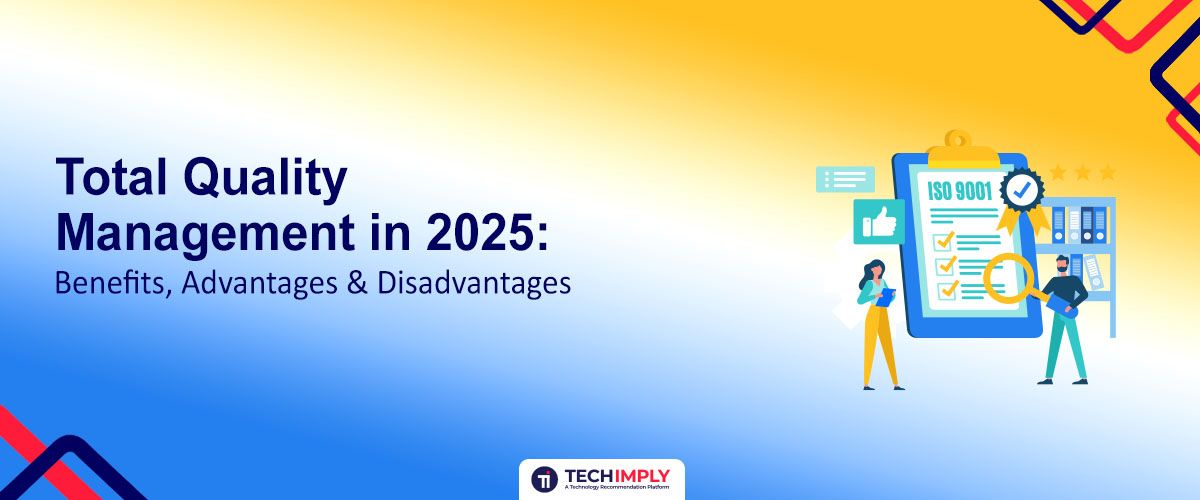
Excellence means surviving in the highly dynamic business environment of 2025, a complex place. The firms can no longer afford the cost of rectifying errors once they occur, or total quality improvement, or they need to integrate quality in all processes early on. This is what TQM (total quality management) is all about.
The total quality management customer-centred strategy is one of ongoing performance enhancement. It combines the basic managerial practices, total quality improvement initiatives that are in place, and technical instruments within a rigorous framework.
What Is Total Quality Management (TQM)?
The main idea of Total Quality Management is that quality must be the work of all people and not of a special department of quality control. Moreover, the objectives of TQM are not just to please the customer but to make them delighted and, at the same time, enhance internal efficiency and minimize cost. The meaning of Total Quality Management (TQM) can be narrowed down to three main components:
- Total: Including all the people in the company, including both the top management and the front-line employees, and all the processes, starting with the design and ending with delivery.
- Quality: Adhering to or surpassing customer demands and expectations, emphasizing error aversion rather than error detection.
- Management: A process that is systematic, disciplined, and continuous, which utilizes the use of data and analysis to enhance processes.
The philosophy of Total Quality Management has been influencing the global enterprises to a high level of performance over the last few decades. TQM is not a program but a management philosophy and a corporate culture that requires improvement in every facet of an organization, which must be constant.

The current business environment demands not just quality but agility. The importance of Total Quality Management has surged as digital transformation and instant customer feedback mean that flaws are exposed immediately. By adopting the concept of Total Quality Management, businesses embed a rigorous system that leads to sustained total quality improvement.
Why Is Total Quality Management Important in Business?
TQM is far more than a set of rules; it is a foundational business strategy. The quality management software market size was valued at USD 9.95 billion in 2024 and is projected to reach USD 19.79 billion by 2032, growing at a CAGR of 9.90% from 2026 to 2032. For any TQM company, implementing the TQM framework provides essential stability and direction in a dynamic marketplace.
1. Improved Quality and Efficiency
The nature of TQM in terms of process standardization and prevention of defects, in turn, results in quality improvement and efficiency. Organizations minimize errors and waste by strictly implementing the total quality improvement techniques.
2. Enhanced Customer Satisfaction
Fundamentally, TQM is customer-centered. TQM ensures that products and services always satisfy and sometimes surpass the expectations of the market by constantly evaluating and improving the process based on customer feedback, thus resulting in improved customer satisfaction.
3. Stronger Competitive Advantage
In competitive markets, quality is a differentiator. A successfully implemented TQM strategy gives a TQM company a stronger competitive advantage by building a reputation for reliability and excellence that competitors struggle to match.
4. Boosted Employee Morale and Engagement
When employees are empowered to identify and solve problems related to quality, their ownership and engagement increase. This participation in continuous process improvement in TQM significantly boosts employee morale and engagement.
5. Data-Driven Decision Making
The scope of Total Quality Management relies heavily on metrics and statistical process control. It replaces guesswork with data-driven decision-making, ensuring that improvement efforts are targeted where they deliver the most impact.
6. Increased Adaptability and Sustainability
The constant drive toward continuous improvement in quality management builds orgaorganizational agility. By making minor, constant adjustments rather than massive overhauls, the business maintains increased adaptability and sustainability.
What Are the Benefits of TQM in Continuous Improvement?
The combination of TQM and the principle of continuous improvement (that is usually implemented in the form of cycles such as PDCA Plan-Do-Check-Act) is where the philosophy provides the most significant benefits. This is more so in the use of continuous process improvement in total quality management.
1. Higher Quality Products and Services
- Reduced Defects and Errors
By focusing on error prevention at the source, TQM dramatically lowers the rate of reduced defects and errors that reach the customer. This systematic approach tackles the root causes of issues.
- Consistency and Reliability
When all process variations are minimized through standardization and control, the organization achieves unparalleled consistency and reliability in its output, a direct reflection of successful total quality improvement.
- Reduced Need for Rework and Rework Costs
Quality built in from the start eliminates the high cost and time sink associated with fixing problems later, resulting in a reduced need for rework and rework costs.
2. Enhanced Customer Satisfaction and Loyalty
- Meeting and Exceeding Expectations
A TQM company continuously tunes its processes to reflect current customer needs, ensuring it is always meeting and exceeding expectations.
- Building Trust and Loyalty
Consistent quality over time creates reliability, which is the foundation of building satisfied customers who are loyal customers, enhancing the importance of Total Quality Management.
- Faster Problem Resolution
When issues do arise, the TQM structure facilitates faster problem resolution by having clear, documented procedures for handling complaints and implementing corrective actions.
3. Greater Efficiency and Productivity
- Streamlined Processes
TQM involves encouraging teams to draw streamlined processes, removing the needless steps and waste, a fundamental aspect of continuous improvement in TQM activity.
- Reduced Waste
The philosophical dedication to quality at all levels results in a lower level of scrap, errors, and optimal use of materials, which translates to reduced waste.
- Optimized Resource Utilization
TQM makes sure that the use of personnel and equipment is as efficient as possible through clearly displayed standards and training of employees, which leads to optimized resource utilization.
4. Reduced Costs
- Preventing Rather Than Correcting Defects
The shift from inspection (correction) to prevention is the single largest cost saver in TQM, preventing rather than correcting defects and moving spending away from futile costs.
- Minimized Waste and Inefficiencies
The combined effect of streamlined processes and reduced defects means overall operational spending is significantly lowered, delivering minimized waste and inefficiencies.
5. Strengthen Competitive Advantage
- Market Differentiation
Superior, reliable quality provides clear market differentiation that competitors cannot easily copy. This is a crucial element when considering the scope of Total Quality Management.
- Adaptability and Agility
By instilling a culture of constant review and refinement (continuous process improvement in total quality management), TQM makes the organization inherently more adaptable and agile to market changes.
What Are the Advantages and Disadvantages of TQM in 2026?
Although TQM has profound benefits, to reach the maximum potential, it takes a lot of commitment and has its share of challenges, and thus, the debate on total quality management advantages and disadvantages is an absolute requirement in any contemporary enterprise.
Advantages
1. Improved Quality and Reduced Defects
TQM shifts the focus from detecting errors after they occur to preventing them throughout the process. By applying total quality management principles like "Do it right the first time," companies meticulously standardize and monitor every step, leading to:
- Reduce defects in products or services.
- Increased reliability and consistency in output.
- Lower failure rates, didirectly supporting overall total quality improvement.
2. Enhanced Customer Satisfaction and Loyalty
The focus is always put on customer needs and satisfaction, as the key concept of total quality management is to give the customer the opportunity to influence or shape the end product by incorporating customer feedback in the continuous process improvement, thereby ensuring that the end product is a perfect fit for the market needs. This results in:
- Consistently enhanced customer satisfaction.
- Higher rates of customer retention and long-term loyalty.
- A stronger reputation in the marketplace for quality and reliability.
3. Increased Efficiency and Productivity
TQM demands that processes are constantly reviewed and streamlined, often leveraging tools for continuous process improvement in TQM. This systematic analysis identifies and eliminates non-value-added activities and waste, leading to:
- Streamlined processes and faster cycle times.
- Increased efficiency by reducing bottlenecks and redundant tasks.
- Higher productivity from employees who are empowered to optimize their own workflows.
4. Reduced Costs
The ideology of quality being free (or, in fact, poor quality being costly) is accomplished by TQM. It is much cheaper to avoid defects than to correct or deal with warranty claims or customers. TQM drives cost reduction by:
- Reduction of costs of waste, scrap, and rework.
- Reducing the costs of inspections and other appraisal costs in the long run.
- Lessening the cost of hidden failures (e.g., expedited shipping, lost goodwill).
5. Stronger Competitive Advantage
To have a TQM-driven organization is an inherent improvement of an organization compared to its competitors. High quality, which is uniform and of superior quality, combined with the reduced cost of operations, is a strong market lever. TQM delivers:
- A competitive advantage is more founded on a reputation of excellence.
- The capacity to dictate high prices because of the greater perceived value.
- Differentiation in the market by reliability that is hard to copy by competitors.
6. Data-Driven Decision Making
TQM focuses on facts, data, and statistical analysis (like the 7 basic tools of total quality management) rather than intuition or guesswork. This rigorous, quantifiable approach ensures:
- Decisions regarding process changes are objective and evidence-based.
- Resources are precisely allocated to areas where the data indicateses the highest need for continuous improvement in quality management.
- The overall TQM framework is supported by measurable metrics, ensuringaccountability and targeted corrective actions.
Disadvantages
1. Significant Time and Resource Investment
TQM is a comprehensive organizational change that requires deep integration, not just a quick fix. Successfully embedding the TQM philosophy demands:
- Extensive training for all employees in quality tools, statistics, and problem-solving techniques.
- Redesigning processes from the ground up, which is time-consuming.
- Allocating dedicated resources (personnel, budget, and time) that may divert focus from immediate operational tasks.
2. Resistance to Change
The TQM philosophy radically changes the attitude of the employees towards their work and imposes new duties (monitoring processes and solving problems). This change of culture does not always go along with itself:
- Anxiety of the unfamiliarity in employees who are accustomed to the status quo.
- Opposition among middle management, whose perception of empowering the lower-level employees may be seen as an extension of their power.
- Overall reluctance to implement new documentation and reporting, as well as meeting schedules.
3. Lack of Management Commitment
TQM requires visible, unwavering support from the highest levels of the organization. If senior leaders fail to provide consistent backing, the initiative is destined to fail. A lack of management commitment often results in:
- Inconsistent resource allocation, leading to stalled projects.
- Failure to lead by example, causing employees to view TQM as a temporary program rather than a core value.
- Difficulty in resolving ccross-functionalconflicts that arise during process reengineering.
4. Difficulty in Quantifying ROI
Contrary to the definite reduction of hard costs (such as scraps and rework) that TQM has, the evaluation of the payback may be abstract and difficult to quantify, especially in the long-term payback:
- The benefits of TQM in increasing revenue can hardly be exactly assigned, particularly when other strategic transformations are taking place at the same time.
- The financial worth of soft benefits, like increased customer loyalty or higher employee morale, is difficult to track and correlate.
- This challenge of quantifying ROI may lead to a challenge of keeping the stakeholders on board in the initial and costly implementation phases.
5. Overemphasis on Metrics
Because TQM heavily relies on data, statistics, and measurable goals, there is a risk of becoming too rigid or bureaucratic:
- An overemphasis on metrics can lead teams to focus only on targets that are easy to measurere, neglecting other critical but less quantifiable aspects like creativity or breakthrough innovation.
- Excessive data collection and documentation can turn into a paperwork burden, diverting employee time away from actual value-creating work.
- Teams may engage in "gaming the system" to meet metric targets without achieving genuine process improvement.
6. Challenges with Implementation
The nature of the task of implementing a system in a whole organization creates a lot of operational challenges:
- It is well known that it is hard to sustain the momentum after the first launch.
- Bringing together TQM and various legacy systems and processes that are already in place may not be that easy.
- It takes enormous coordination and hard work to establish standardized documentation and training of various departments or functions, or even international destinations.
Conclusion
The concept of Total Quality Management is an extremely potent and topical approach to every organization that seeks to achieve success over the long run in 2026. It puts quality as a secondary consideration to a leading, driving philosophy. Through adopting the total quality management philosophy and reducing the identified drawbacks with committed leadership, a TQM organization may introduce a culture of total quality enhancement. It is the philosophy that ensures that the final goal, which is the improved customer satisfaction, is achieved each time, which offers a sustainable competitive differentiation source.