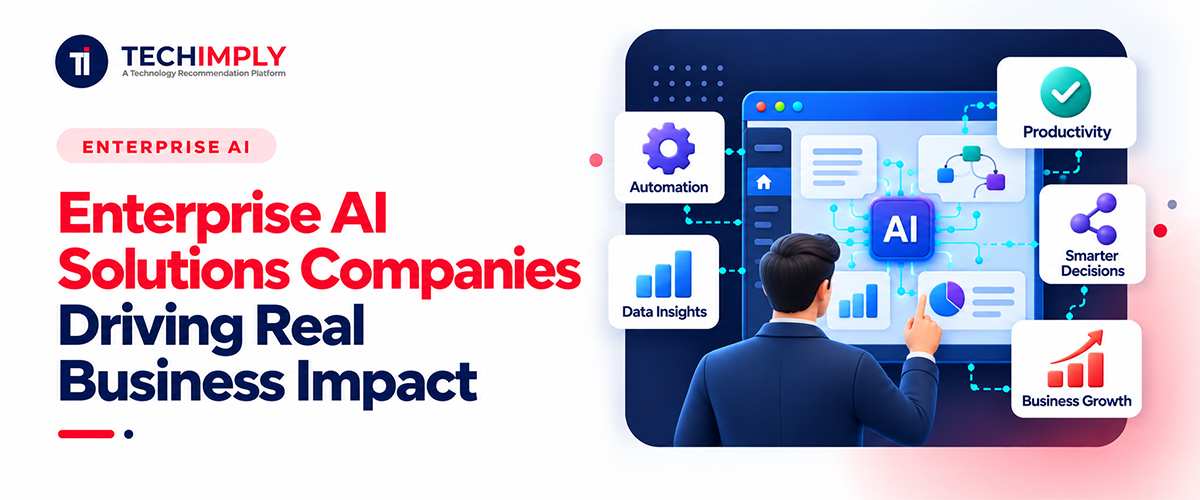
Enterprise AI is no longer just about chatbots or productivity prompts. Large organizations now need AI that can search across internal knowledge, automate workflows, support employees, assist developers, improve customer operations, and operate within clear governance.
The challenge is choosing the right type of solution. Some vendors are AI workflow platforms. Some are copilots. Some are model providers. Some are implementation partners that help enterprises connect AI to existing systems, data, and operating models.
This guide compares 10 enterprise AI solutions using a practical buyer framework, not just vendor popularity.
How We Evaluated the Companies
We reviewed each company using five criteria:
|
Evaluation Criteria |
Weight |
What It Measures |
|
Workflow automation depth |
25% |
Can the solution act inside real business processes? |
|
Enterprise integrations |
20% |
Does it connect with CRM, ERP, ITSM, collaboration, data, or automation tools? |
|
Governance and security |
20% |
Does it support controls, permissions, auditability, and enterprise risk needs? |
|
Scalability and adoption fit |
20% |
Can it support large teams, multiple functions, and production rollout? |
|
Business-impact clarity |
15% |
Does it help tie AI usage to measurable outcomes? |
This is an editorial shortlist, not a universal ranking. The right choice depends on a company’s technology stack, data maturity, workflow complexity, risk profile, and AI operating model.
Quick Comparison Table
|
Rank |
Company |
Best Fit |
Buyer Lens |
|
1 |
ServiceNow |
Workflow-heavy enterprises |
AI embedded into IT, HR, customer service, and operations workflows |
|
2 |
Sage IT |
Enterprises needing implementation support |
AI integration, data readiness, and workflow transformation |
|
3 |
Microsoft 365 Copilot |
Microsoft-first organizations |
AI inside daily productivity and collaboration tools |
|
4 |
Google Gemini Enterprise Agent Platform |
Technical teams building custom agents |
Agent development, model choice, and cloud-native AI architecture |
|
5 |
Salesforce Agentforce |
CRM-led organizations |
AI agents for sales, service, and customer engagement |
|
6 |
OpenAI ChatGPT Enterprise |
Cross-functional AI adoption |
General-purpose AI, custom assistants, and enterprise controls |
|
7 |
Anthropic Claude Enterprise |
Reasoning-heavy teams |
Secure AI for analysis, writing, coding, and knowledge work |
|
8 |
IBM watsonx |
Regulated industries |
Governed AI development, RAG, and enterprise AI lifecycle management |
|
9 |
Glean |
Knowledge-heavy organizations |
Enterprise search and permission-aware AI answers |
|
10 |
UiPath |
Process automation teams |
Agentic automation across robots, people, systems, and workflows |
1. ServiceNow
ServiceNow is one of the strongest enterprise AI platforms for organizations that need AI connected to real workflows. Its AI platform supports service operations, employee workflows, customer service, IT, risk, security, and broader business operations. ServiceNow has also expanded AI Control Tower to help enterprises discover, observe, govern, secure, and measure AI deployed across systems.
ServiceNow is strongest where AI must do more than answer questions. It can support work intake, approvals, ticket resolution, service management, and cross-functional automation.
It is a strong choice for large companies that already use ServiceNow or want AI embedded inside service and operations workflows. The main consideration is ecosystem fit. Buyers should evaluate implementation scope, licensing, workflow maturity, and whether their teams are ready to standardize processes on the platform.
2. Sage IT
Sage IT is best understood as an enterprise AI implementation and integration partner rather than a single packaged software platform. That distinction matters. Many organizations already have AI tools, cloud services, data platforms, CRM, ERP, automation layers, and legacy systems. Their challenge is making AI work across that environment without creating another disconnected tool.
Sage IT’s AI services cover advisory, AI adoption planning, AI governance, value engineering, workflow orchestration, AI software delivery, private LLM patterns, RAG-ready data foundations, data integration, and AI governance services. Its public AI solutions page also highlights AI adoption roadmaps, operating model planning, tool selection, data foundations, retrieval architecture, and cross-system workflow automation.
For companies evaluating Enterprise AI Solutions, Sage IT fits best when the buyer needs help connecting AI to real processes, existing applications, governed data, and measurable business outcomes.
3. Microsoft 365 Copilot
Microsoft 365 Copilot is a strong fit for organizations already using Microsoft 365. It brings AI into familiar tools such as Word, Excel, PowerPoint, Outlook, Teams, enterprise search, agents, notebooks, and Copilot Studio. Microsoft describes Copilot as powered by Work IQ, a workplace intelligence layer that connects data, context, and tools across Microsoft apps.
Its biggest advantage is adoption. Employees can use AI inside tools they already use every day. Common use cases include meeting summaries, email drafting, document creation, internal search, data analysis, and department-specific agents.
The main implementation challenge is governance. Copilot inherits Microsoft 365 permissions, labels, and retention policies, so organizations need clean access controls, content hygiene, and strong data management before scaling.
4. Google Gemini Enterprise Agent Platform
Google Gemini Enterprise Agent Platform is designed for technical teams that want to build, govern, scale, and optimize enterprise AI agents. Google describes it as a platform for building enterprise-grade agents grounded in enterprise data, with support for model choice, model evaluation, MLOps, data integration, and agent deployment.
This makes Google a strong choice for cloud-native organizations, data science teams, and enterprises that want custom agent development rather than only packaged assistants.
Its strength is flexibility. Teams can work with Google models, third-party models, open models, enterprise data, and developer tooling. The main requirement is technical maturity. Buyers need engineering, security, and governance teams capable of managing custom AI systems at scale.
5. Salesforce Agentforce
Salesforce Agentforce is built for AI agents inside CRM and customer-facing workflows. Salesforce positions Agentforce around service, sales, marketing, commerce, employee support, appointment scheduling, product recommendations, observability, multi-agent orchestration, and interoperability. Salesforce also says more than 18,000 companies run on Agentforce.
Agentforce is strongest for organizations already using Salesforce as a major customer data and workflow platform. It can help automate support, qualify leads, recommend actions, and assist service teams without forcing users into a separate AI interface.
The main buyer consideration is ecosystem dependency. Companies outside Salesforce may need more integration planning to get full value.
6. OpenAI ChatGPT Enterprise
ChatGPT Enterprise is a broad enterprise AI option for organizations that want general-purpose AI, internal assistants, coding support, knowledge work, analysis, and custom AI applications. OpenAI’s Trust Portal lists security and compliance documentation for ChatGPT Enterprise and ChatGPT Edu, including SOC 2 Type 2 coverage and ISO certifications.
Its strength is versatility. Teams can use it for research, writing, summarization, analysis, coding, brainstorming, and workflow-connected assistants.
The risk is scattered adoption. Without clear governance, teams may use AI inconsistently across departments. Buyers should define approved use cases, access policies, data-handling rules, model governance, and success metrics before scaling.
7. Anthropic Claude Enterprise
Claude Enterprise is built for organizations that need secure AI for reasoning, analysis, writing, coding, and knowledge work. Anthropic highlights enterprise controls such as no model training by default, SSO/SAML, SCIM provisioning, role-based access control, data retention controls, audit logs, SOC 2, ISO 27001, GDPR, CCPA, and a HIPAA-ready offering.
Claude is especially useful for complex document analysis, policy work, legal and compliance review, software development, and security-oriented use cases.
Its strongest fit is reasoning-heavy work where quality, safety, and secure collaboration matter. For deep workflow execution, companies may still need orchestration, integration, or automation platforms around it.
8. IBM watsonx
IBM watsonx is a strong option for regulated enterprises and data-heavy organizations. IBM documentation explains how watsonx supports RAG solution governance, knowledge base grounding, prompt templates, governance workflows, evaluation, and AI lifecycle controls.
IBM is especially relevant for banking, insurance, healthcare, government, telecom, energy, and manufacturing, where governance, explainability, hybrid deployment, and compliance are important.
Its strength is not just generative AI. It is the ability to support enterprise AI development across data, models, governance, and industry-specific operating requirements.
9. Glean
Glean focuses on enterprise search, workplace AI, and knowledge discovery. Its platform connects business applications and data sources so employees can search, ask questions, and take action using enterprise context. Glean says it supports more than 275 app connectors.
Glean is a strong fit for companies where knowledge is fragmented across Slack, Google Drive, SharePoint, Jira, Confluence, Salesforce, GitHub, Zendesk, and similar systems.
Its value depends heavily on content hygiene, permissions, source-system quality, and internal knowledge management discipline.
10. UiPath
UiPath is a strong enterprise AI option for organizations focused on automation and process orchestration. UiPath Maestro lets businesses design and run processes as BPMN models while coordinating AI agents, robots, people, decisions, handoffs, and systems across workflows.
UiPath is especially relevant for finance operations, procurement, HR, customer service, shared services, insurance, healthcare administration, and other process-heavy functions.
Its strength is controlled execution. UiPath is not just an AI assistant; it is useful when companies need AI agents, robots, humans, and systems to work together inside measurable business processes.
Final Takeaway
The best enterprise AI solution is not always the biggest platform or the most recognized model provider. It is the option that matches the organization’s workflow complexity, data maturity, integration needs, governance requirements, and business goals.
ServiceNow is strong for workflow-heavy enterprises. Sage IT fits organizations that need AI implementation and integration support. Microsoft, Google, Salesforce, OpenAI, Anthropic, IBM, Glean, and UiPath each serve different enterprise AI needs.