The way businesses develop and compete has changed radically in recent years. However, companies are relying on talent management as a strategy to recruit and retain employees rather than relying on traditional hiring and retention practices. Through an appropriate talent management system, the organizations are able to attract, develop, and retain high-performing employees as well as balance people strategies against business objectives.

Looking for Talent Management Software?
Check out Techimply's List of the best Talent Management Software for your business.
And what is talent management that renders it dynamic and data-driven? It allows the HR departments to find the best talents, develop future leaders, and inspire a growth and innovation culture. In the current market that is rapidly changing, a well-designed talent management strategy of the hr department is not only a process but a competitive edge that ensures a successful business in the long term.
What is Talent Management?
Talent management can be described as the strategic thinking of attracting and developing, motivating, and retaining high-performing employees in anticipation of long-term success of a business. That is, it is the right individuals in the right location, and letting them do what is right.
Then what is talent management in the current corporate world? It does not just involve hiring, but it is an ongoing process that develops skills, motivates, and develops a strong organizational culture. This process can be automated and simplified using modern software or a professional talent management company to provide businesses with data insights and performance analytics.
The major points of talent management are:
-
Concentrates on the identification, development, and retention of the best talent
-
Improves employee performance and involvement.
-
Favors succession planning and leadership.
-
Relies on analytics to make smarter workforce decisions.
-
Ensures that there is congruence between people's objectives and business objectives.
Basically, the talent management definition is about matching business strategy with human potential. It is a critical HR activity that will turn employees into assets that develop with the company.

Do You Know?
Firms that spend on systematic talent management systems have a 2.5x higher probability of being ahead of their rivals in productivity and innovativeness.
What is the Talent Management Process?
Talent management process is a systematic process that assists organizations to attract, recruit, nurture, engage, and retain the best talent in order to achieve business goals. It is not merely a matter of filling jobs, but creating a labor force that develops in line with your business vision. The idea of talent management focuses on the correlation of personal ambitions and the success of the organization so that all employees can play an important role.
This process can be made smooth by a powerful HR talent management plan with the help of automation, analytics, and human design. All of the stages have their own special role in talent management to facilitate performance and long-term development. There are seven major stages of this process, which are as follows:
1. Recruit
The process of attracting top talent is initiated by creating awareness of your company culture and opportunities. The job portals, social media, and referral programs are used by businesses to reach competent professionals.
Example: A talent management firm can apply analytics that utilize AI to recognize individuals who fit the job requirements, in addition to being congruous with your organization and its long-term objectives.
2. Hire
Recruiting is not just about interviews but about looking at the potential, attitude, and flexibility. The talent management process helps in ensuring that the appropriate individuals are in the appropriate positions, and this helps in creating long-term congruency with the company's goals. A properly designed HR talent management system facilitates this process by streamlining the process of evaluation by setting similar performance standards, enhancing cooperation between managers executing the hiring process, and eliminating bias.
3. Develop
Talent management is important at this stage because employee growth is among the major components for maintaining a business's competitiveness. The meaning of a talent management system can assist organizations in understanding how the training, mentorship, and ongoing learning programs enable the team leaders to improve their skills and be ready to face the new challenges that are emerging.
Mini Story: It is a medium-sized technology company that introduces an online learning platform that is connected to its talent management platform. In several months, the productivity increased by 30% as the employees felt confident and acquired skills in new technologies.
4. Engage
The key to successful organizations is the engagement of their employees. Productive employees who are engaged are 21 times more productive and tend to be more retentive. The concept of talent management is intended to create a culture of recognition, communication, and collaboration. Encourage feedback, team building, and milestones so that morale is high.
5. Perform
The performance management also makes certain that the objectives are in line with the company's objectives. Managers can understand their strengths and areas for improvement through constant feedback, frequent check-ins, and data-driven reviews. The talent management thing in this is to provide accountability and motivate the employees to do a better job daily.
6. Recognize
Talent management is not just about recruitment and training; it is also about rewarding and acknowledging the efforts of people. Rewards are not all in recognition, but real appreciation is important also. Careful employees feel valued, thereby becoming more committed and engaged. Gamified dashboards, digital badges, or peer-recognition programs can be adopted by organizations to highlight a success story in the organization and reinforce a culture of appreciation.
Example: One of the largest e-commerce companies has installed an internal shout-out system connected to their HR talent management system, and company satisfaction scores among the employees have increased by 25%.
7. Plan
Succession planning is a process that equips your business for the future as it helps to identify and develop employees who have leadership potential. It makes sure that whenever key positions become vacant, there are competent people there who are willing to take over. The necessity of talent management is evident in this case- it assists organizations in predicting the talent needs and creating a powerful and prospective leadership pipeline.
Key Components of Talent Management
The talent management system will be created to unite all the facets of staff development, such as recruitment, training, and retention. These elements are central to the process of attracting, growing, and retaining the most important resource of business people. There are numerous aspects in which talent management can be regarded as an illustration of the direct influence of strategic HR practices on the success of the organization. Now, we are going to discuss each of the components.
1. Talent Acquisition
This is what the whole process is based on. It is also about the identification, attraction, and recruitment of the top talent in your company. A talent management company in this situation is to make sure that every recruit has strategic value and can benefit the business objectives.
Example: Major companies apply the use of AI-based recruiting software in their talent management program to filter applicants according to their skills, experience, and cultural match.
2. Onboarding and Training
Easy onboarding assists with the integration of new employees faster, which minimizes turnover at the initial stages. A properly structured talent management process will make certain that the recruits know the values and policies of the company, as well as the performance expectations.
3. Performance Management
This aspect is to offer accountability and transparency. It can be ensured that the teams remain focused on organizational goals by setting certain KPIs, giving feedback, and carrying out performance reviews.
4. Learning and Development
Lifelong learning promotes innovation and self-improvement. The other benefits of training programs, certifications, and mentorship are that they enhance performance and confidence among employees. Talent management is actually a case study of how organized learning directly affects the ability of a business to survive and be prepared to face the future. To help streamline learning initiatives, companies can use Qooper, a mentoring software that tracks progress, facilitates mentor-mentee connections, and ensures employee development aligns with business goals.
5. Succession Planning
Future-proof your business by training your employees to become leaders when the opportunity arises. An innovative talent management firm assists organizations in formulating data-driven succession plans to ensure that the business continues and the leadership is stable.
Example: Predictive analytics are implemented by many international companies in their talent management system to predict and nurture future leaders at an early stage.
6. Employee Engagement and Retention
Employee engagement is all about long-term success. Employees feel appreciated, and their productivity and loyalty increase automatically. The importance of talent management is the fact that it is possible to develop a culture in the workplace that inspires, advises, and compensates anyone at whichever level.
Pro-tips:
Monitor satisfaction and minimize turnover using engagement surveys and feedback systems built into your talent management system.
Why is Talent Management Process Important for Business Success?
The Talent Management Solutions market is expected to grow 12.64% between 2026 and 2032 to USD 33.9 billion, and will reach USD 12.77 billion in 2024. This underscores the increased presence of talent management because companies are trying to acquire, nurture, and retain the best talent. It is now necessary to understand what a talent management system is and how it relates to organizational strategy to be successful in the long run.
1. Improves Employee Performance
An articulated key process of talent management assists employees to know their career tracks and undergo specific training, as well as be provided with performance feedback. This is a very organized way of enhancing efficiency and motivation, and providing the employees with a means of contributing towards the organizational objectives.
2. Enhances Employee Retention
Strategic sources of talent management help to reduce turnover and recruitment costs because they are used to identify, nurture, and retain the best performers. The employees will be more willing to stay since they will see growth potential, which will hold desirable skills and institutional knowledge within the organization.
3. Drives Innovation and Growth
Through employee development, organizations create creativity and problem-solving abilities by using a holistic talent management system. The motivated and empowered employees are creative, more productive, and helpful in the sustainable business development.
4. Builds a Strong Company Culture
The inclusion of talent management as an element of daily operations fosters a culture of people first,, whereby people collaborate, trust, as well as have a sense of purpose. A great culture attracts great talent and causes the organization to realize its values and mission.
5. Supports Strategic Business Goals
An effective key process of talent management matches the performance goals of individuals against the strategic plans of the organisation. This makes sure that the employees are playing a role straight to the business success and also helping the company in achieving long-term goals.
6. Reduces Hiring Costs
A good talent management system will make recruitment effective, improve retention, and decrease the cost of hiring employees. By making sure that the competent employees are retained and their turnover rates are minimized, the organizations will have an endless supply of talent that will not have to undergo the costly recruiting procedures once again.
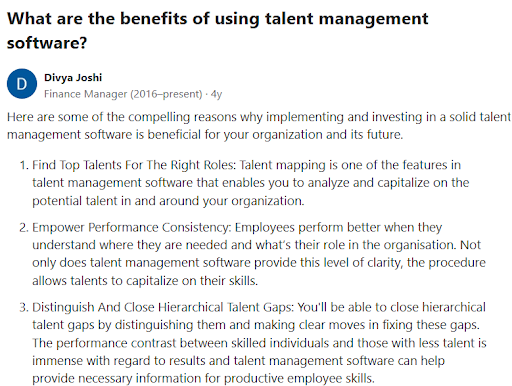
It is no longer a choice to invest in a strong talent management system, as this is a good strategic method of finding sources of talent management, streamlining the most important process of talent management, and ensuring that your organisation finds and develops the talent that will lead to success in the long run.
Refrence: Quora
Using the knowledge and the opportunities of talent management software, companies can address any talent gaps, improve the performance levels, and utilize the necessity of talent management within the construction of the talented, motivated, and future-oriented staff.
Real-World Examples of Leading Talent Management
Google (Alphabet Inc.) – A Culture of Continuous Learning and Innovation
Google has been referred to as an example of excellent talent management and demonstrates how investing in people creates innovation. Their strategy emphasizes how talent management is required in generating a motivated, talented, and business-oriented workforce.
-
"20% Time" / Innovation Time Off
Google stimulates its staff members to dedicate 20 percent of their working weeks to investigating ideas that are out of their job. This program constitutes their significant process of managing talents, and it fosters innovation and allows employees to be inventive and fail without hesitation.
-
Data-Driven HR (People Analytics)
Through its advanced analytics, Google is able to recognize the most efficient ones, forecast the trends of employees, and develop the most efficient team structures. These sources of talent management would assist the company in making effective decisions in order to enhance engagement, retention, and productivity.
-
Performance Management (OKRs & Continuous Feedback)
One of the currently used talent management systems is the use of Objectives and Key Results (OKRs), along with continuous performance feedback by Google. Employees have a clear expectation, feedback in real time, and a measurable objective, and the performance and development take off at every level.
-
Employee Well-being and Perks
Google is another company that invests a lot of money in the wellness of its employees, and it could be reflected not only in on-site wellness centers but also in the flexibility of the working conditions. Such a holistic approach proves the necessity to manage talents in such a way that they go beyond skills and performance and are devoted to the holistic development and the organizational culture.
Why It’s Successful: The case of continuous learning, recognition, and innovation at Google demonstrates that strategic talent management can make an impact that produces international business success. All these strategies have enabled Google not only to recruit the best but also to develop them, thereby remaining innovative and successful in the business over the long term.
Remember: It is people who make the company as strong as possible. Once you realize the real meaning of talent management, which is investing in the growth and potential of your people, then you are not only creating a team but you are creating a successful business in the future.
Conclusion
Talent management is no longer an HR activity; it is now a strategic asset that is significant in the modern, fast-changing business environment. The necessity in talent management is obvious: the introduction of a strong talent management system allows the company to successfully locate the sources of talent management, to streamline the most important process of talent management, and ensure that all employees are working towards organizational success. They are capable of assisting businesses to enhance their performance and innovation through attraction, development, and retention of the best talent and through their long-term and sustainable growth