Stop scrolling for a second.
By the year 2025, you will be one site behind. The audience is not searching now; they are interacting, sharing, and learning new things on social platforms. Unless your business is there, you are missing the greatest opportunity to reach out to the customers.
You need to know: what is social media marketing in digital marketing? It's the essential art of using social media to build your brand, drive sales, and boost traffic. This dynamic, vital component of any Internet Marketing strategy is non-negotiable.

Looking for Social Media Marketing Tools & Software?
Check out Techimply's Best Social Media Marketing Tools & Software in India for your business.
This guide will give you a clear social media marketing explanation. We will discuss how to make social media marketing, the essential features of social media marketing, and present you with examples of social media marketing in real life. Prepare to take advantage of such platforms as Instagram and TikTok to get your business in real motion.
What Is Social Media Marketing(SMM) In Digital Marketing?
Social media marketing (SMM) refers to utilizing social networks in a deliberate plan of marketing your brand, services or products. It encompasses creating content and talking in real time with its followers up to conducting targeted advertising campaigns.
SMM is not about one-way advertising which is traditional. It is not that you are merely broadcasting, but that you are listening, responding and creating a community that your audience already spends time in. The top goals? Create brand awareness, lead generation, sales and customer relationship development.
SMM has a major role in digital marketing, which is in addition to SEO, email, and content marketing. This is not just about posting frequently, but it is more about preparation, keeping track of the feedback and changing trends in the platform quickly.
Why it matters:
- India has around 491 million social media user identities — roughly one-third of the population.
- Social media usage in India is growing at about 6.3% year-on-year, adding around 29 million users in the period.
- The average Indian user spends 2 hours and 28 minutes every day on social media channels.
How To Do Social Media Marketing?
A successful social media marketing process can not be achieved without more than just creating accounts and post randomly. It is systematic and has set goals. The following is a step-by-step tutorial on how to market through the social media:
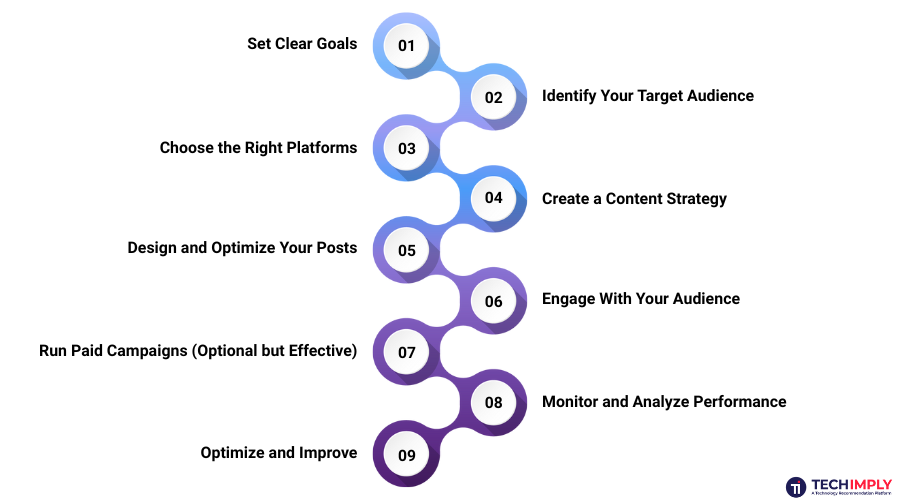
1. Set Clear Goals
Whichever way you choose to go, set out your motive first before you publish any material. Want to be more aware of your brand, site traffic, engagement and direct sales? These will be specific, measurable, achievable, relevant and time-bound SMART goals that will serve as your overall strategy.
2. Identify Your Target Audience
Who are you trying to reach? The demographics (age, location, income), psychographics (interests, values, lifestyle) and the social media usage of your audience should be comprehended. This knowledge will be used to inform your choices on the platforms to be used and the type of content to be used.
3. Choose The Right Platforms
You do not have to be all over. Attend to the mediums where your target audience most interacts and engages. In the case of visual brands that consider younger audiences, potentially important may be social media marketing on Instagram and Tik Tok. In the case of B2B, LinkedIn can be more efficient. It is all about quality and not quantity.
4. Create A Content Strategy
The core of your social media is your content. Establish a plan which will consider the kind of content you are going to produce (photos, videos, articles, stories, polls), how often you will post them, the voice and tone of your brand. This is aimed at serving value, entertainment and informing your audience.
5. Design And Optimize Your Posts
Every platform has its best practices of content. Make sure that your posts in the digital marketing social media are attractive, well written and reach and engagement optimized. Relevant hashtags, eye-catching captions and calls to action. Before hitting publish, product and brand images perform best when the subject stands out cleanly using background remover to strip out cluttered or distracting backdrops takes seconds and instantly makes your visuals look polished and platform ready.
6. Engage With Your Audience
Social media is a two way street. Complete replies, reply to messages, engage in pertinent conversations, and accept mentions. Creating a community as a brand will lead to loyalty and trust.
7. Run Paid Campaigns (Optional But Effective)
Organic outreach is not always easy. Advertisement on paid social media is an advantage since it allows targeting specific demographical groups, which enhances the visibility of your content and accelerates the achievement of the goal. When such campaigns are not carried out in the wrong way, then they can be quite cost-effective.
8. Monitor And Analyze Performance
Monitor your key performance indicators (KPIs) on a regular basis with native platform analytics or third-party tools. Which posts perform best? When is your audience most active? What drives conversions?
9. Optimize And Improve
You need to keep on changing your strategy according to your analysis. The success of one month may not be the same next month. Social media is changing; you should be ready to experiment, learn, and change.

Did You Know?
The social media population is more than half of the global population; it stands at 4.9 billion. This is an incredible amount, which speaks volumes as to why social media marketing is not only a possibility but rather an inseparable component of a contemporary business strategy.
Key Features Of Social Media Marketing(SMM)
The strength of SMM is that it is multifaceted. It integrates different factors in order to produce a comprehensive marketing strategy. The following are main features of social media marketing that render it so effective:
1. Audience Engagement And Interaction
This is perhaps the most unique aspect of SMM compared to traditional marketing.
-
Two-Way Communication: Social media unlike the passive advertisements means that you can conduct a direct conversation with your audience. You are able to comment, answer questions and even address feedback directly in real-time.
-
Community Building: Platforms create brand communities in which the customers are able to communicate with one another and with your brand to create a feeling of belonging and loyalty.
2. Content Creation And Distribution
Social media is a content powerhouse, but it requires strategic execution.
-
Diverse Content Formats: SMM isn't limited to text. With AI on social media, you can create and share images, videos, live streams, stories, polls, infographics, and more, tailoring content to different audience preferences.
-
Platform-Specific Content: Good SMM strategies would be to customize the content to the technical specifications and audience of each platform. The tactics of social media advertising through Instagram (photos, Reels) cannot be the same as those of LinkedIn (business-related articles, business knowledge).
-
Consistent Posting: Quality content with regularity maintains the attention of your audience and the presence of your brand. On LinkedIn that regularity is easier to hold when posts are queued ahead, and a LinkedIn post scheduler like Supergrow keeps a week's updates lined up so the cadence does not slip on busy days
3. Targeted Advertising
Social media platforms offer unparalleled precision in reaching specific groups.
-
Precise Audience Segmentation: Advertisers can tap into users with extremely narrow behaviors including demographic, interests, behaviors, and connections and even historical interest in your brand. This is to make sure that your message is received by the most relevant audience.
-
Cost-Effectiveness: Social media advertisements, in comparison to the conventional ones, can be a better bet as they provide the ability to target a specific group and allow to adjust the budget to meet the financial means.
4. Brand Building And Awareness
Social media is a powerful engine for establishing and growing your brand.
-
Increased Brand Exposure: New postings and engaging material on the trending sites is bringing your brand before the eyes of millions of potential clients who would not normally get to know of your business.
-
Brand Voice And Authenticity: SMM provides you with one of the chances to develop your own brand voice and personality that will make your brand more relatable and memorable.
-
Humanizing The Brand: Businesses can look more like people and seem more friendly by presenting behind-the-scenes content, communicating directly with clients, and disclosing brand values.
5. Data-Driven Insights And Analytics
The best asset of digital marketing, which also applies to SMM, is that it is measurable.
-
Performance Tracking: Platforms are able to offer powerful analytics dashboards, which monitor the performance of such key metrics as reach, impressions, engagement rate, click-through rates, and follower growth.
-
Strategy Optimization: This knowledge could prove invaluable in terms of knowing what works and what does not and marketers can keep improving their content, targeting and overall strategy to achieve a better outcome..
6. Lead Generation And Sales
Ultimately, SMM is a powerful driver of business growth.
-
Driving Website Traffic: Social media can be an important source of traffic to your site, landing pages and online shops with powerful calls to action and direct links.
-
Direct Conversions: A lot of platforms have now become shopping platforms (e.g., Instagram Shop, Facebook Marketplace), where users can directly purchase goods in the app.
-
Word-of-Mouth Marketing (Ewom): By sharing, liking, or commenting on your content, it will be a recommendation to their network which works on strong online marketing principles.
7. Customer Service And Feedback
Customer service expectations have changed with the concept of social media.
-
Real-Time Support: Customers have become accustomed to the fact that they will be able to get a fast response to their inquiries and grievances using social media and make it a vital medium of support.
-
Social Listening: Following up on your brand and key terms in the industry and the competitors give invaluable feedback and insights into customer needs and market sentiment.
Real-World Social Media Marketing(Smm) Example: Hubspot
HubSpot is an ideal case study of a company that is doing well in terms of utilizing social media marketing to create a community, create thought leadership, and grow business.
-
Strategy Use
The HubSpot approach to SMM does not require hard sales, it involves giving massive amounts of value. They pay attention to the principles of inbound marketing and provide educational resources as well as industry and practical advice to marketers, salespeople, and customer service departments. Their content mix includes both short and digestible content in Instagram and longer educational content in YouTube and professional articles in LinkedIn.
-
How It Works
-
Educational Content: They also continuously post blogs, webinars, and free materials that can assist their target audience in solving actual issues.
-
Platform Diversification: Although active on all the major platforms their content is customized. Twitter is where they debate with industry, LinkedIn is where they post thought leadership, Instagram is where they frequently use appealing quotations and brief tips.
-
Community Engagement: They are very supportive in responding to comments, conducting live questions and answers, and creating discussion, posing as a helpful expert and not a software vendor.
-
Why It's Successful?
HubSpot has succeeded in this concept by realizing that social media marketing is all about establishing trust and educating people first. Through continued value provision, they grow and retain a massively active fanbase who, in turn, will think of HubSpot when they require CRM, marketing or sales software. They are an epitome of successful social media marketing in digital marketing as they put the needs of their audience as a priority.
Pro Tip
Powerful visuals have a dramatic effect on engagement irrespective of the platform. To invest in high-quality images, short and effective video creation, and engaging graphics of what to post on your social media of digital marketing. A visual content is 40 time more likely to be shared on social media as compared to plain text! Visual appeal cannot be compromised especially when it comes to social media marketing in the case of Instagram.
Conclusion
The process of social media marketing is endless and data-driven. Posting does not make one successful, but mastering the process of marketing on social media, goals, performance analysis, and optimization on the basis of actual knowledge about the audience.
Utilizing these lessons, you are no longer a participant, but a player in the development of meaningful customer relationships and creation of quantifiable sales. Use these lessons and make a strategic change to your online presence. Your brand is prepared to succeed in the digital age.