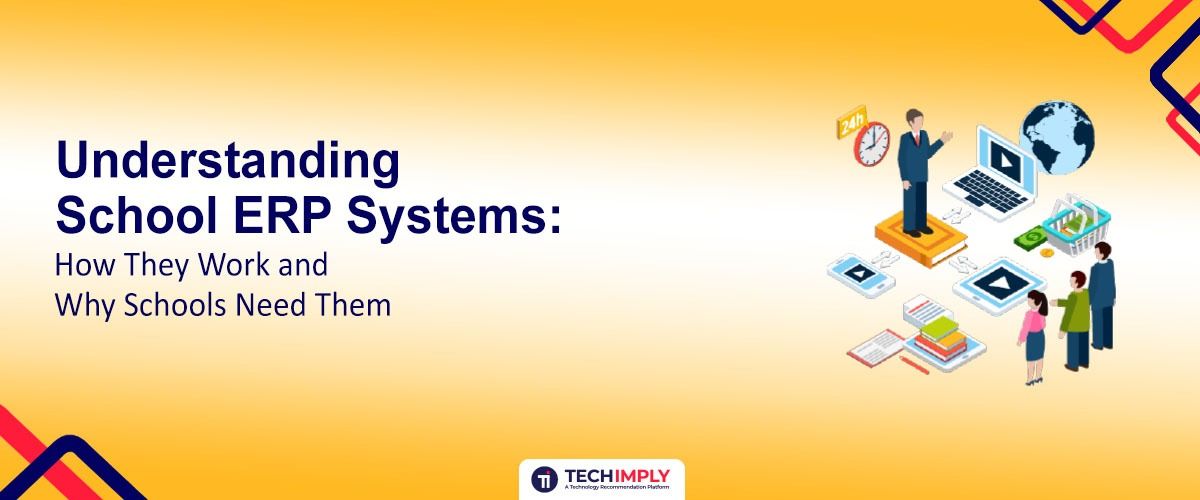
The task of running a contemporary educational facility is one that is based on balancing between the complicated administrative functions and the quality of academic provision. School erp system is the digital gear of an organization, which connects all the departments into one, well-knit space. Through the automation of day-to-day tasks, the technology will enable teachers to abandon tiresome paperwork and invest more time in student development and teaching quality.

Looking for School ERP Software?
Check out Techimply's List of the Best School ERP Software in India for your business.
A school erp software implementation is now not an option anymore, but rather a strategic need of the schools that want to remain orderly and open. A school erp system maintains centralized data, and thus, the administrators, teachers, and parents remain connected because of a single source of truth. And regardless of whether you are searching for my school erp solution or you are just starting to search for school management software, the first step to digital transformation is to know how these systems work.
What is a School ERP System?
Comprising the most essential elements, the ERP (Enterprise Resource Planning) system is a unified software program that is aimed at handling the daily needs of a school. Contrary to standalone software, which only addresses a single activity, an education erp software links all the activities, including admissions and fee collection, with exams and staff payroll.
When individuals refer to what an erp portal is, they are referring to the web-based portals through which the various users are accessing such services. Equally, an erp login refers to the secure entry of a given user, either a parent of the grade inquiry or a clerk of payment being made. Basically, a school management system erp is considered the main brain of the campus as all the departments are communicated on-the-fly.

Do You Know?
The average savings under administrative costs on average are 40% of the original costs of running a school that adopts a comprehensive school erp system within the first two years of implementation.
How Does a School ERP System Work?
To understand why a school ERP system is so effective, we must look at its operational architecture. It functions through three main pillars:
1. Centralized Database
In a traditional setup, the library has one set of records, the accounts office has another, and the principal’s office has a third. This leads to data silos. A school management system ERP eliminates this by storing all information in one place. When a student’s address changes in the admission module, it automatically updates in the transport and fee modules.
2. Integrated Modules
The system consists of specialized modules that talk to each other.
- Admission Module: Digitises the entire journey from inquiry to enrollment, including document uploads and seat allocation.
- Attendance Module: This is where attendance automation shines. Teachers can mark attendance via mobile apps or biometric devices, and the system instantly logs the data.
- Fee Module: It powers the online fee payment portal, allowing parents to pay from home while the system generates instant receipts and sends automated reminders for pending dues.
3. Role-Based Access
Security is a top priority for any education ERP solution. Role-based access ensures that users only see what they need:
- Principals: Access high-level analytics, financial reports, and overall school performance.
- Teachers: Manage lesson plans, mark attendance, and input exam grades.
- Parents: Use their ERP login to view their child’s progress, attendance, and pay fees via the my school erp mobile app.
Key Features of a Modern School ERP System
A robust school management software should offer more than just digital record-keeping. Here are the features that define a modern education ERP software:
1. Student Information System (SIS)
This serves as the digital heart of the education erp software. It maintains a comprehensive, lifelong record of every student enrolled in the institution.
- 360-Degree Profile: Store everything from emergency contacts and medical records to extracurricular achievements in one searchable database.
- Document Vault: Digitally archive birth certificates, previous transcripts, and identity proofs, reducing the need for physical filing cabinets.
2. Fee Management
Modern school management software transforms the complex task of tuition collection into a simplified, transparent process.
- Custom Fee Structures: Easily configure diverse payment plans, including sibling discounts, merit-based sscholarships and late fee calculations.
- Online Fee Payment Portal: Provide parents with a secure gateway to pay via credit cards, UPI, or net banking, which automatically updates the student’s ledger.
3. Attendance Management
By implementing attendance automation, schools can ensure high levels of student safety and accountability with minimal manual effort.
- Real-Time Integration: Connect the software to biometric scanners or RFID gates to log entry and exit times automatically
- Instant Notifications: Trigger automated SMS or alerts to parents the moment a student is marked absent, ensuring immediate awareness.
4. Exam & Grade Management
This module simplifies the heavy lifting involved in academic assessment and report card generation
- Automated Report Cards: Grade professional, customizable grade sheets that comply with board standards (like CBSE, ICSE, or IB) at the click of a button.
- Performance Analytics: Use built-in tools to identify learning gaps by comparing class-wide averages against individual student progress over time.
5. HR & Payroll
An effective education erp solution looks after the educators just as much as the students by automating staff administration.
- Biometric Payroll: Link staff attendance directly to the payroll engine to calculate leaves, overtime, and salary deductions without manual errors.
- Recruitment & Training: Track teacher certifications and professional development milestones to ensure your faculty meets all regulatory standards.
6. Transport & Asset Management
Safety and resource optimisation are the primary goals of this logistical module within the school management system erp.
- GPS Vehicle Tracking: Allow parents and admins to track the school bus in real-time, providing estimated arrival times and ensuring driver accountability.
- Inventory Control: Monitor the lifecycle of school assets, from high-value lab equipment to library books, with automated alerts for low stock or overdue returns.
School ERP vs. SIS: What's the Difference?
Many educators use the terms school erp system and Student Information System (SIS) interchangeably, but they are not the same.
|
Feature |
Student Information System (SIS) |
School ERP System |
|
Primary Focus |
Student academics and records. |
Total institutional management. |
|
Core Functions |
Enrollment, grades, and schedules. |
Finance, HR, Inventory, and SIS. |
|
Target Audience |
Teachers, Students, and Parents. |
Administrators, Owners, and Staff. |
|
Relationship |
A component of an ERP. |
The complete umbrella platform. |
Suggested Read:
Why Schools Need School ERP System in 2026
The educational landscape in 2026 demands agility and data-driven precision. Here is why investing in an education erp solution is critical:
1. Operational Efficiency
Manual data entry is prone to human error and consumes hundreds of staff hours. A school management software automates these repetitive tasks. For example, attendance automation reduces the time spent on morning rolls from fifteen minutes to thirty seconds.
2. Enhanced Communication
Bringing the gap between home and school is vital. Through an erp portal means, parents receive real-time updates. They no longer have to wait for parent-teacher meetings to know how their child is performing.
3. Data Security and Compliance
With increasing concerns over data privacy, a school management system ERP provides encrypted storage and secure backups. This is far safer than keeping sensitive student information in physical files or unsecured spreadsheets.
4. Strategic Decision-Making
When an administrator uses their erp login means, they aren't just looking at names; they are looking at data. They can see which classes are struggling, which fee categories have the most defaults, and how to optimise school bus routes to save fuel.
5. Futuree-Proofing
As schools adopt hybrid learning models, having a digital my school erp platform ensures that the institution can switch between physical and online operations without losing a single day of productivity.
Implementation Considerations
Switching to a school management software is a big step. As of 2025, the global demand for the school ERP market is likely to be at US$ 18,980.5 million and is forecast to reach sales of US$ 51,249.1 million by the end of 2032 and is anticipated to grow at a CAGR of 15.3% from 2025 to 2032. To ensure success, keep these three factors in mind:
1. Initial Setup and Integration
The success of any education erp software depends heavily on how well it integrates with your existing data and workflows. During the initial setup, your primary focus should be on data migration, the process of moving your current student and staff records from spreadsheets or paper files into the new system.
2. Cost Considerations
Although the price is a consideration, the cost of an education erp solution should be seen in the light of long-term value as opposed to a one-time cost. The majority of current systems are subscription-based, and in many cases, they are determined by the number of students you have.
3. Data Privacy and Security
Laws and ethics in ensuring the safety of sensitive student information are a requirement that every school cannot afford to ignore in 2026. By using erp login means, you should be sure that the connection is encrypted and your data is stored in a secure cloud.
Pro-tip
In choosing a software in education erp, focus on the mobile-first systems. By 2026, most parents and teachers would like to handle tasks through smartphones compared to desktops.
Conclusion
The transition to a school erp system is more than a technical upgrade; it is a commitment to better education management. By centralizing data through an education ERP software, schools can eliminate the chaos of manual processes and foster a more transparent environment for everyone involved. Whether it is through a secure online fee payment portal or advanced attendance automation, these tools empower schools to operate with professional excellence. If you want your institution to thrive in 2026, embracing a school management system erp is the most effective path forward.