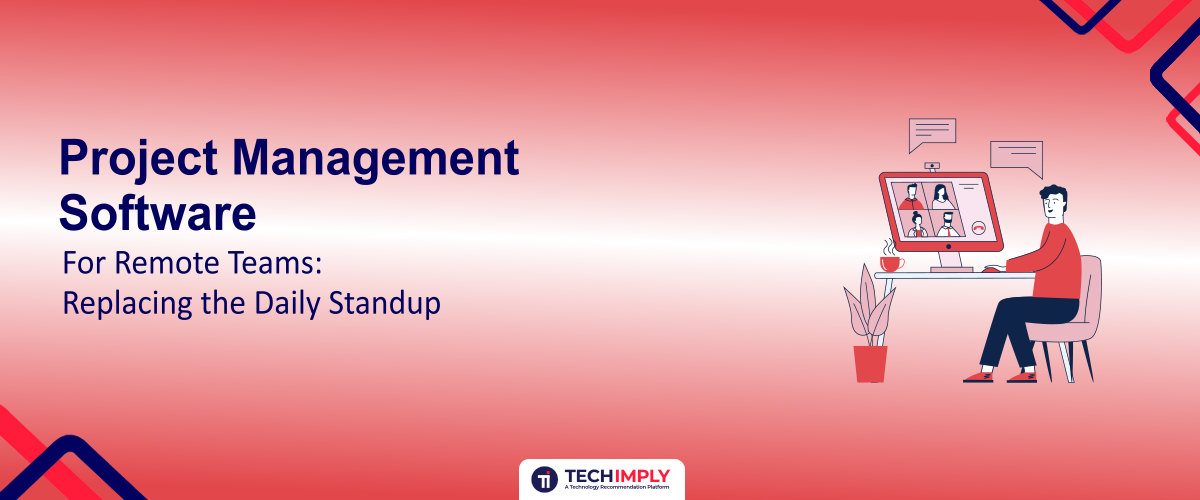
The daily standup survived the move to remote work by becoming a video call, and that's roughly where the trouble started. In a room, a standup was fifteen minutes because standing up is uncomfortable, and everyone could see who was next. On video, it's thirty-five minutes, three people are on mute, someone joins late, and the person in a different time zone is doing it at 9pm. The ritual survived. The properties that made it work didn't.

Looking for Project Management Software?
Check out Techimply's List of the Best Project Management Software in India for your business.
The useful response isn't a better standup. It's understanding what the standup was actually for, and then noticing that most of those jobs are better done by a system than a meeting.
What the Standup Was Actually For
Four things, bundled into one meeting because a meeting was the only available mechanism.
- Status broadcast: What everyone did and will do. In a room this was efficient; there was no alternative.
- Blocker surfacing: The part that genuinely mattered. Someone says they're stuck, someone else says they can help.
- Coordination: Discovering that two people are about to duplicate work, or that a handoff is ready.
- Ambient awareness: The underrated one. Knowing roughly what your colleagues are doing, which builds the shared context that makes everything else cheaper.
Notice that only two of these actually require synchronous humans. Status is data. Coordination is mostly data too. Blockers and ambient awareness are the ones with real social content. That split is the whole argument.
Why Video Standups Fail Specifically
They're status theatre. Everyone reports to a manager while colleagues wait for their turn, contributing nothing. In a room this was tolerable because it took twelve minutes. On video it's twelve minutes of value in thirty-five.
Time zones make them punitive. A standup convenient for Bengaluru is not convenient for Berlin, and someone is always paying. That cost is invisible to whoever picked the time.
They interrupt exactly the wrong thing A 10 am standup destroys the morning for anyone doing deep work, and the destruction is asymmetric: the meeting costs fifteen minutes and the context switch costs an hour.
Blockers get underreported. Saying "I'm stuck" to a camera in front of eight colleagues is socially harder than typing it. The one thing standups were genuinely good for degrades the most in the format.
They substitute for the tool's most damaging effect. If status arrives verbally each morning, nobody updates the board, and the board becomes fiction. Now the standup isn't just a meeting; it's the only source of truth, and it's a verbal one that leaves no record.
That last point is the trap. The standup and the project tool compete, and the standup wins because it's mandatory. Then you have a tool nobody trusts and a meeting you can't cancel.
What Replaces Each Job
Status: the tool, not a meeting
Status is data. It should live in the system and update as work happens, not be recited.
The requirement is that updating a task in your task management software costs almost nothing. If it takes thirty seconds, people won't, and you'll be back to asking. The whole model depends on this, and it's why tool choice matters more for remote teams than co-located ones.
What you want: task state visible without asking, a view showing what's in flight per person, and a change history so anyone can catch up on what moved.
If your board is accurate, the status portion of the standup is redundant by definition. If it isn't, fix that before you cancel anything.
Blockers: explicit, visible, and escalating
This is the job that needs designing, because it's the one that matters and the one that degrades most.
The mechanic that works: a blocked state that's visible and uncomfortable. A task marked blocked, with what it's blocked on and who can unblock it, appearing on a view someone watches.
The social property to preserve: blockers should surface without requiring courage. Typing "blocked on API access" into a field is much easier than announcing it on camera, which is precisely why it works better.
Add an escalation. A task blocked for more than a day should surface to someone whose job is to unblock it. Otherwise blocked tasks sit there being visible and unaddressed, which is worse than the standup.
Coordination: async by default
Comments on tasks, a channel for the project, and a weekly synchronous slot for the things that genuinely need discussion. Project Management Software With Slack integration makes these conversations easier by connecting task updates directly to the channels your team already uses.
Most coordination is a question with an answer, and questions with answers don't need everyone present.
Ambient awareness: this one's real
The hardest to replace and the one people underestimate. Knowing what colleagues are doing isn't just information; it's what makes people feel like a team rather than freelancers with a shared logo.
Partial substitutes: an activity feed people actually read, a weekly written update that's substantive rather than performative, and one genuinely synchronous slot per week that isn't status.
Honest caveat: nothing fully replaces this, and pretending otherwise is how fully async teams end up feeling like contractors. Budget for some synchronous time. Just not daily, and not for status.
The Async Standup Question
The common middle ground: a bot posts three questions in a channel, and everyone types their answers.
It works when the answers are read and acted on, and it exists to surface blockers.
It becomes theater when it's a compliance ritual. Everyone posts, nobody reads, and you've moved the performance from video to text without removing it. Async standup fatigue is real and it looks exactly like meeting fatigue.
The test: does anyone respond to the posts? If a blocker sits in the channel unanswered for four hours, the async standup is doing nothing that the board wasn't already doing.
A leaner version that works better for most teams: skip the daily prompt entirely. Require that blocked tasks are marked blocked, and give someone the job of watching that view every morning. Same outcome, no ritual.
What This Requires From Your Tool
For a remote team, these matter more than they would co-located:
Frictionless updates. The load-bearing requirement. Everything else fails if this does.
A blocked state with a reason field, visible on a shared view.
Async-first communication on the work itself. Comments on tasks, so discussion has context and leaves a record. Decisions made in a call and not written down don't exist for the person who was asleep.
Time zone awareness in dates and notifications. A due date without a time zone is ambiguous, and ambiguity gets resolved badly.
Mobile that works, because "remote" means people aren't at a desk.Project Management Software With Mobile App support is essential because remote means people aren't always at a desk.
Notifications that can be tuned. A remote team lives in notifications, and a tool that fires on everything trains people to ignore all of it, including the one that mattered.
An activity feed that gives ambient awareness without a meeting. The test is whether people read it voluntarily. If it's noise, it's worse than nothing, because it trains people to ignore the place where real updates appear.
Making the Transition
Cancelling the standup on Monday without preparation produces chaos and a restored standup by Friday. The sequence that works:
Fix the board first. For two weeks, keep the standup and require that the board be accurate before it. You'll discover it isn't. That's the actual problem, and it was hidden by the meeting all along.
Introduce blocked-state discipline while the standup still exists so the habit forms before it's load-bearing.
Assign the watcher. Someone checks blocked tasks every morning and unblocks. Without this, the model fails on day three.
Then reduce frequency rather than cancelling it. Daily to twice weekly. See what breaks.
Keep one synchronous slot that isn't status. Team-level, discussion-oriented, for the ambient awareness that async genuinely doesn't deliver.
Watch for silent blocking The failure signal: someone was stuck for two days and nobody knew. That means the blocked state isn't being used or isn't being watched, and it's the one failure mode that's worse than the meeting you cancelled.
Expect it to expose a management gap. The standup was often doing work nobody acknowledged, like a manager checking in or a lead noticing someone was quiet. Removing it removes that too. If nobody replaces it deliberately, the quiet person stays quiet for a week, and the tool will not tell you that anything is wrong.
Conclusion
The daily standup did four jobs: status broadcast, blocker surfacing, coordination, and ambient awareness. Video preserved the ritual while destroying the properties that made it work, and it added a time zone tax that someone always pays. Status belongs in the tool. If your board is accurate, reciting it is redundant. If it isn't, the standup is why, because a verbal status update every morning removes any reason to update the system. Blockers need explicit design: a visible blocked state with a reason and someone whose job is watching it. Typing "blocked on API access" is easier than announcing it on camera, which is exactly the point. Ambient awareness is the one that isn't fully replaced. Keep some synchronous time for it, weekly rather than daily, and make it about discussion rather than status. The prerequisite for all of it is that updating a task costs nearly nothing. Get that wrong and you'll be back to the meeting inside a month, because a board nobody trusts leaves you no alternative.