


A headache is a unanimous project of confusion. Have you ever spent the entire day attempting to locate the appropriate individual to accept a signature or jump-start an activity and discovered three other people were up to the same thing? This is a form of role ambiguity that reduces morale, wastes time, and stalls the proceedings.

Looking for Project Management Software?
Check out Techimply's List Of The Best Project Management Software for your business.
It does not require another long meeting but rather a short and effective tool called the RACI chart (or RACI matrix). This is the hidden weapon of effective project managers and is aimed at providing the answer to the question, "Who does what?" What is RACI matrix? What does the RACI matrix stand for? Definitely. And get rid of those agonizing scenes of I supposed you were doing that.
What is the Definition of the RACI Chart?
The definition of RACI chart is an easy but effective project management tool that is employed to specify and explain the roles and responsibilities of individual tasks or deliverables or decisions in a project or a process.
It represents the four most important roles employed in its structure:
- Responsible
- Accountable
- Consulted
- Informed
The chart is usually in the form of a matrix, which contains the project tasks or deliverables listed in the bottom column and the stakeholders or team members in the top row. The letters R, A, C, or I are then put in the cross of each task and person to denote their respective role.
What Does the RACI Stand For?
The RACI model is a complex but effective model applicable in project management to avoid role confusion and make decisions straightforward. The RACI full form of the four most important roles that an individual or a group can play in relation to any given task or deliverable are represented in an acronym, namely:
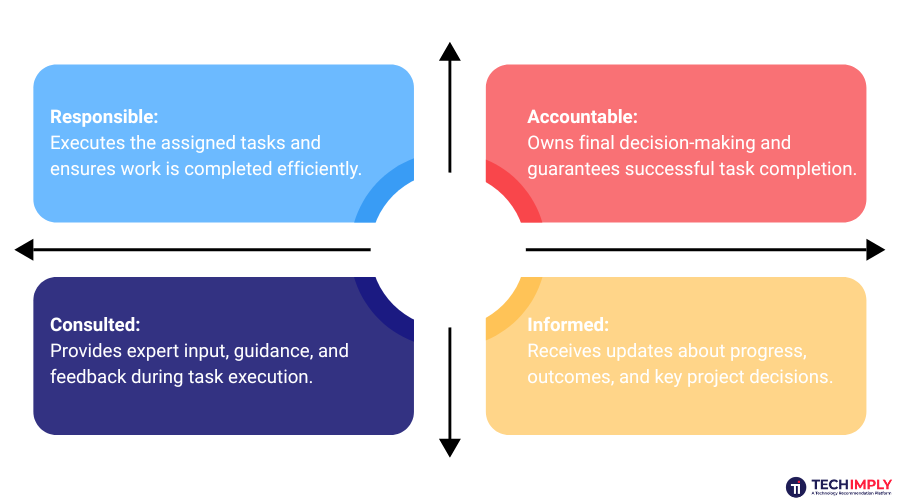
1. R is for Responsible (The Doer)
-
Definition: These are the individuals who are executing the work to complete the task. They are the individuals who are executing the activity, generating the deliverable, or executing the function.
-
Important Point: There may (and frequently are) be multiple responsible parties for a task.
-
Analogy: Consider an example of the construction site workers.
2. A is for Accountable (The Owner/Approver)
-
Definition: It is these who do the work of completing the task. They are the individuals for whom the activity is being done, the deliverable is being produced, or the function is being executed.
-
Important Point: The responsibility for a task should belong to one individual. This is the one who makes the decision; his head goes (metaphorically) when the work goes wrong.
-
Analogy: On a construction site, in this case, it would typically be the general contractor. The general contractor is not the person doing the bricklaying. Rather, they are the person accountable for ensuring the entire wall was built correctly.
The Critical Difference: Responsible vs Accountable. The misunderstanding of RACI is usually found here. Being responsible is having the work done. Accountable implies the responsibility for the outcome. The responsible individual assigns the job as well as verifies/approves the end product. The responsible individual need not be the accountable one and in many case converter!
3. C is for Consulted (The Subject Matter Expert)
-
Definition: These are the individuals whose views or certain expertise are needed prior to the completion of the work. They offer input, feedback, or subject matter expertise.
-
Key Detail: The interaction with them is bi-directional (you approach them, seek their feedback, and leave until they reply to you).
-
Analogy: Take the case of the architect of a building project, who will go through the end plans to check that they are identical to the original design.
4. I is for Informed (The Need-to-Know Stakeholder)
-
Definition: The people who are kept informed about the progress or the end result are called these. They are not part of the work or the decision, but they require being aware of the result in order to plan, coordinate, or have general awareness.
-
Key Detail: You can only communicate with them in the form of one-way communication (you provide them with an update/a notification).
-
Analogy: You can consider the project sponsor or the customer service manager who must be aware of the new feature being launched so as to either train employees or advise clients.

Do You Know?
The idea of clearly outlining roles and responsibilities as part of a hierarchical structure is not new to project management software in the modern world. The RACI acronym is not that old, but the necessity to have the responsibility assignment matrix template has been a demand since the first massive industrial and construction projects!
The Key Benefits of a RACI Chart
There is absolutely nothing administrative about making a RACI chart in project management practice: it is a tactical step that shifts the very nature of the way your team functions. Its use in addressing pitfalls that typically affect projects can be vindicated by the fact that the RACI matrix (high-volume keyword) is quite popular.
-
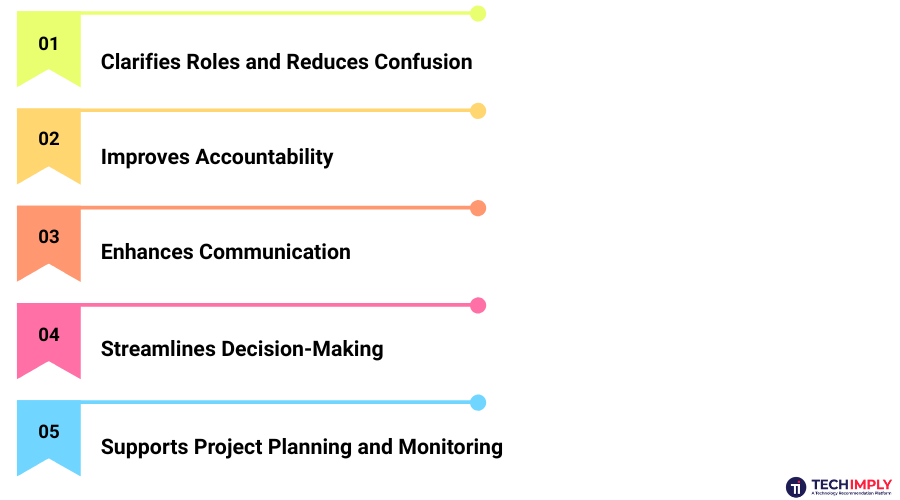
Clarifies Roles and Reduces Confusion
The first advantage is the most immediate: that of clarity. All members of the team are well aware of their respective expectations, which removes the general issue of role overlap or, in the worst case, roles slipping through the cracks. It gives one source of veracity in the roles & responsibilities matrix of the project.
-
Improves Accountability
The number of the A (Accountable) is one and the same, the same way that the number of the tasks is also one: there is no confusion in terms of who will make the final decision. This radically enhances project accountability, whereby a person is always answerable to the result, whoever does the job (responsible vs accountable RACI).
-
Enhances Communication
The desired communication loops are known as the C (Consulted) and I (Informed) roles that clarify the required communication loops. This avoids chain emailings to all people (informing none), but critical stakeholders will never be caught unawares by a decision made at the end of the day.
-
Streamlines Decision-Making
In situations where a difficult decision has to be made, the RACI model identifies the individual who has the authority (A) to directly attend to and bypass the political stalemate.
-
Supports Project Planning and Monitoring
The responsibility matrix sample is an indispensable project plan artifact. When you look at the progress, you can easily know the person assigned to a task and who to call regarding its progress.
Looking for a Collaboration Tool?
Check out Techimply's List Of The Best Collaboration Tools for your business.
The Limitations of RACI Charts
Although the RACI framework is quite powerful, it is not a panacea. In order to make good use of it, you have to be aware of its possible weaknesses.
-
Rigidity and Inflexibility
A very elaborate RACI chart may be too fixed. Roles might change on a daily basis in a fast-paced or agile environment. The RACI should not be left to get out of date, as it may soon be rendered irrelevant and even counterproductive.
-
Oversimplification of Roles and Interactions
The four letters (R, A, C, I) are general categories. They might not be able to represent the complexity of specialized roles or the complexity of interactions in cross-functional teams, and therefore reduce the interactions and roles to simplified forms.
-
Time-Consuming to Create and Maintain
When it comes to large and complex projects, designing the initial responsibility matrix can be a big time investment. Moreover, it needs continuous upkeep and consent among stakeholders, which may not be easily realized.
-
Potential for Bottlenecks and Over-Allocation
When an individual has too many roles of A (Accountable), he/she may be a single point of failure and a project bottleneck. On the other hand, excessive R (Responsible) roles when a small team is assigned to a group may result in burnout.
-
Ignores Power Dynamics
The diagram is objective in nature. It does not take into consideration informal power structures or political relations that tend to determine the way in which work is performed in reality.
-
Unsuitable for All Projects
Although the RACI matrix meaning revolves around the assignment on a task level, it may be excessive when the team is small and located in one place, or the project is highly exploratory.
Real-World Example of a RACI Chart
To illustrate the RACI matrix example, one can take a typical project: the creation of a new company webpage and its introduction.
|
Project Deliverable/Task |
Project Manager (PM) |
Marketing Team Lead (MTL) |
Web Developer (WD) |
Legal Counsel (LC) |
Sales Team (ST) |
|
Draft Website Content |
C |
R |
I |
I |
C |
|
Design Wireframes |
C |
A |
R |
I |
I |
|
Review and Approve Design |
I |
A |
R |
I |
C |
|
Code and Develop Website |
I |
C |
R |
I |
I |
|
Final Legal Review |
A |
C |
I |
R |
I |
|
Final Website Launch |
A |
R |
R |
I |
I |
Under this responsibility assignment matrix type:
-
The design approval lies with the MTL but the coding is with the WD. This does not allow the developer to launch the site on his / her own without the approval of the business.
-
The LC only (C) consulted initially (to verify claims) and Responsible (R) when final legal sign-off was required.
-
There is the PM who will be responsible (A) for the general launch, and that the coordination is done.
Case Study: Isolated Systems to Smooth Success with RACI.
FastTrack Freight is a mid-sized logistics company that was experiencing sluggish delays due to interdepartmental handoffs in the course of its digital transformation initiatives. The IT team thought that the Operations team was to define the user acceptance criteria, and the Operations team thought that IT would offer a standard template, and a six-week stall was created for testing the system.
With the use of a RACI matrix, the project manager was able to designate the Operations Director (A) as accountable to sign off on the criteria, the IT Analyst (R) as responsible to document it, the Training Manager (C) as consulted to provide some input to the usability and the Executive Sponsor (I) as informed of the completion. This mere explanation cleared the confusion, established one owner, and collected the proper input to enable FastTrack Freight to speed up the testing process and launch the new platform in the revised schedule successfully.
When Should You Use a RACI Chart?
The global project management software market is estimated to be USD 6.7 billion as of 2024 and is estimated to be USD 14.88 billion by 2031 with a CAGR of 10.50% between 2024 and 2031. This is a boom by any measure of the growing complexity and dependence of organized tools in contemporary project implementation. The technology is only part of the core issue in the management of these multi-billion-dollar projects; however, it is who does what that is the real issue. That is the point where the RACI chart comes in.
1. Larger Projects with Multiple Stakeholders
The RACI chart is necessary when there are internal and external collaborators (agencies and vendors) of the project, and the team (IT, marketing, and sales) should not have silos.
2. Projects with Uncertainty About Responsibilities
In case a project has previously failed or the first meetings indicate that team members are not certain about who will handle particular deliverables, you must apply a RACI chart template as soon as possible.
3. Waterfall Projects
In projects where the project adopts a linear, phase-gate approach (such as a significant software upgrade, construction, or compliance), the handoffs and sign-offs presented in the RACI are priceless.
4. New Teams or Onboarding
The RACI model immediately creates expectations in a team or among new members and accelerates the learning curve in project governance.
Pro Tip:
Do not leave your RACI chart in a drawer. Revise and approve the RACI with the stakeholders and commence work. This discussion compels an early agreement and commitment, making everyone buy in and realize his or her responsible vs accountable RACI differences.
Conclusion
The RACI chart is a seemingly simple yet very powerful tool. It is not just a table, but it is a communication system that transforms the threat of ambiguity into reality. You can know who is responsible and who is held accountable, consulted and informed and not only get things done more effectively but also form a more efficient, powerful and less frustrated team. Don’t go on guessing who does what. Master your projects with the strength of the RACI matrix.
Suggested Read:
- What Is Collaboration Software & Why Your Organization Needs It?
- When to Implement Team Collaboration Software: A Strategic Approach
- How Team Collaboration Software Transforms Workflow Efficiency?
- The Role of Automation in Modern Project Management Software
- How to Manage Remote Teams Using Project Management Software
- 8 Benefits of Using a Project Management Software
- Cloud-Based Project Management Software: A Complete Guide
- 13 Essential Project Management Software Features




