
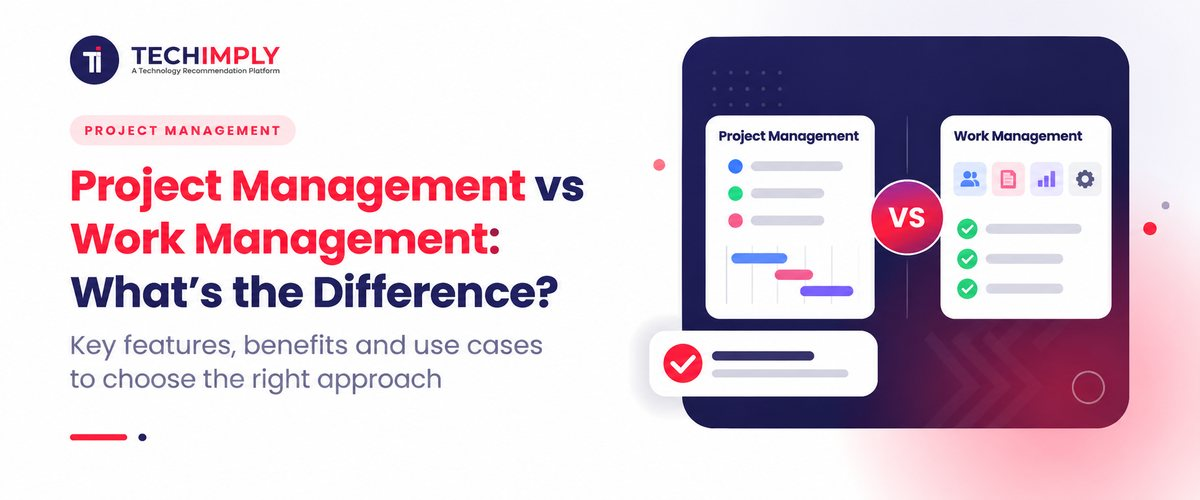
A team may have a project that is perfectly planned yet still battle with daily work. Imagine a marketing team getting ready to introduce a fresh product. There is a deadline, campaign milestones, assigned people, a content calendar, and a clear outcome set for the debut. That is project management. The same group is also handling customer inquiries, updating the website, publishing weekly reports, reviewing social media posts, attending meetings, and dealing with critical requests from sales.
Despite not being solely associated with product launches, these events must be planned and monitored. Work management helps one grasp that larger picture. The two methods overlap but address somewhat different problems. Managing a project aims at launching a given initiative. Work management examines the flow of various kinds of work inside a team or company, including projects, ongoing chores, processes, and unanticipated demands.
What Is Project Management?
Different systematic ways that people follow, in general, to plan, manage, execute, control, and close work are collectively called project management. In project management, it is not unusual to find a defined target goal, target/outcome, completion time, or timeliness reporting, a project manager role, and a clear end date. A project typically has scope control of resources, schedules, risks, budgets, and dependencies.
For example, an Indian retail business could resolve to open a new e-commerce website.
The project could include:
- Defining website requirements
- Designing the user interface
- Developing the website
- Integrating payment processing systems
- Testing the checkout process
- Migrating product information
- Launching the website
Project management achieves its best results when teams understand their required actions, and they know what results they need to produce. The process of planning, organizing, and structuring a project enables teams to break down their major objectives into smaller achievable targets, which include specific deliverables, milestone requirements, and deadline dates.
What Is Work Management?
Work management involves considering a larger scope. It asks, "How does work move through this team, and how can we keep it organized?", rather than just, "How will we complete this project?" Work management encompasses project management, routine tasks, daily responsibilities, requests from different teams, permissions, established processes, and unexpected assignments. This piece, unlike a project, lacks a set start and end date.
Its work may include:
- Recruiting employees
- Processing onboarding tasks
- Managing leave requests
- Maintaining employee records
- Running monthly payroll activities
- Responding to employee questions
- Preparing reports
Some of these activities could become projects. For example, implementing a new HRMS could be a project. But employee onboarding and monthly reporting are ongoing processes.
Do You Know?
A project is only one type of organizational work. Teams also spend significant time on recurring operations, routine tasks, approvals, support requests, and unexpected work. That is one reason work management has a broader scope than traditional project management.
Project Management vs Work Management: Key Differences
The best approach to compare the two is to consider their intended management targets.
- Project management asks: How can we effectively execute this project?
- Work management asks: How do we arrange and enhance the manner work is accomplished?
|
Area |
Project Management |
Work Management |
|
Main focus |
Defined projects |
All types of organizational work |
|
Duration |
Usually temporary |
Continuous or ongoing |
|
Scope |
Specific initiative |
Projects, tasks, processes, and requests |
|
Planning |
Project plans and milestones |
Priorities, workflows, tasks, and processes |
|
Success |
Delivering project outcomes |
Keeping work organized and moving |
|
Typical work |
Product launch, software implementation, website development |
Daily tasks, approvals, recurring processes, projects |
|
Structure |
More project-focused |
More flexible |
|
Main users |
Project teams and project managers |
Teams and departments across the organization |
The important point is that these are not competing concepts. Project management can operate within a broader work management approach.
How the Two Approaches Overlap
There is considerable overlap between project management and work management. Both require people to know:
- What needs to be done
- Who owns the task
- When it is due
- What work is already completed
- What is blocking progress
- Which people or teams need to collaborate
Task management, task tracking, shared documents, notifications, dashboards, automation, and team collaboration capabilities are also available to both. The difference is mostly in scope.
Imagine a software company creates a new mobile app. The development project could include demands, development activities, testing, bug fixing, milestones, and launch activities. Project management arranges these events around the application's implementation.
Apart from being responsible for handling customer-reported problems, the development team could also work on managing internal support tickets, documentation updates, code evaluations, maintenance, and minor improvements. These activities, even if they don't fit a primary project, would Definitely claim the team's work time. Work management provides visibility spanning this expanded workload.
When Should a Business Use Project Management?
When the work has a clear goal and a specified result, project management is more appropriate. Projects can particularly benefit from the following:
- Product or Service Launches: A launch normally includes a deadline, several teams, dependencies, and particular deliverables.
- Software implementation: ERP and CRM or other business software can involve requirements configuration, testing, training and deployment.
- Website Development: Design content development testing approvals and launch may be arranged as a project.
- Office or Infrastructure Expansion: Opening a new branch or moving an office calls for several related activities that must be coordinated.
Managing the project effectively helps align these events to keep the overall project on course toward completion.
When Is Work Management More Useful?
Work management becomes more valuable when teams deal with a mixture of planned and unplanned work. A marketing department is a good example.
The creative team can decide to launch a marketing campaign each quarter as a formal project. At the same time, the rest of their workday is taken by content requests, managing social media channels, publishing email marketing updates, design changes, website modifications, regular internal meetings, and requests from other departments on a priority basis.
One problem with formalizing every piece of work as a project is that teams would be burdened with more paperwork than actually useful work. Work management software solutions help teams keep track of their current tasks, automated workflows, priorities, and duties, so they don't need to assign formal projects for all work. The ability to switch quickly, for the team and management alike. is a fundamental feature of a good work management tool.
Do Businesses Need Project Management or Work Management?
For many growing businesses, the answer is both. They address different layers of the same operating environment. A company can use project management in launching a product and, at the same time, work management can help to coordinate the daily activities of the teams.
To better understand, a product team can have a project for launching an application. In the bigger work setting, the same employees can be doing regular meetings, support tickets, creating documentation, maintenance tasks, and several other duties.
Management could overlook the real work being done in other roles while only looking at the project. Combining both methods can reveal that hidden work. Project management gives minute-to-minute control of a particular project. Work management shows the big picture of the work being shared and completed
How to Choose the Right Approach
Start by looking at the type of work your team handles.
Choose a project-focused approach when:
- The work has a defined start and finish
- There is a specific deliverable
- Milestones and dependencies matter
- A project owner needs detailed visibility
- Scope, budget, and timeline need close tracking
Consider broader work management when:
- Teams handle recurring work
- Priorities change frequently
- Multiple departments share resources
- Employees receive many ad hoc requests
- Managers need visibility into work beyond formal projects
- Workflows and approvals are a major part of daily operations
The main thing is not to go for the one with the most advanced features. Actually, the idea is to come up with a solution that is just sufficient to help you to see the work but not burden you with extra administrative tasks.

Pro-tip
People should make a list of their regular team activities that they perform during their normal workweek before they start looking for software solutions. You need to split this information into three categories, which include projects and ongoing tasks, and random unexpected work assignments. The system needs to operate outside of scheduled projects because it requires a platform that extends its work management capabilities beyond standard project planning functions.
Conclusion
The difference between project management and work management becomes clearer when you stop looking at them as competing methods. Project management focuses on delivering a specific inititive which has been defined. Work management is focused on organizing the broader flow of work. A website redesign can be a project. Publishing content every week is ongoing work. Launching a new CRM can be a project. The operation to process customer requests that come in every day continues to be active. The two elements require direction, goal setting, team updates, and complete disclosure, but different approaches should handle their management needs.