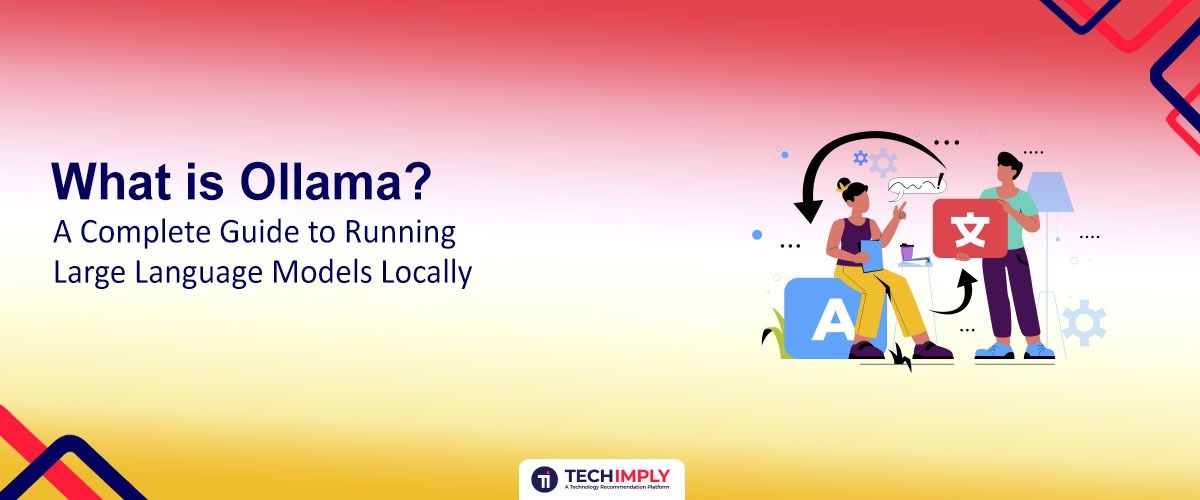
In the swiftly moving panorama of Artificial Intelligence Software, a widespread quiet revolution is taking place right on our computers. For years, the strength of Large Language Models (LLMs) has been locked behind expensive cloud subscriptions and large server farms. If you wanted to interact with a excessive-stage AI, you had to send your statistics over the internet, hoping it remained private. However, that technology is ending. Today, the critical question for tech fans and privacy advocates alike is: what is ollama and the way can it change the way we work?
Ollama is not simply another app; it's far a gateway to virtual sovereignty. It allows customers to run international-class AI fashions like Ollama DeepSeek and Llama 3 at once on their personal hardware. This manual will walk you via the whole lot from the technical structure to the realistic setup, ensuring you understand why this device is turning into the gold standard for local AI.
What Is Ollama and How Does It Work?
To actually hold close the effect of Ollama, we have to examine the "friction" that used to exist in the Artificial Intelligence Software international. Before its arrival, if a developer wanted to run a version domestically, they needed to navigate a minefield of Python dependencies, CUDA drivers, and complicated environment variables.
Ollama works by means of abstracting this complexity. It is an open-supply framework built typically for macOS, Linux, and Windows that packages model weights, configuration, and datasets right into a unified "Modelfile."
-
The Engine Under the Hood
It is powered with the aid of a high-performance backend that leverages the library referred to as llama. Cpp. This allows the software program to perform "quantization" a process that shrinks huge fashions so we can fit into the RAM or VRAM of a preferred customer laptop. When you ask, "what's ollama?", the high-quality answer is that it's an advanced translator that facilitates your laptop’s hardware to talk the complicated language of neural networks with no need for a PhD to set it up.
-
Why Local Execution Matters
When you run a version via Ollama, the facts by no means leave your machine. There is no intermediary, no statistics harvesting for schooling, and no "outage" in case your net is going down. This essential shift is why Artificial Intelligence Software is transitioning closer to a "local-first" philosophy.
Main Features of Ollama Explained Simply
One of the reasons Ollama GitHub has visible such an explosion in stars and individuals is its dedication to simplicity. Here are the middle functions that set it apart:
- Simplified Model Management: Much like how Docker handles containers, Ollama handles models. You can "pull," "push," and "run" models with single-word commands.
- The Ollama API: For those constructing their very own tools, the ollama api is a lifesaver. It presents a nearby server that your other applications can call, allowing you to construct an AI-powered private assistant or a neighborhood document searcher with only a few lines of code.
- Hardware Acceleration: It doesn't simply run to your CPU. It is optimized to utilize Apple’s Metal API, NVIDIA’s CUDA, or even AMD’s ROCm, making sure that the AI feels snappy and responsive.
- The Modelfile: This characteristic allows customers to "music" a version. You can tell a model to act like a expert editor or a snarky comedian by way of clearly enhancing a text document.
- Extensive Model Library: From the big Llama 3 to the specialised ollama deepseek models, the library is curated and updated almost daily.
Understanding DeepSeek, Llama, and Other Popular AI Models
To use Ollama effectively, you need to understand the "flavors" of AI available to you. In the realm of Artificial Intelligence Software, different models have different personalities and strengths.
-
Ollama DeepSeek: The Developer’s Choice
In recent months, ollama deepseek has become one of the most searched terms in the AI community. DeepSeek is a powerhouse when it comes to logic and code. By using ollama deepseek locally, a developer can have a coding partner that is intimately familiar with C++, Python, and Java, but because it's running locally, the company's proprietary code remains 100% secure.
-
The Versatility of Llama
Llama is the backbone of the open-source AI world. But many people still ask, " What is the full form of the llama? It stands for Large Language Model Meta AI. Since Meta (the parent company of Facebook) released these weights to the public, it has sparked a renaissance in Artificial Intelligence Software. Llama is a "generalist" it's far wonderful at summarizing long files, brainstorming creative thoughts, and engaging in natural communication.
-
Niche Models and Specialized Tasks
Beyond the giants, there are niche models available on the platform:
- Mistral: A French model known for being incredibly efficient for its size.
- Phi-3: A Microsoft-built model that can run on even very basic hardware.
- Ollama Claude Code: While the Claude model itself is closed-source, developers are increasingly using local "bridge" tools like Ollama Claude Code to facilitate local coding environments that mimic the behavior of top-tier proprietary models.
How Developers Can Use Ollama API and Integrations
The true power of this ecosystem is unlocked when you move beyond the chat interface. The ollama api is the bridge to the future of automated work.
Imagine you are building a custom application for your company. You need an AI to categorize incoming emails. Instead of paying every time you send an email to a cloud provider, you point your code to your local ollama api endpoint. It costs zero dollars per request and functions at lightning speed.
Furthermore, if you check Ollama GitHub, you will find integrations for:
- LangChain: For building complex chains of AI thought.
- LlamaIndex: For connecting your local files (PDFs, Docs) to an AI.
- Web UIs: Like Open WebUI, which offers you a ChatGPT-like interface, however hosted absolutely on your very own gadget.
How to Set Up Ollama: A Step-by-Step Guide
If you are ready to stop reading and start doing, comply with this guide to get up and going for walks in mins.
-
Step 1: Installation
Navigate to the official web page and download the version in your OS. If you are a power person, you may even run it as a Docker field.
-
Step 2: The First Command
Open your terminal. To confirm everything is working, type:
ollama --version
-
Step 3: Running a Model
Let's try the most popular model first. Type:
ollama run llama3
The software will begin downloading the model weights (usually 4GB to 5GB). Once finished, you will see a >>> prompt. You are now talking to a local AI.
-
Step 4: Trying Ollama DeepSeek
If you want to experience the coding prowess of DeepSeek, exit the current model and type:
ollama run deepseek-coder
This will instantly switch your environment to a specialized coding assistant.
Benefits of Running AI Models on Your Own Device
The shift toward local Artificial Intelligence Software isn't just a trend; it's a necessity for several key reasons.
1. Offline Development
Modern development often happens in "the flow." Having your flow interrupted by using a spotty net connection is frustrating. Because Ollama runs to your hardware, your gear are as reliable as your energy delivery.
2. Sensitive Data Analysis
This is the "killer feature" for enterprise users. If you are analyzing financial records or medical data, you cannot upload that to the cloud. Running Sensitive Data Analysis locally via Ollama ensures that you remain compliant with privacy laws like GDPR or HIPAA.
3. Agentic Workflows
The next frontier of AI is "Agents" programs that can take actions. By using the ollama api, you can create agents that have access to your local file system, allowing them to organize folders, rename files, or summarize your entire hard drive without ever "leaking" that metadata to a third party.
Deep Dive: The Impact of Ollama on the AI Ecosystem
When we look back at the history of Artificial Intelligence Software, there will be a clear line before and after the "local LLM" movement. Tools like Ollama have effectively ended the monopoly that large corporations held over high-intelligence models.
The community activity on Ollama GitHub is a testament to this change. Every time a brand new model is released, whether or not it’s from Google, Meta, or an impartial researcher, the community works to get it running on Ollama within hours. This rapid new release cycle means that personal customers have access to the same modern technology as multi-billion-dollar tech corporations.