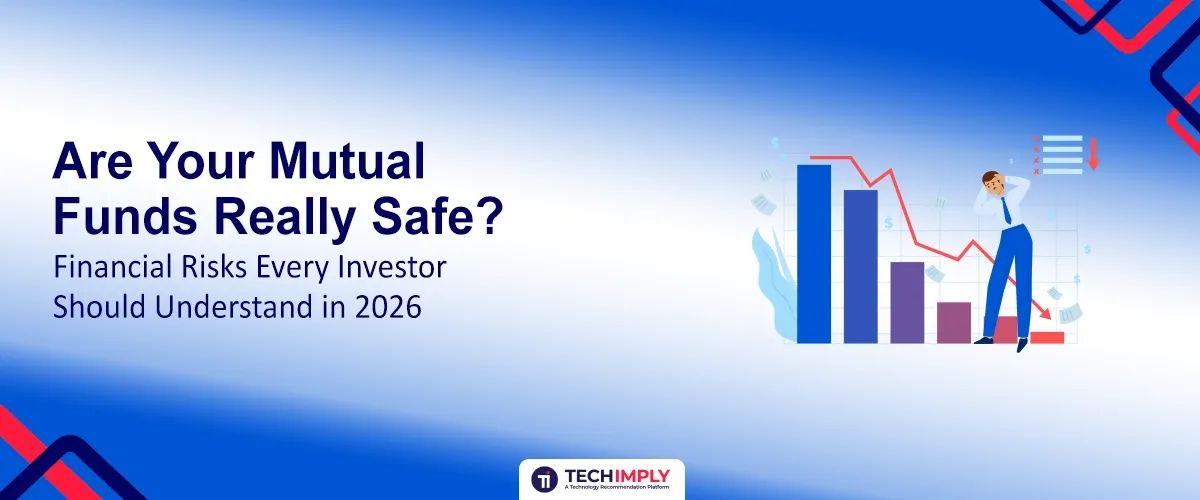
When markets hit consecutive record highs, it is easy to get complacent. For years, retail investors have been fed the narrative that mutual funds are the ultimate "set-and-forget" vehicle for wealth creation. They promise professional management, instant diversification, and historical returns that put traditional savings options to shame.

Looking for Financial Risk Management Software?
Check out Techimply's List of the Best Financial Risk Management Software in India for your business.
But as we navigate the economic landscape of 2026, a critical reality check is overdue: Are your investments actually secure, or are you sitting on hidden vulnerabilities? Treating mutual funds as completely risk-free accounts is a dangerous financial mistake. To protect your hard-earned capital and ensure steady compounding, you have to look past the marketing brochures and understand the shifting financial mechanics pulling the strings behind your money.
Why Mutual Fund Safety Is a Bigger Concern in 2026
The conditions for investing in 2026 vary from the normal patterns seen over the last ten years. The market research is challenging to forecast since regulatory laws evolve quickly, world economic situations change, and cash availability can fall quickly. For people who manage money over long periods, it is necessary to understand how those systems are structured.
The Myth of "Safe" Investments
There is a common, incorrect assumption that spreading your money across fifty stocks completely eliminates danger. While diversification prevents a single company's bankruptcy from destroying your portfolio, it offers zero protection against broader systemic collapses. Every asset class carries a cost. Even debt funds—traditionally viewed as safe havens—can experience sharp drops if corporate borrowers struggle or interest rate cycles shift abruptly.
Factors Influencing Fund Performance Today
The way funds perform is connected to the policies of central banks, the ways that global supply chains move to new locations, and the use of automated high-frequency trading. Volatility triggers happen instantly, and funds that looked stable last quarter can face sudden pressure. Keeping up with these changes requires a closer look at institutional fund accounting transparency and portfolio holdings. Blind trust is no longer a viable strategy.
The Financial Risks That Can Affect Mutual Fund Returns
To create a portfolio that can withstand pressure, it is necessary that you identify the specific difficulties that affect your capital. Effective risk management is not a process of avoiding dangers, but it is a process where you identify them early so that you can change your strategy.
1. Market Risk (Systematic Realities)
This is the baseline risk of investing. When a macroeconomic shock hits, the entire stock market drops, dragging down even the most fundamentally sound companies. If the broader index takes a hit, your equity mutual fund will drop in value alongside it, regardless of how skilled your fund manager is.
2. Interest Rate Risk
This is the primary threat to fixed-income portfolios. Debt funds buy bonds, and bond prices move in the opposite direction of interest rates. When central banks raise interest rates to curb inflation, older bonds with lower payouts lose value. If your debt fund holds long-duration papers during a rate hike cycle, your returns will shrink.
3. Credit and Liquidity Risks
- Credit Risk: This happens when a corporate borrower defaults on its debt obligations. If a debt fund holds papers from a company that faces financial distress, the fund’s Net Asset Value (NAV) can tank overnight.
- Liquidity Risk: With liquidity risk, investors try to withdraw their funds quickly when they are anxious. If a person who manages a fund holds assets that are difficult to sell, they might sell valuable securities at prices far below their worth to create cash. By doing this, they cause financial harm to the investors who remain in the fund.
4. Sector and Concentration Risk
As for sectoral funds, those focus on one industry like technology, infrastructure, or banking. If that industry faces new legal restrictions or a period of low economic activity, you do not have the protection that a diverse range of investments provides. And this situation causes large losses that are limited to that specific area.
- Do You Know?
A mutual fund's past performance is often the least reliable indicator of its future success. Statistically, less than 20% of top-performing equity funds manage to maintain their first-quartile ranking over a continuous five-year period. Choosing a fund solely based on last year's chart is one of the quickest ways to underperform the market.
How Financial Analysis Helps Investors Make Smarter Decisions
You do not need an advanced economics degree to run a basic health check on your investments, but regular financial analysis is vital if you want to keep your portfolio healthy.
Key Performance Indicators to Evaluate
When reviewing your funds, look beyond the basic return chart and check these operational metrics:
- Expense Ratio: The ongoing fee charged to manage your money. On the topic of costs, a difference of 0.5% appears small at this time - but this amount reduces the total wealth by tens of thousands of units over fifteen years.
- Portfolio Turnover Ratio: This shows how often the stock portfolio manager buys and sells equities. A high proportion implies frequent trading, which adds hidden transaction fees and indicates a lack of long-term conviction.
Evaluating Risk-Adjusted Returns
If the manager had to take great chances to achieve such returns, a fund producing 18% returns is not always superior to one with 15%. You need to know if the performance is due to genuine skill or dangerous gambling.
|
Metric |
Direct Function |
Strategic Importance |
|
Sharpe Ratio |
Measures excess return per unit of total volatility. |
Higher numbers prove the manager is generating returns efficiently, not just recklessly. |
|
Sortino Ratio |
Evaluates returns specifically against downside movements. |
It ignores upward volatility and focuses entirely on how well the fund protects you during drops. |
|
Beta |
Tracks the fund's volatility relative to its benchmark. |
A beta above 1.0 means the fund moves faster than the market, increasing both potential gains and losses. |
Fund Transparency and Portfolio Review
Make it a habit to check monthly fund factsheets. Look at where your money is actually going. If a debt fund is buying lower-rated corporate bonds for higher yields or if an equity fund is quietly increasing its exposure to highly volatile small-cap equities just to inflate its short-term results, your risk profile has silently altered.
Risk Management Strategies to Protect and Grow Your Investments
Protecting your capital means building an asset allocation structure capable of handling economic volatility. Incorporating sound accounting system discipline into your personal workflow is what separates reactive investors from successful ones.
Diversification Best Practices
True diversification requires holding assets that react differently to the same economic news. Loading up on five different aggressive growth equity funds isn't diversification—it's duplication.
A well-balanced 2026 asset allocation strategy should blend:
- Core Index or Large-Cap Funds: For basic stability and consistent corporate development, use Core Index or Large-Cap Funds.
- Mid-Cap and Small-Cap Allocations: For increased long-term development potential, capped at a reasonable percentage.
- Short-Duration Debt Funds: To guard capital from interest rate changes and serve as an emergency buffer.
- International or Commodity Funds: To hedge against localized market downturns and currency inflation.
Portfolio Rebalancing: The Core Discipline
Over time, market movements will warp your planned asset distribution. A massive equity bull run can easily turn a conservative 60/40 equity-to-debt split into a highly volatile 80/20 mix without your intervention.
If the market suddenly corrects, your losses will be far worse than you anticipated. Rebalancing your portfolio once a year involves selling a portion of your winning assets to buy underperforming ones. This forces you into a disciplined cycle of selling high and buying low.
Long-Term Financial Management Principles
At the end of the day, emotional discipline beats complex market timing every single time.
Automate Your Investments: Relying on systematic investment plans (SIPs) ensures you average out your purchase costs during market lows, turning volatility into your friend.
Maintain an Emergency Fund: Never invest money in equity mutual funds that you might need within the next three years. Having separate liquidity prevents you from being forced to liquidate your investments during a market crash.
Align with Concrete Goals: Invest with specific timelines in mind. If you are saving for a milestone that is two years away, your money belongs in a low-risk debt or liquid fund, not an aggressive equity fund.

Pro-tip
When rebalancing your portfolio, always account for exit loads and capital gains taxes. Switching funds carelessly can trigger unnecessary tax liabilities that wipe out the benefits of rebalancing. Try to direct new investments into your under-allocated assets first to restore your target balance naturally without selling existing holdings.
Conclusion
The era of viewing mutual funds as automated, risk-free accounts is over. While these funds remain foundational vehicles for retail wealth creation, navigating the complex financial environment of 2026 requires moving past generic marketing promises and actively monitoring your holdings. Understanding the changing structural mechanisms underlying market volatility, interest rate cycles, and fund transparency helps one to achieve real portfolio security. You safeguard your hard-earned capital from unanticipated market dips by routinely assessing risk-adjusted returns using operational key performance indicators and keeping a strict rebalancing schedule.