


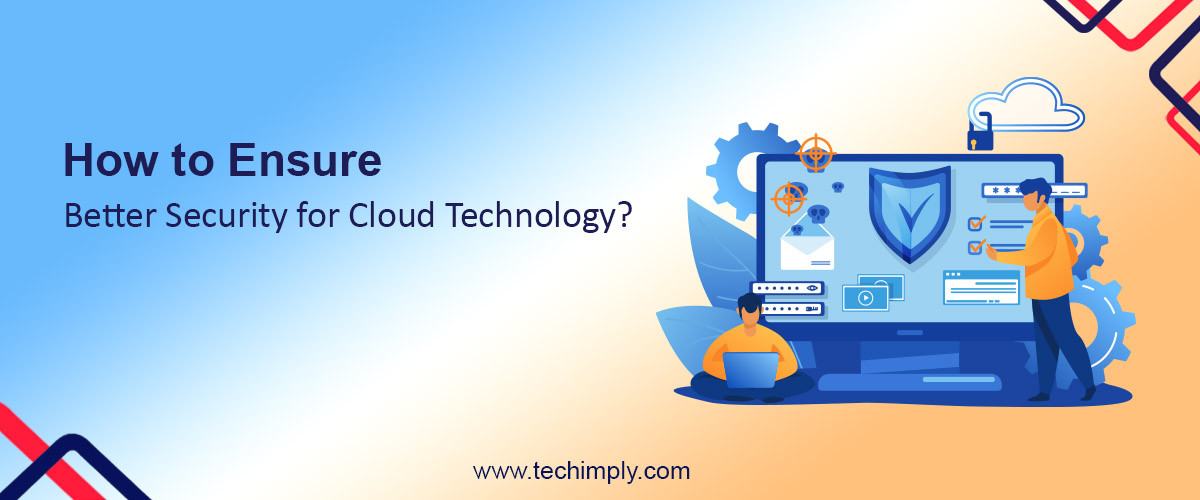
Migrating to cloud technology has become an essential strategy for companies wishing to engage in digital transformation and compete in today's market.
Cloud security software gives fee and performance benefits at the same time as additionally introducing complexities in management, traumatic elevated interest and employee sources. This intricacy arises from the truth that each cloud has its own siloed systems and setup.
Furthermore, as additional cloud-based apps are deployed, businesses must handle new security concerns that require often-missing insights, slowing the adoption and maintenance of a multi-cloud approach.
With this in mind, we have produced this material with critical guidance so that your clients may have confidence in the security of their infrastructure and apps in this age of cloud technology.
Some precautions must be taken throughout the relocation to preserve these settings. Look at what they are!
Cloud Infrastructure and Application Security
With various providers' adoption of cloud services, the security perimeter has expanded beyond the local network to include a plethora of cloud apps utilized for business-critical activities.
As a result, businesses must be prepared to cope with employees who expect to be able to collaborate and access resources from anywhere, at any time, and on any device.
Workloads in one cloud may be invisible to IT operations experts entrusted with protecting workloads in another in this new reality, making it more straightforward for hackers.
Cloud infrastructures provide hackers with an excellent attack surface, primarily if the organization employs many public clouds. B2B businesses can get cloud services for SaaS or eCommerce to ensure they keep data safe.
As a result, the more apps a corporation has operating in the cloud, the more probable a misconfiguration or data disclosure issue will occur.
As a result, it is vital to invest in a centralized visibility and management method to ensure the security and compliance of all applications in cloud environments simultaneously.
Cloud Security is a Shared Responsibility
The cloud provider and its clients share responsibilities for cloud computing security. The Shared Responsibility Type divides obligations into three categories— those that always belong to the provider, those that always belong to the client, and those that vary based on the service model utilized, such as SaaS, PaaS, and IaaS.
Protecting the infrastructure itself, as well as accessing, patching, and configuring physical hosts and the physical network on which compute instances operate and storage and other resources are kept, are always the provider's responsibilities.
Customers must now manage users and their access entitlements to prevent illegal access, encrypt and safeguard cloud-based data assets, and manage regulatory compliance. It's essential to emphasize that AWS cloud security, like cloud security in general, is a shared responsibility between AWS and its customers.
As a result, for businesses to satisfy all of their requirements, a cloud-native solution with centralized visibility and granular, policy-based management is essential.
Consider leveraging professional cloud migration services to seamlessly navigate and optimize these shared responsibilities, ensuring a secure and efficient cloud computing environment.
How to Ensure Better Security for Cloud Technology?
Enterprises must fine-tune deployment procedures and ensure network access and security rules are standardized and enforced across clouds to provide practical application protection across clouds.
Furthermore, some procedures must be put in place.
Establish A Unified Network And Security Policy
One of the most challenging aspects of cloud deployment is that cloud providers frequently have proprietary designs based on frameworks, application programming interfaces (APIs), and toolkits unique to their environment.
As a result, an effective cloud solution must provide a standard network and security fabric that spans all clouds utilized on an enterprise network.
This necessitates the abstraction of cloud-native functionality via APIs, the centralization of administration, the configuration and orchestration of policies, and the dynamic management of cross-cloud connections via automation.
Across complicated infrastructures, implement granular, policy-based identity and access management (IAM) and authentication controls. Companies can only provide the bare minimum of access credentials to assets and APIs required for a group or function to function.
As a result, in addition to requiring each user to access just what is required for their role, more layers of authentication for individuals with greater rights are conceivable.
Be Familiar with the Notion of Shared Responsibility Models
In addition to centralized control and visibility, the company should consider shared responsibility from the start of its multi-cloud contact center software application conversion process.
Determining which tasks will be handled by the service provider and which will be handled by internal IT will allow teams to plan more effectively. It is critical to note that while the provider is responsible for securing the cloud infrastructure, the firm is responsible for protecting any applications hosted in the cloud.
As a result, you must guarantee that your workloads are secure, your data is compliant, and access control is correctly controlled.
Employ a Next-Generation Web Application Firewall (WAF)
The WAF can inspect and manage the traffic of web application servers. It is designed to tackle attacks that standard firewalls cannot handle.
Web Application Firewall distinguishes itself by safeguarding internal web applications at the application layer against sophisticated external assaults. As a result, it establishes a barrier between your web-based service and the rest of the Internet, preventing and safeguarding apps from malicious activity.
Make Access Control and Cloud Governance A Top Priority
Cloud governance administers people, processes, and other actions related to cloud policies and standards.
To prevent access control failures, centralized management teams across clouds are required. Furthermore, configuration and deployment control, as well as cross-cloud security regulations, must be considered.
As a result, businesses should prioritize governance automation over other objectives, such as cost reduction or the usage of container technology.
Boost Workload And Application Visibility across Deployments
Visibility is an essential component in developing a successful cloud strategy. Furthermore, while some cloud providers provide network visibility capabilities, many of them are ineffective in cloud ecosystems.
As a result, the company must guarantee that each task is secure, that no integration exposes essential data, and that apps remain accessible to users.
One method is to invest in cloud management solutions like Middleware. that are mainly intended to handle various clouds. They are capable of managing and monitoring any asset. Furthermore, they may centralize information and give a single pane of glass to provide visibility into workload protection, components, and regulatory compliance.
Conclusion
Cloud environments, such as NetworkIQ, are becoming increasingly popular due to various benefits. However, without suitable answers and strategies, they might pose hazards for which many businesses are unprepared.
As a result, businesses must update and invest in optimal solutions for this new reality. Only in this manner will it be possible to ensure the security of your infrastructure and apps from the start of the Cloud migration.


.png "Role of Tablets in Enhancing Healthcare Efficiency")


