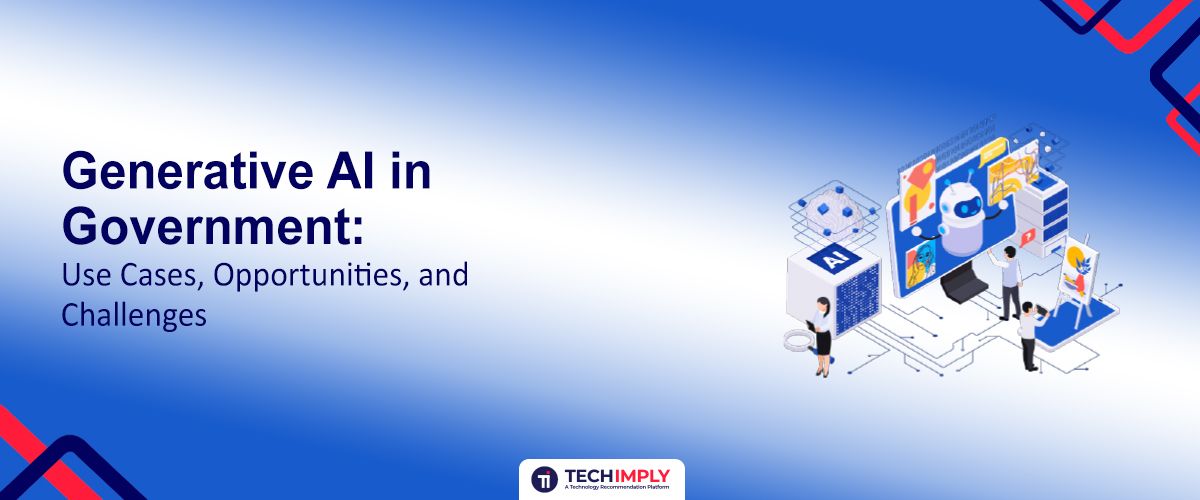
The Star Trek series once showed us what ideal artificial intelligence in the public sector could look like. The Enterprise computer responded instantly to queries, generated necessary information and reports, and even proposed solutions — calmly, accurately, and without unnecessary meetings. This is how many imagined the future of the public sector: technological, intelligent, and human-centered.
Several decades have passed, and this fantasy is finally beginning to approach reality across various countries on a massive scale. AI has been moving so fast that it’s hard to keep up. And today, generative tools aren’t just experiments — governments around the world are already trying them out in real projects.
Government agencies deal with huge amounts of data every day (reports, paperwork, procedures) all while having to make difficult decisions. Yet the system is naturally very conservative: any change requires years. This is precisely why implementing generative AI tool in government and public sector could be the catalyst that accelerates modernization.
In this article, we'll examine how generative AI in public sector is already being used today, what opportunities it opens, what problems it creates, and what's needed for this technology to truly work — not in theory, but in practice.
What Is Generative AI in the Public Sector
Generative AI is a system capable of creating new content: texts, images, analytics, recommendations, and even making complete decisions based on data. Simplifying it, it doesn't just analyze data — it generates meaning from it. And this is precisely why generative AI in government and public sector attracts so much attention: governments work daily with tons of information that must not just be stored but understood.
Previously, artificial intelligence in the public sector mostly meant automating routine tasks — for example, checking forms or processing citizen requests. Generative AI in public sector opens a new level: it can summarize legislative documents, create draft reports, help develop policies, or even forecast scenarios for crisis management. It's like having an assistant who not only follows instructions but also proposes solutions.
According to the United States Government Accountability Office report, the number of initiatives using generative AI in government and public sector increased nearly ninefold during 2023–2024. And this is hardly surprising: the technology enables government structures to act faster, more accurately, and more transparently.
The main reason this technology is now "in line" is that most countries have accumulated a vast array of open data that can finally be transformed for the benefit of citizens. Instead of endless spreadsheets and PDF reports — analytics, dialogs, and ready answers to queries from civil servants or residents.
So when we talk about generative AI in government and public sector, we're not talking about the future, but about ongoing transformation: governments are learning to speak with their data in human language.
Real Examples: What's Already Being Done
Clearly, many governments aren't just talking about AI — they've already launched it. Let's look at several interesting examples.
- As part of a collaboration with the Tax Department of Brussels, the DXC team is implementing agent AI to improve first-call handling: personalized responses, real-time coaching, and data consolidation from multiple systems. Such it solutions for public sector reduce request processing time and increase operational efficiency.
- In the United States, the Patent and Trademark Office faced a problem that initially sounds mundane but actually has enormous significance: examiners spent too much time finding relevant information among millions of patent documents. Now instead of manual searching, they use an AI system based on generative AI, which helps find needed patents faster and reduces application review time.
- The state of Indiana went even further and launched the Captain Record system — an AI tool that allows civil servants to search through hundreds of years of archival records simply using natural language. No need to know complex codes or indices: an official can write an ordinary question, and the system instantly finds the needed document.
- In New York, generative AI came closer to citizens. They created MyCity Chatbot software a service that allows residents to ask questions about municipal services 24/7, without queues or bureaucracy. In New Jersey, they followed a similar path but focused on internal use: state workers received their own AI assistant and training on ethical use of the technology.
- On an international level, Australia sets an example. There, the government conducted a large-scale pilot with Microsoft 365 Copilot — over 7,400 civil servants from various agencies tested how generative AI could help with reporting, planning, and communication. This project became not just an experiment but a systematic analysis of how technology can transform the work of the entire state apparatus.
- Other examples show that generative AI isn’t only about convenience but also about safety. In the U.S., for instance, it’s used to simulate natural disasters: systems predict how events might unfold, estimate the damage, and help launch evacuation plans more quickly.
- The Department of Veterans Affairs is already automating medical image processing to improve diagnostics, and the Department of Health uses AI to scan scientific publications and detect new polio cases in areas where the disease was thought to be gone.
Generative AI in government and public sector has already become a practical technology that helps officials make decisions faster, more accurately, and more efficiently every day.
Opportunities: What This Means for Governments
When you look at the numbers, the potential is enormous. Consulting research shows that the productivity gains that generative AI can provide to governments will amount to $1.75 trillion per year on a global scale.
- The first advantage we see is efficiency. People who once spent days processing documents can now do it in hours. Organizations free people from primitive tasks for more strategic work. Instead of formatting reports and rewriting information, teams can now focus on analysis, strategy, and decisions truly beneficial for citizens.
- The second advantage, more tangible for citizens, is improved service. Imagine document submission that once took weeks but now takes hours. AI analyzes forms, understands requirements, extracts needed information. People get faster answers, fewer errors, greater satisfaction. Improved engagement means more trust in government institutions.
- The third advantage is decision-support. When systems can process millions of terabytes of data, create scenarios and generate analytics based on it, managers make decisions based on facts, not intuition. State leaders gain better understanding of the consequences of different policy options.
- Fourth is the possibility of modernization. Many governments are stuck with old systems that are extremely difficult to update. Generative AI can be a bridge. It integrates with outdated infrastructure, extracts useful information, and presents it in new ways. This doesn't mean recreating all tools from scratch. It means intelligently expanding the functionality of what you already have.
Challenges and Risks: Where You Can Get Stuck
Much attention in popular culture has been devoted to demonstrating what chaos AI can introduce into life. But this is worth keeping in mind: these systems must work for the benefit of citizens while being reliable, transparent, and accountable to people. Here’s what needs attention and what challenges come with bringing generative AI into government:
- Data and infrastructure. Many government organizations have outdated systems that collect data in different formats and, worse, are not organized in any way. Without addressing this problem, artificial intelligence will not be able to generate accurate and useful results.
- Ethics and privacy. Models can repeat old systemic biases, and confidential information can accidentally go where it shouldn't. In government processes, this is critical because citizen trust depends on how their data is processed.
- Personnel and changing roles. Employees need to embrace AI and learn to interact with it. Sometimes expectations can be too high, and some don’t realize all the possibilities.
- Organizational barriers: limited budgets, the strong "shadow" of manual processes, management hesitation. All these factors must be considered to ensure that implementing generative AI is not chaotic but effective and safe.
This section illustrates that even with enormous potential, generative AI in government and public sector requires careful planning and monitoring to avoid repeating Portal's GLaDOS scenario. The existing processes should genuinely improve, not create actual chaos — which is why this niche remains very conservative with a long decision-making path.
An Opportunity for Real Change
Let's be honest. Generative AI in public sector is not a magic wand. It won't solve everything automatically. It requires significant work in planning, implementation, management, and monitoring. Also, not all countries are ready to apply it simultaneously.
But it's a chance. A chance for governments to become more data-oriented. A chance to reduce bureaucracy through automation. A chance to build citizen trust by providing them with faster, fairer answers.
If you're responsible for government or municipal operations, it's time to act. Look at uses that have already shown success. Start small. Build partnerships with organizations that understand it solutions for public sector and are ready to help you. Set expectations, but be realistic. Train people. Build a culture, not just buy tools.
The future of the public sector will be decidedly different from the present. With generative AI in government and public sector, it can be done better, faster, and more fairly.