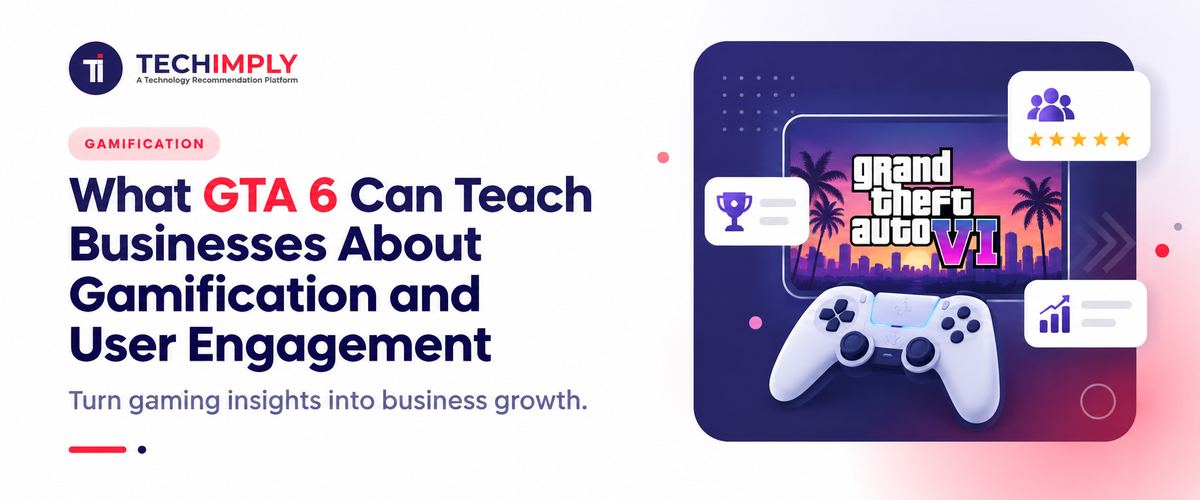
GTA 6 is more than a video game people have been waiting years to play. Its appeal also raises an interesting question for businesses: what makes people want to keep exploring, completing challenges, and returning to an experience?
Businesses can learn from the design principles behind engaging games without turning their products or workplaces into video games. This is where gamification in business becomes relevant.
By applying selected game mechanics such as progress tracking, challenges, rewards, and feedback to everyday activities, companies can make customer interactions, employee training, and internal processes more engaging.

Looking for Gamification Software?
Check out Techimply's best Gamification Software in India for your business.
What Is Gamification in Business?
Gamification for business means using game elements such as points, levels, challenges and rewards in non-game settings, to encourage a specific behavior. A sales team might earn points for follow-ups. A new employee might unlock the next training module after finishing the last. A customer might reach a higher loyalty tier after a few purchases.
It isn’t about turning work into a game. It’s about making progress visible and effort feel worthwhile, which is why it shows up in training, sales, customer loyalty and app onboarding.
Do You Know?
A 2025 systematic review examined 56 studies on games and gamification in business and training. It found growing applications in employee learning and engagement, while identifying the need for more research into long-term results, personalisation, and ethical considerations.
5 Lessons GTA 6 Can Teach Businesses About Gamification
GTA 6 offers several useful examples of how an experience can keep people interested. These are not direct business features, but design principles that companies can adapt.
1. Give Users Freedom to Explore
One reason open-world games attract players is that they do not restrict every action to a fixed sequence. Players can explore different locations, discover activities, and choose how they approach certain objectives.
GTA 6's mission design gives players more freedom to decide how they approach certain objectives. GamesRadar+ reports that Rockstar deliberately worked to make missions more open-ended, allowing players to experiment with different approaches. Businesses can apply the same principle by giving users meaningful choices within a structured experience.
For example, an online learning platform could allow employees to choose between video lessons, interactive quizzes, and practical assignments. Everyone works towards the same learning objective, but they can choose a format that suits their preferences.
Similarly, businesses can use customer loyalty software to manage reward programmes that let members earn points, choose relevant benefits, and receive personalised offers.
Business takeaway: Give users meaningful choices. A gamified experience should guide people towards a goal without making every interaction feel compulsory.
2. Break Large Goals into Smaller Challenges
A large objective can feel difficult when users do not know where to start. Games solve this by dividing progress into missions, tasks, and smaller objectives.
GTA 6 uses a combination of main missions and optional activities. Players can explore different parts of the world and take on additional activities alongside the central storyline.
Businesses can use a similar structure to make larger tasks easier to complete.
Consider an Indian company onboarding new employees. Instead of asking a new hire to complete a long training programme at once, HR can divide it into smaller stages:
- Complete the company introduction.
- Learn the basic workplace policies.
- Finish a product knowledge quiz.
- Attend a team introduction session.
- Complete the final assessment.
The employee can see what has been completed and what remains.
This is one of the practical gamification techniques that can make employee training more manageable. It also helps managers identify where learners need additional support.
Business takeaway: Divide larger goals into clear, achievable challenges so users can see their progress.
3. Make Progress Visible
People are more likely to understand their development when they can see how far they have come.
Games often use progress indicators, completed missions, achievements, and levels to show players what they have accomplished. GTA 6 also provides ways to track progress towards completion, including activities beyond the main storyline.
Businesses can apply this idea through progress bars, completion badges, achievement records, and performance dashboards.
For example, a sales team could use a gamification platform to track monthly targets. Employees might see how many qualified leads they have generated, how many demonstrations they have completed, and how close they are to their monthly goal.
An online course could show learners that they have completed six out of eight modules.
These features make gamification in business more measurable because users can connect their actions with visible progress.
Business takeaway: Show users what they have achieved and what they need to do next. Progress should be easy to understand, not hidden inside reports.
4. Keep the Experience Fresh with Different Activities
Repeating the same task can make an experience feel predictable. Games maintain interest by introducing different activities, environments, challenges, and interactions.
GTA 6 combines its central missions with optional activities and unexpected discoveries. Review coverage has highlighted the variety of activities available across its open world.
Businesses can use variety to improve user engagement strategies.
For example, a company running employee learning programmes could combine:
- Short knowledge quizzes
- Team-based challenges
- Scenario-based exercises
- Product demonstrations
- Monthly learning goals
An e-commerce business could introduce seasonal challenges, product discovery activities, and loyalty rewards to encourage customers to interact with its platform.
The important point is to keep activities connected to the purpose of the experience. Adding random games or rewards does not automatically improve engagement.
Business takeaway: Use different activities to maintain interest, but make sure each one supports a meaningful goal.
5. Make Feedback and Rewards Meaningful
Players need to understand whether their actions are helping them progress. Games provide feedback through completed objectives, achievements, rewards, and changes in the experience.
Businesses can use the same principle to recognise useful actions.
For example, a customer loyalty programme might award points after a purchase, provide a reward after a certain number of transactions, or recognise customers who participate in a referral programme.
An employee training platform could issue a certificate or badge after someone completes a course and passes its assessment.
However, rewards should reflect the value of the activity. Giving points for every click may increase activity without improving customer satisfaction, learning, or business performance.
Business takeaway: Give users timely feedback and rewards that recognise meaningful progress, not just activity.
How Businesses Can Apply GTA 6-Inspired Gamification
The lessons from GTA 6 can be translated into practical activities across different departments.
Here are a few examples.
|
Business area |
Gamification idea |
Expected purpose |
|
Employee training |
Learning missions and badges |
Track course completion and assessment scores |
|
Sales teams |
Monthly targets and leaderboards |
Track qualified leads and conversion rates |
|
E-commerce |
Loyalty points and rewards |
Measure repeat purchases and redemption rates |
|
Customer support |
Recognition for quality resolutions |
Track customer satisfaction and resolution quality |
|
Education |
Learning paths and quizzes |
Track module completion and assessment results |
For example, a Bengaluru-based SaaS company could introduce a monthly product-learning challenge. Employees complete short modules, answer product questions, and earn recognition for demonstrating their knowledge.
Businesses can also use employee engagement software to support employee recognition, collect feedback, and track participation in workplace activities.
A retailer in Ahmedabad could introduce a customer loyalty programme where shoppers earn points for eligible purchases and redeem them for relevant benefits.
These are examples of gamification in business that focus on actual customer or employee behaviour rather than adding game elements without a clear purpose.
What Is the Role of Gamification Software?
Managing points, challenges, rewards, progress, and user participation manually can become difficult as a programme grows. Gamification software helps businesses organise these activities through a central platform.
Depending on the product, common features include:
- Points and badges: Recognise completed tasks and achievements.
- Leaderboards: Display individual or team progress.
- Challenge management: Create activities linked to specific goals.
- Progress tracking: Monitor participation and completion.
- Rewards management: Set up incentives for selected actions.
- Analytics and reporting: Review participation and performance.
For instance, an HR team could use gamification software to manage employee learning challenges, while a marketing team could use it to run customer engagement campaigns.
The right platform depends on the business objective. Some tools focus on employee performance and training, while others support customer loyalty, marketing, or education.
Important to know:
Before selecting a platform, identify what you want to gamify. An HR team may need learning paths, employee progress tracking, and performance reports. A marketing team may prioritise loyalty points, reward management, and customer activity tracking. Check whether the software supports your required activities, integrates with your existing tools, and provides reports linked to your business goals.
When Gamification Can Backfire
Not every game mechanic works for every audience. A poorly planned programme can make routine activities feel more complicated instead of more engaging.
Here are a few mistakes businesses should avoid:
- Using leaderboards for every activity: Public rankings can motivate some people but discourage employees who consistently appear at the bottom. Team-based recognition or personal progress tracking may work better.
- Rewarding quantity instead of quality: If customer support employees receive points only for closing tickets quickly, they may rush through conversations instead of solving customer problems properly.
- Offering rewards without a clear purpose: Users may participate temporarily to collect rewards but stop when the incentives disappear.
- Ignoring user preferences: Some people enjoy competition, while others prefer individual progress or collaborative activities. One design may not work for everyone.
A 2025 systematic review of games and gamification in business and training also highlights risks such as negative pressure, reduced autonomy, and lower motivation when systems are poorly designed.
Effective gamification in business should make useful activities easier to understand and complete. It should not create unnecessary pressure or distract people from the actual work.
How to Build a Gamification Strategy That Works
Before choosing gamification software or introducing rewards, businesses should decide what they want to improve.
Use these steps to create a practical approach:
- Choose one business objective: Decide whether you want to improve customer retention, employee training completion, sales participation, or another measurable outcome.
- Understand your audience: Identify what motivates the people participating in the programme.
- Select suitable game mechanics: Use points, badges, challenges, levels, or rewards only when they support the objective.
- Set clear rules: Explain how users earn points, complete challenges, and receive rewards.
- Track meaningful results: Measure outcomes such as repeat purchases, course completion, customer satisfaction, or task quality.
- Improve the programme: Collect feedback and adjust activities when users lose interest or the programme fails to meet its objective.

Pro-tip
Start with one small gamification campaign instead of introducing points, badges, rewards, and leaderboards across your entire organisation. Measure participation and the actual business result before expanding it.
Conclusion
GTA 6 shows how meaningful choices, varied activities, visible progress, and well-designed challenges can keep people involved in an experience. Businesses can apply these principles to employee training, customer loyalty, sales activities, and other everyday processes.
However, successful gamification in business is not about adding points and badges everywhere. It starts with understanding the behaviour you want to encourage and choosing mechanics that support it.
Start with one activity, define how you will measure its success, and test a small gamification campaign before expanding it across your business.